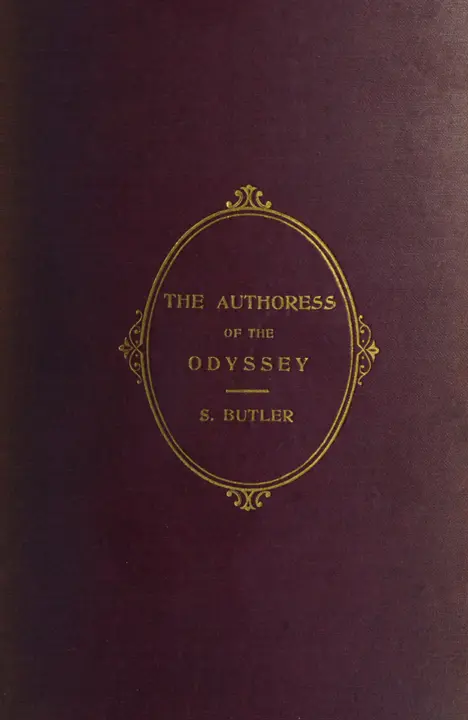
The Authoress of the Odyssey Where and when she wrote, who she was, the use she made of the Iliad, and how the poem grew under her hands
Samuel Butler
THE CLASSIC COLLECTION · 1887
"Luck, or Cunning, as the Main Means of Organic Modification" by Samuel Butler is a scientific publication written in the late 19th century. The book explores the complex relationship between heredity and memory while seeking to reintegrate the concept of design into the evolutionary narrative, challenging the dominant Darwinian view of natural selection. The beginning of the text establishes Butler's intent to delve into the nuances of organic development, arguing for the significant overlap between heredity and memory. Following an introduction that highlights his shift from an initial focus on the division of life forms to a deeper examination of Darwin's theories, Butler reflects on his interactions with influential contemporaries such as Alfred Tylor and Herbert Spencer. He articulates that understanding the intricacies of descent requires acknowledging design's role in evolution while arguing that instinct should be perceived as inherited memory—a concept he aims to substantiate throughout the work.
Introduction adapted from the source catalogue; source summaries may be automatically generated.
Free to read · English · 84,207 words · No account needed
MAKE TIME FOR A GOOD BOOK
On by default. Untick to stop anonymous reading totals. Each page counts after 10 seconds in view. How this works.
Anonymous counting is on unless you have switched it off.
Footnotes
{17a} “Nature,” Nov. 12, 1885.
{20a} “Hist. Nat. Gén.,” tom. ii. p. 411, 1859.
{23a} “Selections, &c.” Trübner & Co., 1884. [Out of print.]
{29a} “Selections, &c., and Remarks on Romanes’ ‘Mental Intelligence in Animals,’” Trübner & Co., 1884. pp. 228, 229. [Out of print.]
{35a} Quoted by M. Vianna De Lima in his “Exposé Sommaire,” &c., p. 6. Paris, Delagrave, 1886.
{40a} I have given the passage in full on p. 254a of my “Selections,” &c. [Now out of print.] I observe that Canon Kingsley felt exactly the same difficulty that I had felt myself, and saw also how alone it could be met. He makes the wood-wren say, “Something told him his mother had done it before him, and he was flesh of her flesh, life of her life, and had inherited her instinct (as we call hereditary memory, to avoid the trouble of finding out what it is and how it comes).”—Fraser, June, 1867. Canon Kingsley felt he must insist on the continued personality of the two generations before he could talk about inherited memory. On the other hand, though he does indeed speak of this as almost a synonym for instinct, he seems not to have realised how right he was, and implies that we should find some fuller and more satisfactory explanation behind this, only that we are too lazy to look for it.
{44a} 26 Sept., 1877. “Unconscious Memory.” ch. ii.
{52a} This chapter is taken almost entirely from my book, “Selections, &c.. and Remarks on Romanes’ ‘Mental Evolution in Animals.’” Trübner, 1884. [Now out of print.]
{52b} “Mental Evolution in Animals,” p. 113. Kegan Paul, Nov., 1883.
{52c} Ibid. p. 115.
{52d} Ibid. p. 116.
{53a} “Mental Evolution in Animals.” p. 131. Kegan Paul, Nov., 1883.
{54a} Vol. I, 3rd ed., 1874, p. 141, and Problem I. 21.
{54b} “Mental Evolution in Animals,” pp. 177, 178. Nov., 1883.
{55a} “Mental Evolution in Animals,” p. 192.
{55b} Ibid. p. 195.
{55c} Ibid. p. 296. Nov., 1883.
{56a} “Mental Evolution in Animals,” p. 33. Nov., 1883.
{56b} Ibid., p. 116.
{56c} Ibid., p. 178.
{59a} “Evolution Old and New,” pp. 357, 358.
{60a} “Mental Evolution in Animals,” p. 159. Kegan Paul & Co., 1883.
{61a} “Zoonomia,” vol. i. p. 484.
{61b} “Mental Evolution in Animals,” p. 297. Kegan Paul & Co., 1883.
{61c} Ibid., p. 201. Kegan Paul & Co., 1883.
{62a} “Mental Evolution in Animals,” p. 301. November, 1883.
{62b} “Origin of Species,” ed. i. p. 209.
{62c} Ibid., ed. vi., 1876. p. 206.
{62d} “Formation of Vegetable Mould,” etc., p. 98.
{62e} Quoted by Mr. Romanes as written in the last year of Mr. Darwin’s
life.
{63a} Macmillan, 1883.
{66a} “Nature,” August 5, 1886.
{67a} London, H. K. Lewis, 1886.
{70a} “Charles Darwin.” Longmans, 1885.
{70b} Lectures at the London Institution, Feb., 1886.
{70c} “Charles Darwin.” Leipzig. 1885.
{72a} See Professor Hering’s “Zur Lehre von der Beziehung zwischen Leib und Seele. Mittheilung über Fechner’s psychophysisches Gesetz.”
Your reading position is saved on this browser. Take it to another device with a library code. Reading pages adapt to text, rather than matching a printed edition.
Samuel Butler
Samuel Butler
Samuel Butler
Samuel Butler
BEHIND THE BOOK
This eBook is for the use of anyone anywhere in the United States and most other parts of the world at no cost and with almost no restrictions whatsoever. You may copy it, give it away or re-use it under the terms of the Project Gutenberg License included with this eBook or online at www.gutenberg.org. If you are not located in the United States, you will have to check the laws of the country where you are located before using this eBook. Read the source licence.
The original source file, including credits and licence, is retained by this library. Request an original-format copy at no charge. Please include the book title and Project Gutenberg identifier #4967.
KEEP YOUR CURIOSITY GOING

David Patterson (Spirit) Hatch
Coulson Kernahan

Ralph Waldo Emerson
Frances Wright

Edwin Abbott Abbott

Joseph Droz