THE CLASSIC COLLECTION✦ChildhoodCLASSIC FREE BOOKS
Childhood
Alice Meynell
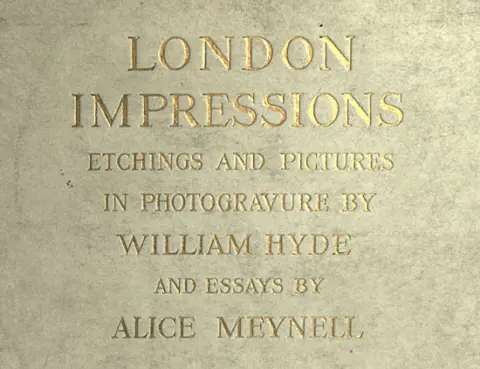
THE CLASSIC COLLECTION · 1898
"London Impressions: Etchings and Pictures in Photogravure by Alice Meynell" is a beautiful collection of essays and illustrations that explores the multifaceted character of London in the late 19th century. Co-authored by the renowned writer Alice Meynell and complemented by the etchings of William Hyde, the book captures the essence of London through both visual artistry and literary expression. It delves into the myriad influences of the city's landscape and life, examining its architecture, atmosphere, and the social tapestry woven within its streets. The content of the book is a rich blend of descriptive essays and pictorial representations, each illuminating different aspects of London. Meynell's essays encapsulate her observations on various subjects such as the climate of smoke, the beauty of its streets and parks, and the unique character of its riverside and marketplaces. The essays are interspersed with Hyde's stunning photogravures and etchings, showcasing scenes from the city, from the iconic landmarks like Westminster Abbey to more intimate portrayals of daily life in its back streets. This work stands as both a celebration and contemplation of the capital, providing readers with vivid imagery and thought-provoking commentary on the complexities of urban existence.
Introduction adapted from the source catalogue; source summaries may be automatically generated.
Free to read · English · 12,382 words · No account needed
MAKE TIME FOR A GOOD BOOK
On by default. Untick to stop anonymous reading totals. Each page counts after 10 seconds in view. How this works.
Anonymous counting is on unless you have switched it off.
Produced by Chris Curnow and the Online Distributed
Proofreading Team at https://www.pgdp.net (This file was
produced from images generously made available by The
Internet Archive.)
THE RIVER ETCHING Frontispiece
WESTMINSTER ABBEY PHOTOGRAVURE facing page 2
TERRIBLE LONDON Do. " 4
AN IMPRESSION Do. " 6
END OF A WINTER DAY Do. " 8
UTILITARIAN LONDON Do. " 10
KENSINGTON GARDENS Do. " 12
NIGHT SCENE, BERMONDSEY Do. " 14
THE CLOCK TOWER, WESTMINSTER Do. " 16
ST. PAUL'S AT DAWN Do. " 18
WATERLOO BRIDGE Do. " 20
BELOW BRIDGE Do. " 22
ST. PAUL'S FROM WATLING STREET Do. " 24
THE VICTORIA TOWER Do. " 28
ST. PAUL'S IN A STORM PHOTOGRAVURE On Title-page
A CHEAP MARKET Do. page v
A FORGOTTEN CORNER Do. " 1
THE NERVES OF LONDON Do. " 6
THE EMBANKMENT AT NIGHT Do. " 9
BELOW BRIDGE Do. " 22
A BACK STREET Do. " 24
A COFFEE STALL Do. " 26
RAIN, SMOKE, AND TRAFFIC Do. " 29
This seems to be a thing that all exclaim against, and but few see. The phrase is never varied--a sure sign of lack of experience. One cries, 'Oh, the London Sunday!' and another, 'It must be too dreadful for foreigners!' and before the topic disappears something yet vaguer has been said, in a flickering manner, as to the Boulevards. But in fact London Sunday is little understood even by those who know its aspect, and the greater number do not know even so much.
Obviously, it is one thing in the summer of livelong sunshine, and another thing in winter. When the tops of the steeples fly a blue and white sky as far as the eye may see--a broad flag for the streets, and a narrow, wavering pennon for the alleys; when the reluctant faces of grey houses are compelled by the fires of the day to bandy reflections with the grey houses opposite; when the sun himself is lodged in every window, so that the town multiplies his very face, and sets up suns to the west in the morning and to the east in the evening--suns in rows, and suns that run fluctuating along the windows of a long, unequal street; when the plane-tree is fresh and the leaf of the elm already dry, the London Sunday, from beginning to end, is passed by the London people out of doors. For this reason it is difficult to understand it; you cannot tell whither these streams of people are bound. They all have the gait of making for some end; they do not stroll, and there is doubtless some excursion afoot. The number of young men, in proportion to the numbers of older men, of women, girls, and children, is curious, especially in the further east. They go in great straggling gangs, and though they do nothing--not even much talking--they give a false air of lawlessness to the streaming street. They are the ugliest of all the populace, their clothing, besides, being the most dull and indescribable, and their bearing indefinitely defiant. The men of other kinds and ages, and the women, who needs must balance such a horde of men of twenty, seem to spend less of their Sunday on the road, and you may see them, accordingly, in great numbers in the open spaces--the vague lands on the other side of Clapton, for instance. Very few people of any kind seem to be within their houses in the free afternoon.
Your reading position is saved on this browser. Take it to another device with a library code. Reading pages adapt to text, rather than matching a printed edition.
Alice Meynell
Alice Meynell
Alice Meynell
Alice Meynell
BEHIND THE BOOK
This eBook is for the use of anyone anywhere in the United States and most other parts of the world at no cost and with almost no restrictions whatsoever. You may copy it, give it away or re-use it under the terms of the Project Gutenberg License included with this eBook or online at www.gutenberg.org. If you are not located in the United States, you will have to check the laws of the country where you are located before using this eBook. Read the source licence.
The original source file, including credits and licence, is retained by this library. Request an original-format copy at no charge. Please include the book title and Project Gutenberg identifier #32842.
KEEP YOUR CURIOSITY GOING
Wilfrid Scawen Blunt
Wilfrid Scawen Blunt

E. W. (Edgar Watson) Howe

David Patterson (Spirit) Hatch

David Patterson (Spirit) Hatch

David Patterson (Spirit) Hatch