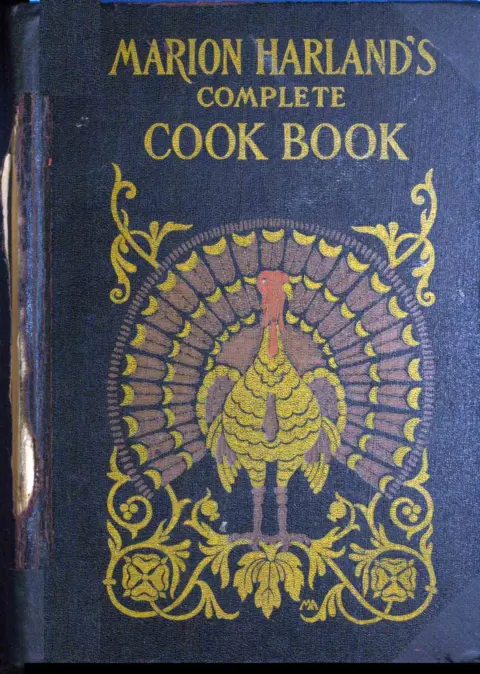
Marion Harland’s Complete Cook Book A Practical and Exhaustive Manual of Cookery and Housekeeping
Marion Harland
THE CLASSIC COLLECTION · 1880
"Loitering in Pleasant Paths" by Marion Harland is a travel narrative written in the late 19th century. The book recounts the experiences of an American family traveling through England and Europe with the primary goal of restoring health to one of its members. Through a series of personal reflections, anecdotes, and observations, the author explores cultural contrasts, historical landmarks, and the emotional journey of the protagonists. At the start of the book, the narrator describes their arrival in London on a gloomy day, contrasting the dreary atmosphere with their anticipation for seeing the city’s sights. They share their discomfort with the persistent gray clouds, comparing them to mourning attire. However, the tone shifts as the gloomy weather lifts momentarily, affording them a glimpse of sunlight, which invigorates their spirits. The narrator observes the historical significance of various sites in London and humorously recounts their interactions with locals as they seek historical information about noteworthy events, particularly concerning King Charles I’s execution. This opening portion sets the stage for a journey filled with historical reflections, cultural inquiries, and personal growth amidst the backdrop of the old world.
Introduction adapted from the source catalogue; source summaries may be automatically generated.
Free to read · English · 132,619 words · No account needed
MAKE TIME FOR A GOOD BOOK
On by default. Untick to stop anonymous reading totals. Each page counts after 10 seconds in view. How this works.
Anonymous counting is on unless you have switched it off.
*** The above books for sale by all booksellers, or mill be sent, post or express charges paid, upon receipt of the price by the publishers,
Transcriber’s Notes:
Obvious punctuation errors repaired. Archaic spellings such as “checquered” and “chabybeate” were retained as was the varied hyphenation. Text also uses Hotel Bellevue and Hotel Belle Vue.
Page v, “Ollapodrida” changed to “Olla Podrida”
Pages 25 and 27, “Bronté” changed to “Brontë” (Here the Brontë) (or the sisters Brontë)
Page 86, “brighest” changed to “brightest” (highest and brightest)
Page 90, “surburban” changed to “suburban” (our suburban towns)
Page 115, “faience” changed to “faïence” (faïence in a tumbling-down)
Page 118, “clerygman” changed to “clergyman” (applied to the clergyman)
Page 143, “Tuilleries” changed to “Tuileries” (Tuileries, where he had)
Page 145, “revolulution” changed to “revolution” (another
revolution—that)
Page 148, “l’infame” changed to “l’infâme” (fenêtre que l’infâme)
Page 149, “brulée” changed “brûlée” (burned (brûlée), but)
Pages 154 and 373, “chateau” changed to “château” (central château, facing) (handsome château over)
Page 155, “regle” changed to “règle” (en règle for a)
Page 162, “inquitude” changed to “inquietude” (and moral inquietude)
Page 166, poem, “cimitiere,” “chére,” and “légére” changed to “cimetière,” “chère,” and “légère.”
Pages 205 and 240, “cocchiere” changed to “cocchière” (said our cocchière) (the cocchière upon)
Page 219, “quareled” changed to “quarrelled” (crows quarrelled at)
Page 228, “rilievo” changed to “relievo” (in basso-relievo)
Page 229, “dasies” changed to “daisies” (picked the daisies)
Page 230, “Réni” changed to “Reni” (by Guido Reni)
Page 233, “Réni’s” changed to “Reni’s” (containing Guido Reni’s)
Page 265, “stubborness” changed to “stubbornness” (a mule’s in
stubbornness)
Page 272, “deceiftul” changed “deceitful” (climate is deceitful)
Page 275, “Liliputian” changed “Lilliputian” (Lilliputian mansion, is)
Page 302, “propretor” changed “proprietor” (with the proprietor)
Page 359, “an” changed to “as” (level as an Illinois)
Page 370, “Goldnau” changed to “Goldau” (The Goldau Landslip)
Page 377, “heacons” changed to “beacons” (by one, as beacons)
Page 382, “feed” is past tense of “fee” in this instance so is correct
as printed.
Page 394, “chateaux” changed to “châteaux” (châteaux and humbler)
Page 404, “géne” changed to “gêne” (je vous gêne)
Pages 405 and 432, “Plait” changed to “Plaît” (Plaît-il?)
End of Project Gutenberg's Loitering in Pleasant Paths, by Marion Harland
Your reading position is saved on this browser. Take it to another device with a library code. Reading pages adapt to text, rather than matching a printed edition.
Marion Harland
Marion Harland
Marion Harland
Marion Harland & Virginia Terhune Van de Water
BEHIND THE BOOK
This eBook is for the use of anyone anywhere in the United States and most other parts of the world at no cost and with almost no restrictions whatsoever. You may copy it, give it away or re-use it under the terms of the Project Gutenberg License included with this eBook or online at www.gutenberg.org. If you are not located in the United States, you will have to check the laws of the country where you are located before using this eBook. Read the source licence.
The original source file, including credits and licence, is retained by this library. Request an original-format copy at no charge. Please include the book title and Project Gutenberg identifier #50511.
KEEP YOUR CURIOSITY GOING
Wilfrid Scawen Blunt
Wilfrid Scawen Blunt

E. W. (Edgar Watson) Howe
Francis Greenleaf Allinson & Anne C. E. (Anne Crosby Emery) Allinson
Cyrenus Cole

John Martineau