
The Writing of News A Handbook with Chapters on Newspaper Correspondence and Copy Reading
Charles G. (Charles Griffith) Ross
THE CLASSIC COLLECTION · 1884
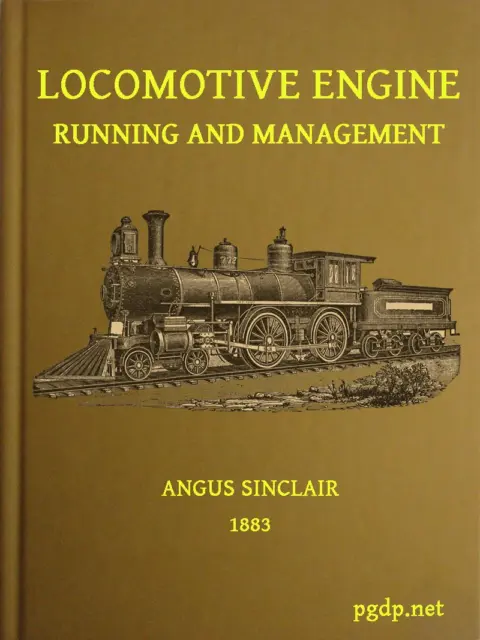
"Locomotive Engine Running and Management" by Angus Sinclair is a technical treatise focused on the operation and maintenance of locomotive engines, written in the late 19th century. The book serves as a comprehensive guide for locomotive engineers, detailing the principles of efficient engine management, care, repair, and the technical intricacies involved in locomotive operation. It aims to provide clear and practical insights into the responsibilities and skills required for ensuring smooth and economical train operations. The opening of the book sets the stage by introducing the author's personal experience as a locomotive engineer. Sinclair outlines his motivation to document observations and issues encountered while operating engines, which ultimately formed the basis for this publication. He discusses the importance of understanding mechanical principles, the rigorous self-improvement needed by engineers, and the value of practical knowledge gained through experience. The introductory chapters highlight the attributes of successful locomotive engineers, emphasize the necessity of systematic inspections, and provide guidance on preparing engines for service, laying the groundwork for the detailed operational techniques and practices covered in subsequent sections.
Introduction adapted from the source catalogue; source summaries may be automatically generated.
Free to read · English · 98,654 words · No account needed
MAKE TIME FOR A GOOD BOOK
On by default. Untick to stop anonymous reading totals. Each page counts after 10 seconds in view. How this works.
Anonymous counting is on unless you have switched it off.
The train consists of five Pullman sleeping-cars and one dining-car, the six cars weighing 200 tons. The engine and tender, in working order, weigh 74 tons, which gives a total weight of 274 tons to be moved by the force exerted by the pistons.
As the signal is given to start, the engineer drops the links full forward by means of the steam reverse gear, pulls the throttle lever open, and the engine responds by moving forward. A sprinkling of sand is dropped upon the rails, the throttle-valve is opened a little wider, and with resounding exhausts the engine is working into speed. From the start, the necessity of pushing forward, and utilizing every second of time, is recognized. The train has not moved more than its own length when a speed of ten miles an hour is reached. The engineer now hooks back the links to cut off at ten inches, pulls the throttle wide open, and “lets her go.” While waiting at the station, steam was kept down to 130 pounds by the injector and heater. The injector was shut off just before starting. When we got out about half a mile, the steam-gauge began to point towards 140, the popping pressure; and the engineer started the injector, and it was kept going continually during the remainder of the trip. It is a No. 9 Sellers, and can supply the boiler during the heaviest work without reaching the limit of its capacity. There is a No. 8 injector on the fireman’s side, but it is never used to run by. The injector and air-pump are two things about these engines that seldom need to be touched on the road after they are set to work.
The first two miles out of Jersey City a grade of about 40 feet is ascended, but the summit is reached in four minutes; then the links are hooked up to the 8-inch cut-off, which is the ordinary running-point with this train. Next mile is passed in 85 seconds, but is finished by shutting off steam to let the engine roll over a bridge. Here the valves are oiled, a duty which is repeated three times during the trip. Although steam was shut off for only about 300 yards, the speed was perceptibly reduced; and it took a minute and a half to make the next mile. Three miles succeeding that were traversed in 3½ minutes, one of them being run in 59 seconds; but again a demand for reduced speed intervened in the shape of the street-crossings of Newark,--the city being approached by a sharp curve. Here the speed was reduced to 12 miles an hour, and two miles were run at a rate under 30 miles an hour. A spurt is again made; and the second mile, after getting clear of the street-crossings, is passed in 63 seconds, the next mile in 61 seconds, when another reduction of speed for Elizabeth streets and a railroad crossing takes place. After passing this town, a speed of one mile in 57 seconds was attained, several miles having been traversed in a minute each: then came the watering-point, where the speed was reduced under 20 miles an hour. Thus it was through the whole trip,--a struggle to get up speed: then comes the necessity for dissipating part of the power gained in raising the load to the required velocity. The engine maintained a speed of sixty miles an hour easily enough; but it was a laborious proceeding, increasing the speed in a couple of miles from a mile in two minutes to a mile in one minute. Several heavy grades were ascended, one of them three miles long, which reduced the speed in the second two miles to 30 miles an hour, although the links were dropped to ten inches cut-off. The highest speed attained during the run was a mile in 55 seconds. The greatest speed was reached with the links hooked back to cut-off at 7 inches. It is well understood by engineers running these trains, that high velocity can only be attained with the lever well notched back. Sixty miles an hour is nearly the maximum speed these engines will make cutting off at 8 inches, and the train is so heavy that the amount of steam represented by that cut-off is needed to maintain the speed on curves or slightly ascending grades. The fastest running is done under the favorable conditions of a straight, level track, or descending grade, where the engine can handle the train at 6 or 7 inches cut-off. When running over 60 miles an hour, if the lever be advanced a notch the speed will decrease; for more steam gets into the cylinders than can be exhausted at the high piston velocity, and back pressure ensues, which acts as a brake upon the engine. Even with the big driving-wheels of this locomotive, the piston-speed at 60 miles an hour is very high. In traversing a mile in one minute, the wheels make 258½ revolutions, giving a piston-speed of 1,034 feet.
Your reading position is saved on this browser. Take it to another device with a library code. Reading pages adapt to text, rather than matching a printed edition.
BEHIND THE BOOK
This eBook is for the use of anyone anywhere in the United States and most other parts of the world at no cost and with almost no restrictions whatsoever. You may copy it, give it away or re-use it under the terms of the Project Gutenberg License included with this eBook or online at www.gutenberg.org. If you are not located in the United States, you will have to check the laws of the country where you are located before using this eBook. Read the source licence.
The original source file, including credits and licence, is retained by this library. Request an original-format copy at no charge. Please include the book title and Project Gutenberg identifier #62609.
KEEP YOUR CURIOSITY GOING
Charles G. (Charles Griffith) Ross
Hannah Webster Foster

Emily Lawless
Edwin Hamlin Carr

Charles De Lano Hine
Andrew Ure