Lives of Fair and Gallant Ladies. Vol 1
Pierre de Bourdeille Brantôme
THE CLASSIC COLLECTION · 1922
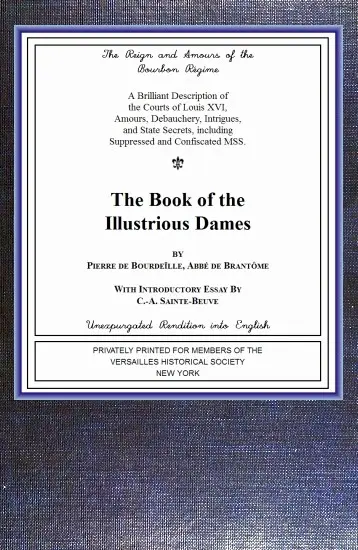
"Lives of Fair and Gallant Ladies. Vol 2." by Pierre de Bourdeille Brantôme is a historical account likely written during the late 16th century. This work presents a compilation of anecdotes and discourses describing the interactions between noblewomen and men of valor, exploring themes of love, honor, and chivalry. The text reflects the moral and social dynamics of the French court, particularly focusing on prominent figures from the Valois era. The opening of the book introduces the theme of love among noble individuals, highlighting how women of status are often enchanted by the bravery and courage of men, despite their own more delicate inclinations. Brantôme discusses notable historical and mythical examples, including Venus's infatuation with Mars and the tale of the Amazonian Queen Penthesilea's admiration for Hector of Troy. He illustrates the reciprocal nature of valor and love, suggesting that acts of bravery in war are intertwined with romantic pursuits, thereby setting the tone for a broader exploration of love's complexities throughout the text.
Introduction adapted from the source catalogue; source summaries may be automatically generated.
Free to read · English · 118,777 words · No account needed
MAKE TIME FOR A GOOD BOOK
On by default. Untick to stop anonymous reading totals. Each page counts after 10 seconds in view. How this works.
Anonymous counting is on unless you have switched it off.
◆Baron de Vitteau was this member of the Du Prat family; he killed Louis de Béranger du Guast.
◆Chicot was Henri III.’s jester who killed M. de La Rochefoucauld on Saint Bartholomew’s Day.
◆Alberic de Rosate, under the word “Matrimonium” in his Dictionary reports an exactly similar instance. Barbatias has something even more extraordinary, how a boy of seven got his nurse with child.
◆The Queen Mother Catherine de Medici. The author gives her name in his book of the Dames Illustres, where he tells the same story.
◆Jean de Rabodanges, who married Marie de Clèves, mother of Louis XII. She was reine blanche, that is, she was in mourning; at that time the women of the nobility wore white when in mourning.
◆These eighteen chevaliers, who were elevated in one batch, caused a good deal of gossip at the court.
◆Louis de Béranger du Guast.
◆She was thirty-five; she died three years later.
◆It is the Château d’Usson in Auvergne.
◆Louis de Saint-gelais-Lansac.
◆Jeanne, married to Jean, Prince of Portugal. She died in 1578.
◆Sébastien, died in 1578. This passage in Brantôme is not one of the least irreverent of this hardened sceptic.
◆The portraits of Marie disclose a protruding mouth. She is generally represented with a cap over her forehead. This feature is to be found in a marked degree in Queen Eleanore; and her brother Charles V. also had a protruding mouth. The drooping lip was likewise characteristic of all the later Dukes de Bourgogne.
◆The entanglements of which Brantôme speaks were: the revolt of the Germanats, in Spain, in 1522; of Tunis or Barbarie, 1535; the troubles in Italy, also in 1535; the revolt in the Netherlands, provoked by the taxes imposed by Maria, in 1540. M. de Chièvres was Guillaume de Croy.
◆Folembray, the royal residence occupied by François I^{er} and later by Henri II. Henri IV. negotiated there with Mayenne during the Ligue.
◆Bains en Hainaut.
◆Claude Blosset, surnamed Torcy, lady of Fontaine Chalandray.
◆Christine of Denmark, daughter of Christian II., first married to Francesco Maria Sforza, Duke of Milan. In 1540, five years after her husband’s death, she married Francis I. of Lorraine. Her son was Charles II. of Lorraine.
◆N. de La Brosse-Mailly.
◆A small plank attached to the saddle of a lady’s horse, and serving to support the rider’s feet. Superseded by the single stirrup and pommel.
◆Guy du Faur de Pybrac.
◆Renée, wife of Guillaume V., Duke de Bavière.
Your reading position is saved on this browser. Take it to another device with a library code. Reading pages adapt to text, rather than matching a printed edition.
Pierre de Bourdeille Brantôme
Pierre de Bourdeille Brantôme
BEHIND THE BOOK
This eBook is for the use of anyone anywhere in the United States and most other parts of the world at no cost and with almost no restrictions whatsoever. You may copy it, give it away or re-use it under the terms of the Project Gutenberg License included with this eBook or online at www.gutenberg.org. If you are not located in the United States, you will have to check the laws of the country where you are located before using this eBook. Read the source licence.
The original source file, including credits and licence, is retained by this library. Request an original-format copy at no charge. Please include the book title and Project Gutenberg identifier #67026.
KEEP YOUR CURIOSITY GOING
Cécile Tormay

Moritz Busch
John L. Ransom
Frances Wright
Cécile Tormay

Mabel Potter Daggett