Lives of Fair and Gallant Ladies. Vol 1
Pierre de Bourdeille Brantôme
THE CLASSIC COLLECTION · 1922
"Lives of Fair and Gallant Ladies. Vol 2." by Pierre de Bourdeille Brantôme is a historical account likely written during the late 16th century. This work presents a compilation of anecdotes and discourses describing the interactions between noblewomen and men of valor, exploring themes of love, honor, and chivalry. The text reflects the moral and social dynamics of the French court, particularly focusing on prominent figures from the Valois era. The opening of the book introduces the theme of love among noble individuals, highlighting how women of status are often enchanted by the bravery and courage of men, despite their own more delicate inclinations. Brantôme discusses notable historical and mythical examples, including Venus's infatuation with Mars and the tale of the Amazonian Queen Penthesilea's admiration for Hector of Troy. He illustrates the reciprocal nature of valor and love, suggesting that acts of bravery in war are intertwined with romantic pursuits, thereby setting the tone for a broader exploration of love's complexities throughout the text.
Introduction adapted from the source catalogue; source summaries may be automatically generated.
Free to read · English · 118,777 words · No account needed
MAKE TIME FOR A GOOD BOOK
On by default. Untick to stop anonymous reading totals. Each page counts after 10 seconds in view. How this works.
Anonymous counting is on unless you have switched it off.
◆The son of this lady was Henri d’Angoulème, who killed Altoviti and was killed by him at Aix, and not at Marseilles, June 2, 1586. Philippe Altoviti was the Baron of Castellane; he had married the beautiful Renée de Rieux-Châteauneuf.
◆Le Tigre—a pamphlet by François Hotman directed against the Cardinal de Lorraine and the Duchesse de Guise, 1560.
◆Philibert de Marcilly, lord of Cipierre.
◆That pamphlet was aimed at Anne d’Este, Duchess de Guise, at the time of her marriage with the Duc de Nemours.
◆Brantôme alludes to the hatred of the Duchess de Montpensier.
◆Marie de Clèves, who died during her lying-in in 1574.
◆Catherine Charlotte de La Trémolle, Princess de Condé.
◆Not found anywhere in Brantôme’s extant works.
◆Du Guast or Lignerolles. However, it may refer to Bussy d’Amboise.
◆Marie Babou de la Bourdaisière, who married Claude de Beauvillier
Saint-Aignan in 1560.
◆Plutarch, Sylla, cap. XXX.
◆Queen Maria of Hungary, ruler of the Netherlands, and sister of
Charles V.
◆Plutarch, Cato of Utica, cap. XXXV.
◆The personages in question are Henri III., Renée de Rieux-Châteauneuf, then Mme. de Castellane, and Marie de Clèves, wife of the Prince de Condé.
◆Louis de Condé, who deserted Isabeau de La Tour de Limeuil to marry Françoise d’Orléans. The beauty of which Brantôme speaks can scarcely be seen in the portrait in crayon of Isabeau de Limeuil who became Mme. de Sardini.
◆Mottoes were constantly used at that time.
◆Anne de Bourbon, married in 1561 to François de Clèves, Duke de
Nevers and Count d’Eu.
◆The empress was Elizabeth of Portugal; the Marquis de Villena, M. de Villena; the Duke de Feria, Gomez Suarez de Figueroa, Duke de Feria; Eleonor, the Queen of Portugal, later married to François I^{er}; Queen Marie, the Queen of Hungary.
◆Elizabeth, daughter of Henri II.
◆The MS. of this discourse is at the Bibliothèque Nationale (Ms. fr. 3273); it is written in a good hand of the end of the sixteenth century. It is dedicated to the Duke d’Alençon.
◆Opere di G. Boccaccio, Il Filicopo, Firenze, 1723, t. II., p. 73.
◆La Tournelle in the original. This was the name given to the Criminal Court of the Parliament of Paris.
◆Barbe de Cilley; she died in 1415.
◆Brantôme is undoubtedly referring to Mme. de Villequier.
◆This is again Isabeau de La Tour Limeuil.
◆See XXVth Tale in Cent Nouvelles nouvelles.
◆Honoré Castellan.
Your reading position is saved on this browser. Take it to another device with a library code. Reading pages adapt to text, rather than matching a printed edition.
Pierre de Bourdeille Brantôme
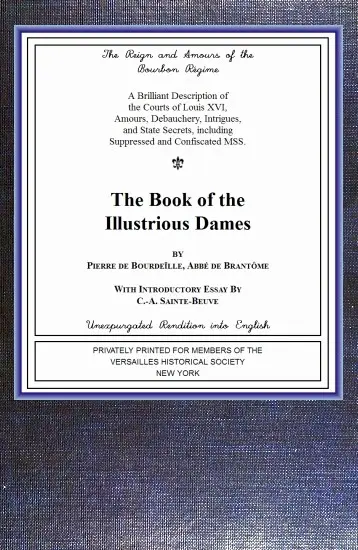
Pierre de Bourdeille Brantôme
BEHIND THE BOOK
This eBook is for the use of anyone anywhere in the United States and most other parts of the world at no cost and with almost no restrictions whatsoever. You may copy it, give it away or re-use it under the terms of the Project Gutenberg License included with this eBook or online at www.gutenberg.org. If you are not located in the United States, you will have to check the laws of the country where you are located before using this eBook. Read the source licence.
The original source file, including credits and licence, is retained by this library. Request an original-format copy at no charge. Please include the book title and Project Gutenberg identifier #67026.
KEEP YOUR CURIOSITY GOING
Cécile Tormay

Moritz Busch
John L. Ransom
Frances Wright
Cécile Tormay

Mabel Potter Daggett