Lives of Fair and Gallant Ladies. Vol 2.
Pierre de Bourdeille Brantôme
THE CLASSIC COLLECTION · 1922
"Lives of Fair and Gallant Ladies. Vol 1" by Pierre de Bourdeille Brantôme is a historical account written in the late 16th century. This work presents a collection of anecdotes and narratives concerning women of high social standing and their experiences with love and relationships. The writing reflects a mixture of admiration for and satire of the gallant ladies of the court, delineating their romantic exploits and the social constructs surrounding them. The opening of this volume sets the stage with a foreword praising A. R. Allinson's translation, stating that it retains the charm and essence of Brantôme's original work. It introduces readers to the author's intentions as he dedicates the tales to a noble patron, expressing both jest and reverence. The initial discourse explores themes of infidelity, displaying women’s cunning and bravery in the face of possessive husbands, while also hinting at the dangers and violent outcomes that often accompany such escapades. Brantôme mentions various characters, illustrating a keen understanding of human nature through anecdotes about lovers and their perilous affairs, thus inviting readers into a world of gallantry, seduction, and the complexities of marital relationships.
Introduction adapted from the source catalogue; source summaries may be automatically generated.
Free to read · English · 126,938 words · No account needed
MAKE TIME FOR A GOOD BOOK
On by default. Untick to stop anonymous reading totals. Each page counts after 10 seconds in view. How this works.
Anonymous counting is on unless you have switched it off.
◆Marie d’Aragon, wedded to Alphonse d’Avalos, Marquis del Guasto or
Vasto.
◆Henri II., son of Francis I., and husband of Catherine de Medici. Born 1518. Came to throne in 1547; accidentally killed in a tourney by Montgommeri 1559.
◆Paul IV. (of the illustrious Neapolitan family of Caraffa) was raised to the chair of St. Peter in 1558; died 1559.
◆This viceroy was Don Perafan, Duke d’Alcala, who entered Naples
June 12, 1559.
◆Claude de Lestrange?
◆Brantôme’s memory fails him. Of the two daughters of the Marquess, Béatrix, the first married Count de Potenza; the other, Prince de Sulmone.
◆His son was François Ferdinand, Viceroy of Sicily, died in 1571.
◆Soliman II.
◆Referring to Montaigne’s Essays.
—————————————— End of Book ——————————————
Transcriber’s Note (continued)
The book contains long passages of older French in which the reader will notice many flaws in grammar, spelling and accents. These may make some of the French difficult to read but it will be obvious that this cannot be fixed without sometimes inadvertently changing the intended meaning. For that reason all passages in French are presented unchanged in this transcription.
Similarly with the passages in Italian and Spanish.
For the rest of the text, the many inconsistencies in English spelling, capitalisation, and hyphenation have been left unchanged except where noted below. Other minor typographical errors have been corrected without note.
Page xxvi – “ocasionally” changed to “occasionally” (occasionally borrow)
Page 5 – “satsified” changed to “satisfied” (would fain be satisfied)
Page 18 – “emprisonment” changed to “imprisonment” (in perpetual imprisonment)
Page 27 – “notorios” changed to “notorious” (most notorious harlot)
Page 46 – “pourtrayed” changed to “portrayed” (were portrayed a
number of)
Page 133 – “armourors” changed to “armourers” (armourers that do make swords)
Page 145 – “si” changed to “is” (love is mastered by scorn)
Page 152 – “exceeding” changed to “exceedingly” (an exceedingly
narrow)
Page 157 – “hade” changed to “had” (that had made)
Page 162 – “acommodating” changed to “accommodating” (far more accommodating)
Page 199 – “consecrate” changed to “consecrated” (the most surely consecrated and devoted to Venus)
Page 226 – “alway” changed to “always” (always hard at the collar)
Page 236 – “thans” changed to “than” (than Zeuxis himself)
Page 237 – “alway” changed to “always” (yet will a beautiful woman always be beautiful)
Page 237 – “an” changed to “and” (and if she have but the half)
Page 242 – “witties” changed to “wittiest” (one of the wittiet men at Court)
Page 248 – “vigins” changed to “virgins” (even virgins of marriageable age)
Page 288 – “nypmh” changed to “nymphs” (in the nymphs’ costume)
The numbered references to endnotes on the pages of the book are incorrect in most cases. Many other pages of the book should have had references to endnotes but those references are missing.
Your reading position is saved on this browser. Take it to another device with a library code. Reading pages adapt to text, rather than matching a printed edition.
Pierre de Bourdeille Brantôme
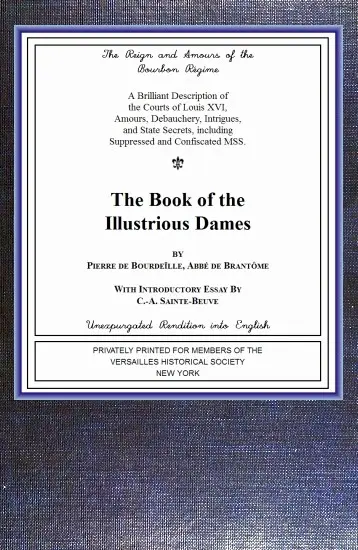
Pierre de Bourdeille Brantôme
BEHIND THE BOOK
This eBook is for the use of anyone anywhere in the United States and most other parts of the world at no cost and with almost no restrictions whatsoever. You may copy it, give it away or re-use it under the terms of the Project Gutenberg License included with this eBook or online at www.gutenberg.org. If you are not located in the United States, you will have to check the laws of the country where you are located before using this eBook. Read the source licence.
The original source file, including credits and licence, is retained by this library. Request an original-format copy at no charge. Please include the book title and Project Gutenberg identifier #67025.
KEEP YOUR CURIOSITY GOING
Cécile Tormay

Moritz Busch
John L. Ransom
Frances Wright
Cécile Tormay

Mabel Potter Daggett