Lives of Fair and Gallant Ladies. Vol 2.
Pierre de Bourdeille Brantôme
THE CLASSIC COLLECTION · 1922
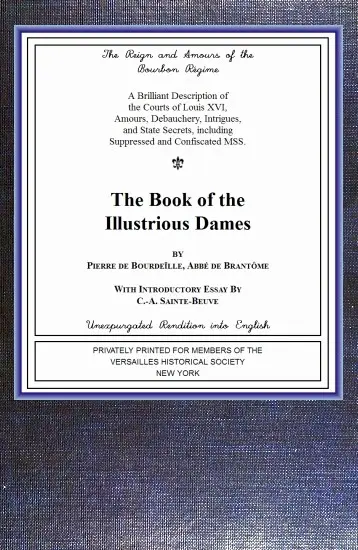
"Lives of Fair and Gallant Ladies. Vol 1" by Pierre de Bourdeille Brantôme is a historical account written in the late 16th century. This work presents a collection of anecdotes and narratives concerning women of high social standing and their experiences with love and relationships. The writing reflects a mixture of admiration for and satire of the gallant ladies of the court, delineating their romantic exploits and the social constructs surrounding them. The opening of this volume sets the stage with a foreword praising A. R. Allinson's translation, stating that it retains the charm and essence of Brantôme's original work. It introduces readers to the author's intentions as he dedicates the tales to a noble patron, expressing both jest and reverence. The initial discourse explores themes of infidelity, displaying women’s cunning and bravery in the face of possessive husbands, while also hinting at the dangers and violent outcomes that often accompany such escapades. Brantôme mentions various characters, illustrating a keen understanding of human nature through anecdotes about lovers and their perilous affairs, thus inviting readers into a world of gallantry, seduction, and the complexities of marital relationships.
Introduction adapted from the source catalogue; source summaries may be automatically generated.
Free to read · English · 126,938 words · No account needed
MAKE TIME FOR A GOOD BOOK
On by default. Untick to stop anonymous reading totals. Each page counts after 10 seconds in view. How this works.
Anonymous counting is on unless you have switched it off.
◆Pandolfo Collenuccio, famous as author, historian and juris-consult towards the end of the XIVth century. Born at Pesaro, where he spent most of his life, and where he was executed (1500) by order of Giovanni Sforza, in consequence of his intrigues with Cæsar Borgia, who was anxious to acquire the sovereignty of that city.
◆Daughter of Bernardin de Clermont, Vicomte de Tallard.
◆Brantôme undoubtedly aims here at Marguerite de Clermont.
◆Jean de Bourdeille.
◆Renée, daughter of Louis XII., married to the Duke of Ferraro. She was ungainly but very learned.
◆Marguerite d’Angoulème.
◆Meung-sur-Loire, dep. Loiret, on right bank of the Loire, eleven
miles below Orléans.
◆Eclaron, dép. Maute-Marne.
◆Leonor, Duke de Longueville.
◆François de Lorraine, Duke de Guise.
◆Louis I., Prince de Condé.
◆Captain Averet, died at Orléans in 1562.
◆Compère was the name King Henri II. gave the Constable de
Montmorency.
◆Octavius is translated Octavie by Brantôme. Cf. Suetonius, Caligula, XXXVI., and Octavius Augustus, LXIX.
◆Suetonius, Nero, XXXIV.
◆Brantôme undoubtedly refers to Henri III. and to the Duke
d’Alençon, his brother.
◆Plutarch names this woman Aspasia and makes her a priestess of Diana. Cf. Artaxerxes-Mnemon, Chap. XXVI.
◆Collenuccio, liv. V., p. 208.
◆Artaxerxes I. (Longimanus), King of Persia for forty years, B. C. 465 to 425; he succeeded his father Xerxes, having put to death his brother Darius.
◆Wife of François d’Orléans.
◆Diane died at the age of 66, April 22, 1566; she was born in 1499.
◆Jacqueline de Rohan-Gié, married to François d’Orléans, Marquis de
Rothelin.
◆François Robertet, widow of Jean Babou, whose second husband was
Field Marshal d’Aumont.
◆Catherine de Clermont, wife of Guy de Mareuil, grandmother of the Duke du Montpensier, François, surnamed the Prince-Dauphin.
◆Gabrielle de Mareuil, married to Nicolas d’Anjou, Marquis de
Mézières.
◆Jacqueline or Jacquette de Montberon.
◆Françoise Robertet, widow of Jean Babon de la Bourdaisière.
◆Paule Viguier, baronne de Fontenille.
◆Françoise de Longwi.
◆The praise of this Toulousean beauty is to be found in the very rare opuscule by G. Minot, De la beauté, 1587.
◆Anne d’Este. She was not exempt from the faults of a corrupt court.
◆This journey occurred in 1574.
◆Louis XII.
◆Jean d’O, seigneur de Maillebois.
◆It is not François Gonzagne, but Guillaume Gonzagne, his brother and successor to the duchy of Mantoue, born in 1538, died in 1587.
◆He returns here to the Duchess de Guise.
◆At the wedding of Charles Emmanuel, married to Catherine, daughter
of Philip II. of Spain.
Your reading position is saved on this browser. Take it to another device with a library code. Reading pages adapt to text, rather than matching a printed edition.
Pierre de Bourdeille Brantôme
Pierre de Bourdeille Brantôme
BEHIND THE BOOK
This eBook is for the use of anyone anywhere in the United States and most other parts of the world at no cost and with almost no restrictions whatsoever. You may copy it, give it away or re-use it under the terms of the Project Gutenberg License included with this eBook or online at www.gutenberg.org. If you are not located in the United States, you will have to check the laws of the country where you are located before using this eBook. Read the source licence.
The original source file, including credits and licence, is retained by this library. Request an original-format copy at no charge. Please include the book title and Project Gutenberg identifier #67025.
KEEP YOUR CURIOSITY GOING
Cécile Tormay

Moritz Busch
John L. Ransom
Frances Wright
Cécile Tormay

Mabel Potter Daggett