Lives of Fair and Gallant Ladies. Vol 2.
Pierre de Bourdeille Brantôme
THE CLASSIC COLLECTION · 1922
"Lives of Fair and Gallant Ladies. Vol 1" by Pierre de Bourdeille Brantôme is a historical account written in the late 16th century. This work presents a collection of anecdotes and narratives concerning women of high social standing and their experiences with love and relationships. The writing reflects a mixture of admiration for and satire of the gallant ladies of the court, delineating their romantic exploits and the social constructs surrounding them. The opening of this volume sets the stage with a foreword praising A. R. Allinson's translation, stating that it retains the charm and essence of Brantôme's original work. It introduces readers to the author's intentions as he dedicates the tales to a noble patron, expressing both jest and reverence. The initial discourse explores themes of infidelity, displaying women’s cunning and bravery in the face of possessive husbands, while also hinting at the dangers and violent outcomes that often accompany such escapades. Brantôme mentions various characters, illustrating a keen understanding of human nature through anecdotes about lovers and their perilous affairs, thus inviting readers into a world of gallantry, seduction, and the complexities of marital relationships.
Introduction adapted from the source catalogue; source summaries may be automatically generated.
Free to read · English · 126,938 words · No account needed
MAKE TIME FOR A GOOD BOOK
On by default. Untick to stop anonymous reading totals. Each page counts after 10 seconds in view. How this works.
Anonymous counting is on unless you have switched it off.
◆Brantôme does not appear to know very well the persons he is speaking of here: Hostilla is Orestilla; Tullia is Lollia; Herculalina is Urgulanilla.
◆Claudius, the fourth Roman Emperor, A. D. 41–54. The notorious Messalina was his third wife. For a lurid picture of her immoralities see Juvenal’s famous Sixth Satire.
◆Giovanni Boccaccio, the author of the Decameron, was born at Paris in 1313, being the (illegitimate) son of a wealthy merchant of Florence. He died 1375 at Certaldo, a village near Florence, the original seat of the family.
◆Does the following chanson refer to the same woman?
On void Simonne
Proumener aux bordeaux
Matin, soir, nonne,
Avec ses macquereaux.
(Bib. Nat., ms. français 22565, f^o 41 v^o.)
◆This is indeed one of the most curious passages of the book, and I am glad to remove one of Lalanne’s doubts. Brantôme is really talking of a statue, an antique piece which was found July 21, 1594, in a field near the Saint-Martin priory. It had been admirably conserved. Unfortunately, Louis XIV. having claimed it later, it was placed on a barge which sank in the Garonne, and was never recovered. (O’Reilly, History of Bordeaux, 1863, Vol. II.) The statue is described as having had one breast uncovered and curled hair, a description that agrees only partly with Visconti’s type (Iconographie romaine, t. II., planche 28), in which Messalina is not décolleté and carries her son. Was the Bordeaux statue indeed a Messalina?
◆Brantôme is mistaken; Nero caused Octavia to be killed. (See Suetonius, Nero, Chap. XXXV.)
◆Nero, fifth Roman Emperor, A. D. 54–63.
◆Domitian succeeded his father Titus on the Imperial throne; reigned
from A. D. 81 to 96.
◆Pertinax, a man of peasant birth, but who had carved out for himself a distinguished career as soldier and administrator, was elected Emperor by the Prætorian Guards on the murder of Commodus, A. D. 193. Himself murdered after a two months’ reign.
◆Septimius Severus, Emperor from A. D. 193 to 211. He was a great general and conducted successful campaigns in Britain, where he died,—at York.
◆Philippe Auguste, King of France 1180–1223. Philip Augustus repudiated Ingeburga after twenty-eight days of marriage, and married Agnes de Méranie. The censure of the church induced the king to discard the second marriage and return to Ingeburga (1201). The latter was reputed to have a secret vice which greatly angered the king.
◆Marguerite, daughter of the Archduke Maximilian, whom Charles VIII. rejected in order to marry Anne of Brittany (1491). Louis XII. turned away Jeanne in order to marry the widow of Charles VIII.
◆Charles VIII., 1483–1498, of the House of Valois.
Your reading position is saved on this browser. Take it to another device with a library code. Reading pages adapt to text, rather than matching a printed edition.
Pierre de Bourdeille Brantôme
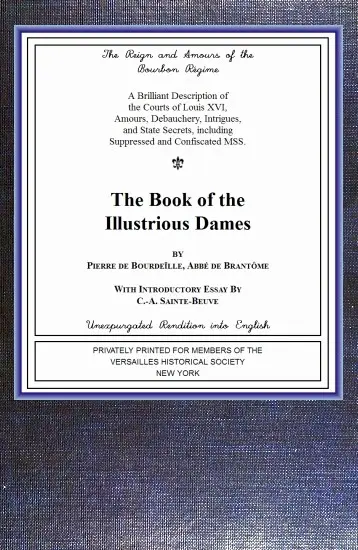
Pierre de Bourdeille Brantôme
BEHIND THE BOOK
This eBook is for the use of anyone anywhere in the United States and most other parts of the world at no cost and with almost no restrictions whatsoever. You may copy it, give it away or re-use it under the terms of the Project Gutenberg License included with this eBook or online at www.gutenberg.org. If you are not located in the United States, you will have to check the laws of the country where you are located before using this eBook. Read the source licence.
The original source file, including credits and licence, is retained by this library. Request an original-format copy at no charge. Please include the book title and Project Gutenberg identifier #67025.
KEEP YOUR CURIOSITY GOING
Cécile Tormay

Moritz Busch
John L. Ransom
Frances Wright
Cécile Tormay

Mabel Potter Daggett