Lives of Fair and Gallant Ladies. Vol 2.
Pierre de Bourdeille Brantôme
THE CLASSIC COLLECTION · 1922
"Lives of Fair and Gallant Ladies. Vol 1" by Pierre de Bourdeille Brantôme is a historical account written in the late 16th century. This work presents a collection of anecdotes and narratives concerning women of high social standing and their experiences with love and relationships. The writing reflects a mixture of admiration for and satire of the gallant ladies of the court, delineating their romantic exploits and the social constructs surrounding them. The opening of this volume sets the stage with a foreword praising A. R. Allinson's translation, stating that it retains the charm and essence of Brantôme's original work. It introduces readers to the author's intentions as he dedicates the tales to a noble patron, expressing both jest and reverence. The initial discourse explores themes of infidelity, displaying women’s cunning and bravery in the face of possessive husbands, while also hinting at the dangers and violent outcomes that often accompany such escapades. Brantôme mentions various characters, illustrating a keen understanding of human nature through anecdotes about lovers and their perilous affairs, thus inviting readers into a world of gallantry, seduction, and the complexities of marital relationships.
Introduction adapted from the source catalogue; source summaries may be automatically generated.
Free to read · English · 126,938 words · No account needed
MAKE TIME FOR A GOOD BOOK
On by default. Untick to stop anonymous reading totals. Each page counts after 10 seconds in view. How this works.
Anonymous counting is on unless you have switched it off.
◆Louis X., surnamed le Hutin, had caused his wife Marguerite de Bourgogne to be strangled at the Château-Gaillard. She had been imprisoned there in 1314. As to Gaston II., of Foix, outraged by the life of debauch Jeanne d’Artois (his mother) led, he obtained from Philippe de Valois an order of internment in 1331.
◆Anne Boleyn, who was the cause of the Anglican schism. The king had had her beheaded because of her infidelity and married Jane Seymour. As to the charge of which Brantôme speaks, Henry VIII. was so keen on that matter that he had caused Catherine Howard to be beheaded because he had not been quite convinced of her virginity.
◆Baldwyn II., cousin and successor of the first Baldwyn, king of Jerusalem, brother of Godfrey de Bouillon, reigned from 1119 to 1131. Brantôme is mistaken here. Baldwyn II. had married Morphie, daughter of Prince de Mélitine; but he had not been formerly married. Does he wish to speak of Baudoin I^{er}, who repudiated the daughter of the Prince d’Arménie and then Adéle de Monferrat? (Cf. Guillaume de Tyr, liv. II, c. xv.)
◆Read Melitene; this is how the Ancients named this town, the modern name of which is Meletin, in Latin Malatia; in Armenia, on the Euphrates.
◆History of the Holy Land; by William of Tyre.
◆Louis VII. succeeded his father, Louis le Gros, on the throne of France 1137, and died 1180. His wife, whom he divorced soon after his return from the Holy Land, whither she had accompanied him, was Eleanore of Guienne. This divorce was very painful to Louis VII., surnamed le Jeune, because he had to give up the duchy of Aquitaine and cast off the beautiful equestrian seal which he had had engraved for himself in his rank as duke.
◆Suetonius, Cæsar, Chap. VI. Brantôme is thinking of Clodius; but Cicero never made the speech in question.
◆Brantôme (Lalanne edition, t. VIII, p. 198) repeats this anecdote without giving further details.
◆Fulvia. (Sallust, Chap. XXIII.)
◆Octavius (Augustus), first Roman Emperor, was the son of C. Octavius, by Atia, a daughter of Julia, the sister of Julius Cæsar. He was therefore the grand-nephew of the latter, the founder of the Empire and virtual, though not nominal, first Emperor. He married Livia after his divorce of Scribonia.
◆Caligula, the third Roman Emperor, A. D. 37–41. His name was Caius Cæsar, Caligula being properly only a friendly nickname, “Little Boots,” bestowed on him as a boy by the soldiers in his father, Germanicus’ camp in Germany, where he was brought up. He was inordinately cruel and licentious and madly extravagant. Eventually murdered.
Your reading position is saved on this browser. Take it to another device with a library code. Reading pages adapt to text, rather than matching a printed edition.
Pierre de Bourdeille Brantôme
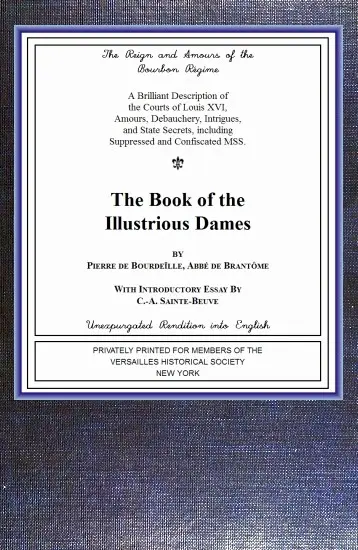
Pierre de Bourdeille Brantôme
BEHIND THE BOOK
This eBook is for the use of anyone anywhere in the United States and most other parts of the world at no cost and with almost no restrictions whatsoever. You may copy it, give it away or re-use it under the terms of the Project Gutenberg License included with this eBook or online at www.gutenberg.org. If you are not located in the United States, you will have to check the laws of the country where you are located before using this eBook. Read the source licence.
The original source file, including credits and licence, is retained by this library. Request an original-format copy at no charge. Please include the book title and Project Gutenberg identifier #67025.
KEEP YOUR CURIOSITY GOING
Cécile Tormay

Moritz Busch
John L. Ransom
Frances Wright
Cécile Tormay

Mabel Potter Daggett