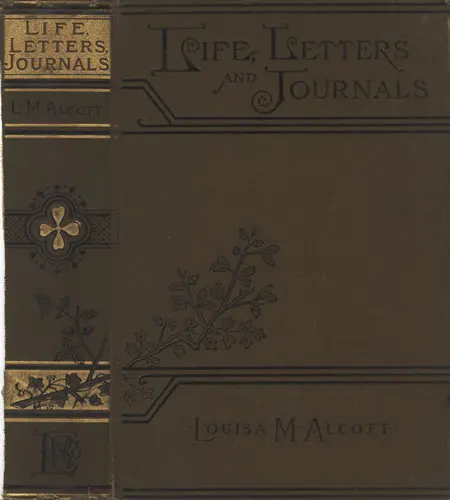
Louisa May Alcott : Her Life, Letters, and Journals
Louisa May Alcott
THE CLASSIC COLLECTION · 1899
"Little Men: Life at Plumfield with Jo's Boys" by Louisa May Alcott is a children's novel published in 1871. This sequel to "Little Women" follows Jo Bhaer and her husband as they run an unconventional school at Plumfield. Young orphan Nat Blake arrives to find a place where pillow fights are scheduled, children tend gardens and pets, and learning combines book education with moral lessons and nature. As diverse students navigate friendships, mischief, and growing pains, the Bhaers guide them through experiences that challenge traditional schooling methods.
Introduction adapted from the source catalogue; source summaries may be automatically generated.
Free to read · English · 107,168 words · No account needed
MAKE TIME FOR A GOOD BOOK
On by default. Untick to stop anonymous reading totals. Each page counts after 10 seconds in view. How this works.
Anonymous counting is on unless you have switched it off.
“Mrs. Shakespeare Smith would like to have Mr. John Brooke, Mr. Thomas Bangs, and Mr. Nathaniel Blake to come to her ball at three o’clock to-day.
“P.S.--Nat must bring his fiddle, so we can dance, and all the boys must be good, or they cannot have any of the nice things we have cooked.”
This elegant invitation would, I fear, have been declined, but for the hint given in the last line of the postscript.
“They have been cooking lots of goodies, I smelt ’em. Let’s go,” said
Tommy.
“We needn’t stay after the feast, you know,” added Demi.
“I never went to a ball. What do you have to do?” asked Nat.
“Oh, we just play be men, and sit round stiff and stupid like grown-up folks, and dance to please the girls. Then we eat up everything, and come away as soon as we can.”
“I think I could do that,” said Nat, after considering Tommy’s
description for a minute.
“I’ll write and say we’ll come;” and Demi despatched the following
gentlemanly reply,--
“We will all come. Please have lots to eat.--J. B. Esquire.”
Great was the anxiety of the ladies about their first ball, because if every thing went well they intended to give a dinner-party to the chosen few.
“Aunt Jo likes to have the boys play with us, if they are not rough; so we must make them like our balls, then they will do them good,” said Daisy, with her maternal air, as she set the table and surveyed the store of refreshments with an anxious eye.
“Demi and Nat will be good, but Tommy will do something bad, I know he will,” replied Nan, shaking her head over the little cake-basket which she was arranging.
“Then I shall send him right home,” said Daisy, with decision.
“People don’t do so at parties, it isn’t proper.”
“I shall never ask him any more.”
“That would do. He’d be sorry not to come to the dinner-ball, wouldn’t
he?”
“I guess he would! we’ll have the splendidest things ever seen, won’t we? Real soup with a ladle and a tureem [she meant tureen] and a little bird for turkey, and gravy, and all kinds of nice vegytubbles.” Daisy never could say vegetables properly, and had given up trying.
“It is ’most three, and we ought to dress,” said Nan, who had arranged a fine costume for the occasion, and was anxious to wear it.
Your reading position is saved on this browser. Take it to another device with a library code. Reading pages adapt to text, rather than matching a printed edition.
Louisa May Alcott
Louisa May Alcott
Louisa May Alcott
Louisa May Alcott
BEHIND THE BOOK
This eBook is for the use of anyone anywhere in the United States and most other parts of the world at no cost and with almost no restrictions whatsoever. You may copy it, give it away or re-use it under the terms of the Project Gutenberg License included with this eBook or online at www.gutenberg.org. If you are not located in the United States, you will have to check the laws of the country where you are located before using this eBook. Read the source licence.
The original source file, including credits and licence, is retained by this library. Request an original-format copy at no charge. Please include the book title and Project Gutenberg identifier #52900.
KEEP YOUR CURIOSITY GOING
Cécile Tormay

Moritz Busch
Coulson Kernahan
John L. Ransom

Maurice Baring
Frances Wright