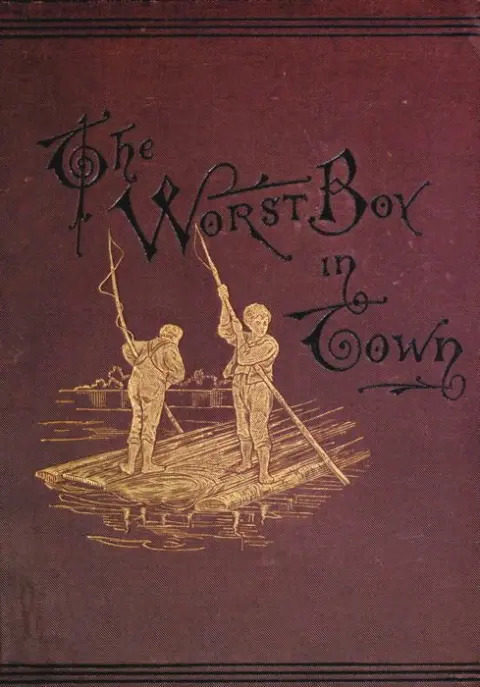
The Worst Boy in Town
John Habberton
THE CLASSIC COLLECTION · 1878
"Little Guzzy" by John Habberton is a collection of short stories written in the late 19th century. The stories range across various themes, capturing humorous, grave, and poignant moments in life. The book likely appeals to readers who enjoy light-hearted narratives with engaging characters, as suggested by its connection to Habberton's previous work, "Helen’s Babies." The opening of "Little Guzzy" introduces the setting of a mining camp called Bottle Flat, where the arrival of a new schoolteacher stirs discontent among local miners who are vehemently opposed to formal education. The miners plot to confront the teacher, but their plans shift when they discover that the incoming educator is a charming young woman named Miss Brown. Her pleasant demeanor leads to unexpectedly warm interactions, challenging the men’s initial resistance and igniting a change in their attitudes towards education and women in their community. The narrative captures the dynamics of small-town life, infusing humor and character depth throughout its opening chapter.
Introduction adapted from the source catalogue; source summaries may be automatically generated.
Free to read · English · 114,349 words · No account needed
MAKE TIME FOR A GOOD BOOK
On by default. Untick to stop anonymous reading totals. Each page counts after 10 seconds in view. How this works.
Anonymous counting is on unless you have switched it off.
“I’d rather hear him whistlin’ Windham or Boylston,” thought Mrs. Simmons; “that tune don’t fit any hymn I know. P’r’aps, though, they sing it in some of them churches up to Cincinnaty,” she charitably continued.
“Cap’en,” said she, at breakfast, next morning, when the other guests had departed, “is your mind at peace?”
“Peace?” echoed the captain—“peaceful as the Ohio at low water.”
The captain’s simile was not so Scriptural as the old lady could have desired, but she remembered that he was but a young convert, and that holy conversation was a matter of gradual attainment. So, simply and piously making the best of it, she fervently exclaimed:
“That it may ever be thus is my earnest prayer, cap’en.”
“Amen to that,” said Captain Sam, very heartily, upsetting the chair in his haste to get out of the room.
For several days Mrs. Simmons lived in a state of bliss unknown to boarding-house keepers, whose joys come only from a sense of provisions purchased cheaply and paying boarders secured.
From the kitchen, the dining-room, or wherever she was, issued sounds of praise and devotion, intoned to some familiar church melody. Scrubbing the kitchen-floor dampened not her ardor, and even the fateful washing-day produced no visible effects on her spirits. From over the bread-pan she sent exultant strains to echo through the house, and her fists vigorously marked time in the yielding dough. From the third-story window, as she hung out the bed-linen to air, her holy notes fell on the ears of passing teamsters, and caused them to cast wondering glances upward. What was the heat of the kitchen-stove to her, now that Captain Sam was insured against flames eternal? What, now, was even money, since Captain Sam had laid up his treasures above?
And the captain’s presence, which had always comforted her, was now a perpetual blessing. Always pleasant, kind, and courteous, as of old, but oh, so different!
All the coal-scuttles and water-pails in the house might occupy the
stairway at night, but the captain could safely thread his way among
them.
No longer did she hurry past his door, with her fingers ready, at the slightest alarm, to act as compressers to her ears; no, the captain’s language, though not exactly religious, was eminently proper.
He was at home so much evenings, that his lamp consumed more oil in a week than it used to in months; but the old lady cheerfully refilled it, and complained not that the captain’s goodness was costly.
Your reading position is saved on this browser. Take it to another device with a library code. Reading pages adapt to text, rather than matching a printed edition.
John Habberton
John Habberton
John Habberton
John Habberton
BEHIND THE BOOK
This eBook is for the use of anyone anywhere in the United States and most other parts of the world at no cost and with almost no restrictions whatsoever. You may copy it, give it away or re-use it under the terms of the Project Gutenberg License included with this eBook or online at www.gutenberg.org. If you are not located in the United States, you will have to check the laws of the country where you are located before using this eBook. Read the source licence.
The original source file, including credits and licence, is retained by this library. Request an original-format copy at no charge. Please include the book title and Project Gutenberg identifier #67985.
KEEP YOUR CURIOSITY GOING
Coulson Kernahan

Maurice Baring
Frances Wright
Cécile Tormay

Frederic Jesup Stimson

W. H. P. (William Henry Pope) Jarvis