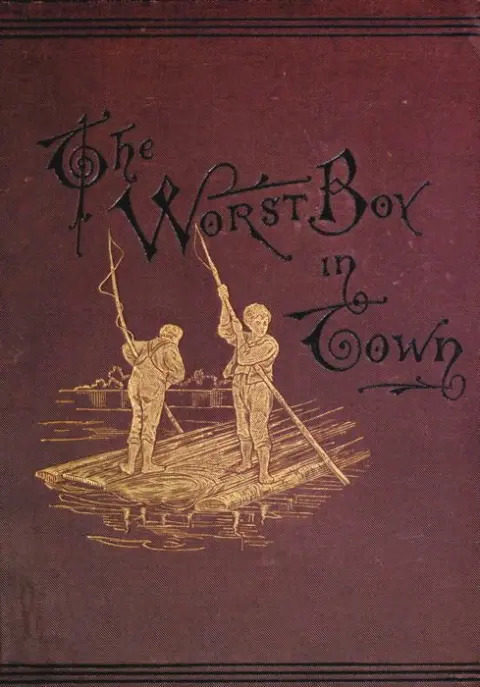
The Worst Boy in Town
John Habberton
THE CLASSIC COLLECTION · 1878
"Little Guzzy" by John Habberton is a collection of short stories written in the late 19th century. The stories range across various themes, capturing humorous, grave, and poignant moments in life. The book likely appeals to readers who enjoy light-hearted narratives with engaging characters, as suggested by its connection to Habberton's previous work, "Helen’s Babies." The opening of "Little Guzzy" introduces the setting of a mining camp called Bottle Flat, where the arrival of a new schoolteacher stirs discontent among local miners who are vehemently opposed to formal education. The miners plot to confront the teacher, but their plans shift when they discover that the incoming educator is a charming young woman named Miss Brown. Her pleasant demeanor leads to unexpectedly warm interactions, challenging the men’s initial resistance and igniting a change in their attitudes towards education and women in their community. The narrative captures the dynamics of small-town life, infusing humor and character depth throughout its opening chapter.
Introduction adapted from the source catalogue; source summaries may be automatically generated.
Free to read · English · 114,349 words · No account needed
MAKE TIME FOR A GOOD BOOK
On by default. Untick to stop anonymous reading totals. Each page counts after 10 seconds in view. How this works.
Anonymous counting is on unless you have switched it off.
Once again the Queen Ann needed repairing, and again the captain found himself at his old boarding-place.
Good Mrs. Simmons surveyed him tenderly through her glasses, and instantly saw there had something unusual happened. Could it be—oh! if it only could be—that he had put off the old man, which is sin! She longed to ask him, yet, with a woman’s natural delicacy, she determined to find out without direct questioning.
“Good season, cap’en?” she inquired.
“A No. 1, ma’am—positively first-class,” replied the captain.
“Hed good health—no ager?” she continued.
“Never was better, my dear woman—healthy right to the top notch,” he
answered.
“It must be,” said good Mrs. Simmons, to herself—“it can’t be nothin’ else. Bless the Lord!”
This pious sentiment she followed up by a hymn, whose irregularities of time and tune were fully atoned for by the spirit with which she sung. A knock at the door interrupted her.
“Come in!” she cried.
Captain Sam entered, and laid a good-sized, flat flask on the table,
saying:
“I’ve just been unpackin’, an’ I found this; p’r’aps you ken use it fur cookin’. It’s no use to me; I’ve sworn off drinkin’.”
And before the astonished lady could say a word, he was gone.
But the good soul could endure the suspense no longer. She hurried to
the door, and cried:
“Cap’en!”
“That’s me,” answered Captain Sam, returning.
“Cap’en,” said Mrs. Simmons, in a voice in which solemnity and excitement struggled for the mastery, “hez the Lord sent His angel unto you?”
“He hez,” replied the captain, in a very decided tone, and abruptly turned, and hurried to his own room.
“Bless the Lord, O my soul!” almost shouted Mrs. Simmons, in her ecstasy. “We musn’t worry them that’s weak in the faith, but I shan’t be satisfied till I hear him tell his experience. Oh, what a blessed thing to relate at prayer-meetin’ to-night!”
There was, indeed, a rattling of dry bones at the prayer-meeting that night, for it was the first time in the history of the church that the conversion of a steamboat captain had been reported.
On returning home from the meeting, additional proof awaited the happy old saint. The captain was in his room—in his room at nine o’clock in the evening! She had known the captain for years, but he had never before got in so early. There could be no doubt about it, though—there he was, softly whistling.
Your reading position is saved on this browser. Take it to another device with a library code. Reading pages adapt to text, rather than matching a printed edition.
John Habberton
John Habberton
John Habberton
John Habberton
BEHIND THE BOOK
This eBook is for the use of anyone anywhere in the United States and most other parts of the world at no cost and with almost no restrictions whatsoever. You may copy it, give it away or re-use it under the terms of the Project Gutenberg License included with this eBook or online at www.gutenberg.org. If you are not located in the United States, you will have to check the laws of the country where you are located before using this eBook. Read the source licence.
The original source file, including credits and licence, is retained by this library. Request an original-format copy at no charge. Please include the book title and Project Gutenberg identifier #67985.
KEEP YOUR CURIOSITY GOING
Coulson Kernahan

Maurice Baring
Frances Wright
Cécile Tormay

Frederic Jesup Stimson

W. H. P. (William Henry Pope) Jarvis