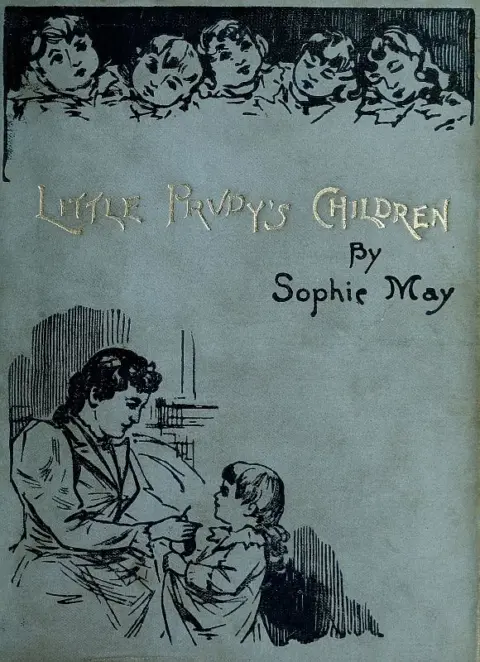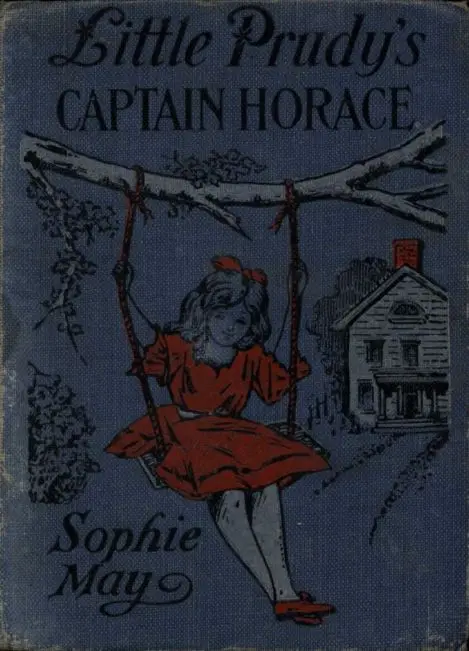
Little Prudy’s Captain Horace
Sophie May
THE CLASSIC COLLECTION · 1873
"Little Grandfather" by Sophie May is a children's novel written in the late 19th century. It follows the mischievous but endearing character of Willy Parlin, a young boy who navigates the adventures and challenges of childhood, particularly in a household filled with love and a bit of chaos. The story is set against the backdrop of family dynamics, depicting the various relationships between Willy, his siblings, his parents, and other characters in their community. The opening of "Little Grandfather" introduces us to Willy Parlin, a spirited three-year-old boy who takes pride in his unique appearance in a new outfit despite being teased by his older brother. His close-knit family consists of loving parents, siblings, and household helpers, each with their distinct perspectives on Willy's antics. As we delve further into the chapter, we learn about Willy's nocturnal adventures, including his tendency to walk in his sleep, and how this quirk ties into the stories of the adults around him. The narrative sets the stage for Willy's explorations of both the joys and the trials of childhood, hinting at further adventures and lessons to come as he interacts with the world around him.
Introduction adapted from the source catalogue; source summaries may be automatically generated.
Free to read · English · 26,601 words · No account needed
MAKE TIME FOR A GOOD BOOK
On by default. Untick to stop anonymous reading totals. Each page counts after 10 seconds in view. How this works.
Anonymous counting is on unless you have switched it off.
"Boys," said Willy, sternly,--for he felt all the importance of the occasion,--"boys, remember, George Washington was the Father of his Country; so you've got to behave."
The boys remembered "the father of his country" for a while, but before the close of the afternoon forgot him entirely. There were several stalls where refreshments were to be had,--such as cakes, apples, molasses taffy, sugar candy, and cider by the mugful, not to mention the liquors, which were quite too fiery for the little Never-Give-Ups.
At every halt in the march the boys bought something to eat or drink. There had been a barrel of cider brought from Mr. Chase's for their especial use, and Fred sold it out to the boys for four cents a glass. This was a piece of extraordinary meanness in him, for his father had intended the cider as a present to the company. The boys did not know this, however, and paid their money in perfect good faith.
"Hard stuff," said Willy, draining his mug. "I don't like it much."
"Why, it's tip-top," returned Fred. "My father says it's the best he
ever saw."
Mr. Chase had never said anything of the sort. He had merely ordered his colored servant, Pompey, to put a barrel of cider on the wheelbarrow, and take it to the muster-ground. Whether Pompey and Fred had selected this one for its age I cannot tell, but the boys all declared it was "as hard as a stone wall."
Dr. Hilton, who seemed to be everywhere at once, heard them say that,
and exclaimed,--
"Then I wouldn't drink any more of it, boys. Hard cider does make anybody dreadful cross. Better let it alone."
I fear the boys did not follow this advice, for certain it is that they grew outrageously cross. The trouble began, I believe, with Abram Noonin, who suddenly declared he wouldn't march another step with Jock Winter. As the marching was all done for the day, Abram might as well have kept quiet.
"Yes, you shall march with Jock Winter, too," said Captain Willy, exasperated with the throbbing pain in his head--the first he had ever felt in his life. "Pretty doings, if you are going to set up and say, 'I will' and 'I won't!'"
While the captain and the private were shooting sharp words back and forth, and Fred was busy drawing cider, Isaac Lovejoy, the rogue of the company, was very busy with his own mischief.
"Look here, Fred," said Joshua Potter, going up to the stall with a twinkle in his eye; "they don't ask but three cents a mug, round at the other end of the barrel!"
Your reading position is saved on this browser. Take it to another device with a library code. Reading pages adapt to text, rather than matching a printed edition.
BEHIND THE BOOK
This eBook is for the use of anyone anywhere in the United States and most other parts of the world at no cost and with almost no restrictions whatsoever. You may copy it, give it away or re-use it under the terms of the Project Gutenberg License included with this eBook or online at www.gutenberg.org. If you are not located in the United States, you will have to check the laws of the country where you are located before using this eBook. Read the source licence.
The original source file, including credits and licence, is retained by this library. Request an original-format copy at no charge. Please include the book title and Project Gutenberg identifier #25481.
KEEP YOUR CURIOSITY GOING
Coulson Kernahan

Maurice Baring
Frances Wright
Cécile Tormay

Frederic Jesup Stimson

W. H. P. (William Henry Pope) Jarvis