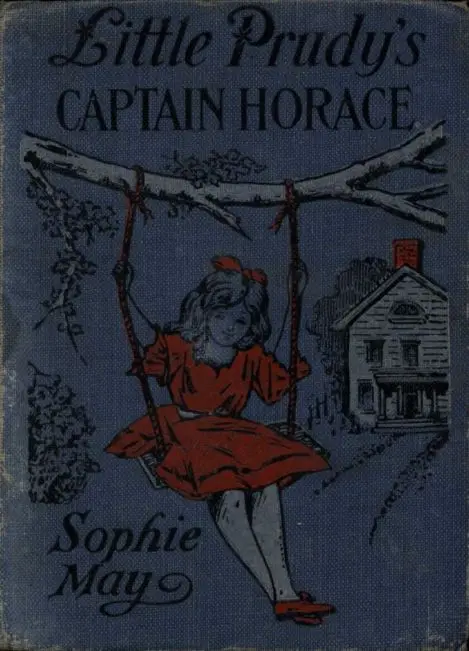
Little Prudy’s Captain Horace
Sophie May
THE CLASSIC COLLECTION · 1873
"Little Grandfather" by Sophie May is a children's novel written in the late 19th century. It follows the mischievous but endearing character of Willy Parlin, a young boy who navigates the adventures and challenges of childhood, particularly in a household filled with love and a bit of chaos. The story is set against the backdrop of family dynamics, depicting the various relationships between Willy, his siblings, his parents, and other characters in their community. The opening of "Little Grandfather" introduces us to Willy Parlin, a spirited three-year-old boy who takes pride in his unique appearance in a new outfit despite being teased by his older brother. His close-knit family consists of loving parents, siblings, and household helpers, each with their distinct perspectives on Willy's antics. As we delve further into the chapter, we learn about Willy's nocturnal adventures, including his tendency to walk in his sleep, and how this quirk ties into the stories of the adults around him. The narrative sets the stage for Willy's explorations of both the joys and the trials of childhood, hinting at further adventures and lessons to come as he interacts with the world around him.
Introduction adapted from the source catalogue; source summaries may be automatically generated.
Free to read · English · 26,601 words · No account needed
MAKE TIME FOR A GOOD BOOK
On by default. Untick to stop anonymous reading totals. Each page counts after 10 seconds in view. How this works.
Anonymous counting is on unless you have switched it off.
Perhaps the shock had some effect upon Willy's habits, for after this he did not walk in his sleep for some time.
But one night, as the teamsters were drinking their cider, and talking about the well-beloved "Kellup," wondering why he should take it into his head to steal,--"as honest a man, they had always thought, as ever trod shoe-leather,"--the bar-room door softly opened, and in glided Willy, in his flannel night-dress.
The men were really glad to see him, and nodded at one another, smiling, but, as usual, made no remark about the child. They knew he could not hear, but it seemed as if he could, and they were a little careful what they said before him.
"Yes," said Mr. Parlin, going on to speak of Caleb, "I considered him an honest, God-fearing man, and trusted him as I would one of my own sons. If there was any other way to account for that money, I should be glad, I assure you,--as glad as any of you."
"Where has Kellup gone to?" asked Mr. Griggs.
"Gone to Bangor, they say."
All this while Willy had not seated himself in his little chair, but was walking towards the bar. After muttering to himself a little while, he went in and took from the shelf the old account-book. Mr. Parlin looked at the teamsters, and put his finger on his lips as a hint for them to keep still, and see what the child would do.
Willy felt in the account-book for the key, then glided along to the
money-drawer and opened it.
"There, now, it isn't here," said he, after he had fumbled about for a while with his chubby fingers; "the book isn't here that had the ox-money in it. Caleb mustn't have that money; it belongs to my father."
The men grew very much interested, and began to creep up a little nearer, in order to catch every word.
"Money all gone," sighed Willy; and then, appearing to think for a moment, added, "O, yes; but I know where I put it!"
Breathless with surprise, Mr. Parlin and his guests watched the child as he pattered with bare feet across the floor to the west side of the room, climbed upon a high stool, and opening the "vial cupboard," took out from a chink in the wall, behind the bottles, a little old singing-book.
It was only the danger of startling Willy too suddenly that prevented the amazed father from snatching the book out of his hand.
"Yes, the ox-money is here," said Willy, patting the notes, which lay
between the leaves.
Your reading position is saved on this browser. Take it to another device with a library code. Reading pages adapt to text, rather than matching a printed edition.
BEHIND THE BOOK
This eBook is for the use of anyone anywhere in the United States and most other parts of the world at no cost and with almost no restrictions whatsoever. You may copy it, give it away or re-use it under the terms of the Project Gutenberg License included with this eBook or online at www.gutenberg.org. If you are not located in the United States, you will have to check the laws of the country where you are located before using this eBook. Read the source licence.
The original source file, including credits and licence, is retained by this library. Request an original-format copy at no charge. Please include the book title and Project Gutenberg identifier #25481.
KEEP YOUR CURIOSITY GOING
Coulson Kernahan

Maurice Baring
Frances Wright
Cécile Tormay

Frederic Jesup Stimson

W. H. P. (William Henry Pope) Jarvis