THE CLASSIC COLLECTION✦The claims of decorative artCLASSIC FREE BOOKS
The claims of decorative art
Walter Crane
THE CLASSIC COLLECTION · 1900
"Line and Form" by Walter Crane is a treatise on art and design written in the late 19th century. This work centers around the principles of line and form in artistic creation, exploring their historical significance and practical applications in drawing and design. The author presents a variety of methods and approaches for students and practitioners in the arts, aiming to enhance their understanding and capacity for artistic expression. The opening of the book establishes its academic foundation, indicating that it comprises a series of lectures originally delivered at an art school. Crane emphasizes the importance of outline as a fundamental aspect of art, discussing its origins and functions. He introduces various drawing methods, such as the progressive method and the calligraphic method, while also touching on the emotional and textural qualities conveyed through line. The text sets the stage for a deeper exploration of these concepts, framing the subsequent chapters on the language of line and the relationship between line and form in artistic endeavors.
Introduction adapted from the source catalogue; source summaries may be automatically generated.
Free to read · English · 45,455 words · No account needed
MAKE TIME FOR A GOOD BOOK
On by default. Untick to stop anonymous reading totals. Each page counts after 10 seconds in view. How this works.
Anonymous counting is on unless you have switched it off.
Form, its relation to line, 27;
importance of knowledge of, 31;
choice of, 73, 79;
elementary forms and their relation to forms in nature and art, 73-77;
grouping of, 83-87;
analogies of, 89-91;
typical forms of ornament, 92-95;
equivalents in, 95, f057;
variation of allied forms, 103;
governed by shape of inclosing boundary, f063b, 106, f066;
relief of, 165, et seq.;
expression of, by light and shade, 205, f112.
Frieze, origin of the, 113, 133;
and field, 133-135;
use of the, 236;
treatment of, 240.
Fruit forms, treatment of, f054, 89.
Gems, engraved, 200.
Geometric forms, elementary, 73;
structural plans in surface design, 128-133.
Ghirlandajo, 226.
Giotto, "Chastity," f119.
Gozzoli, Benozzo, 226.
Graphic aim, the, in drawing, 29-31, 205, 208-211.
Grouping of forms, 83-87.
Holbein, "The Ambassadors," f137.
Human figure, use of the,
in design, 104-107;
decorative spacing of
within geometric boundaries, 105-106, 107;
governed by inclosing boundaries, 110, f066;
principles of line in, f081a.
Indian ornament, typical, 212, 216;
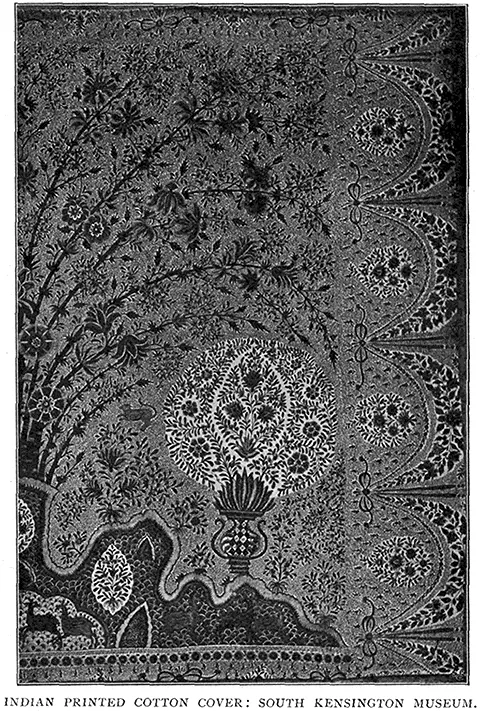
printed cotton designs, 246, f130.
Inlay work, choice of forms for, 81-83.
Japanese method of drawing with the brush, 10, 68;
diagonal pattern, f053;
colour prints, 266.
Keene, Charles, 190.
Landscape, expression of storm and calm in, 158, f089.
Lead pencil, 70.
Letters, formation of, 4;
Durer's method, f005a.
Line, methods of drawing in, 6-12;
quality of, 12-14;
the language of, 23;
comparison of style in, 24;
scale of degrees and qualities of, 24, 25;
its relation to form, 27;
question and answer in, 35, f025;
recurring, f031, f032;
radiating principle of, 46-50;
range and use of, 47-49;
choice of, 51;
degree and emphasis of, 54;
influence of technical conditions on, 58-62;
controlling influence of, as a boundary of design, 106, 108-113;
value of recurring, 119-124;
combinations of, 139;
principles of structural and ornamental line, 140-145;
selection of, f117a, f117b.
Linear expression, of movement, 15, 16, 17;
of textures and surfaces, 18, 19;
of emotion, 19, 20, f015;
scale of, 21;
power of, 158, 160;
of fur and feathers, 208, f113.
Linear motives and pattern bases, simple, 109-111.
Lippi, Filippino, study of drapery by, f101.
Lorenzo di Credi, 226.
Lysicrates, monument of, 133.
Madox Brown, Ford, mural painting at Manchester, 226, 227; "Christ washing Peter's feet," 280, f142.
Mantling, treatment of, 170-173.
Medals, 200, f110.
Memory, importance of, in design, 39.
Michael Angelo, ceiling of the Sistine Chapel, 225.
Modelling, principle of relief in, 192.
Montague, mantling from Garter plate of, f094b.
Morris, William, tapestry of, 236, 240.
Movement, linear expression of, 15-17;
lines of, in a procession, f091a;
in a dancing figure, f117a;
in water, f118b.
Mural decoration, 224, 225;
diagram of systems of line governing, f121;
scale in, 230;
choice of line and form in, 236.
Nauplia, Gulf of, coast and mountain lines, f004, f118a.
Nerva, Forum of, 192, f105.
Nuremberg, ceiling in the Castle of, 136, 137.
Olive branch, study of from nature, f020;
decorative treatment of, f021.
Ornament, typical forms of, 92-94.
Ornamental purpose, the, in drawing, 29, 31-33, 210, et seq.
Ornamental units, 94;
use of intervals in repeating, f065.
Outline, origin and function of, 1.
Your reading position is saved on this browser. Take it to another device with a library code. Reading pages adapt to text, rather than matching a printed edition.
Walter Crane
Walter Crane
Walter Crane

Walter Crane
BEHIND THE BOOK
This eBook is for the use of anyone anywhere in the United States and most other parts of the world at no cost and with almost no restrictions whatsoever. You may copy it, give it away or re-use it under the terms of the Project Gutenberg License included with this eBook or online at www.gutenberg.org. If you are not located in the United States, you will have to check the laws of the country where you are located before using this eBook. Read the source licence.
The original source file, including credits and licence, is retained by this library. Request an original-format copy at no charge. Please include the book title and Project Gutenberg identifier #25290.
KEEP YOUR CURIOSITY GOING

Charles G. (Charles Griffith) Ross
Hannah Webster Foster

Emily Lawless
Edwin Hamlin Carr

Charles De Lano Hine
Andrew Ure