
Life of Edwin Forrest, the American Tragedian. Volume 1 (of 2)
William Rounseville Alger & Horatio, Jr. Alger

THE CLASSIC COLLECTION · 1877
"Life of Edwin Forrest, the American Tragedian. Volume 2 (of 2)" by William Rounseville Alger is a historical account written in the late 19th century. The book explores the life and career of Edwin Forrest, one of America's most prominent actors in the 19th century, noting his impact on the dramatic arts as well as the public's and critics' reception of his performances. It delves into his struggles with criticism and the evolution of public perception, highlighting both the acclaim he received and the scorn from detractors. The beginning of this volume presents a rich discussion on the nature of newspaper criticism during Edwin Forrest's career, illustrating how different factions of critics regarded him. It outlines the complexities of dramatic art and the difficulties actors face in responding to public scrutiny. Additionally, it emphasizes Forrest's careful reading of critiques and his aspirations to improve his craft, as well as the influence of personal animosities and societal expectations on the perception of his work. The opening sets the stage for a nuanced exploration of Forrest's challenges and achievements in the theatrical world.
Introduction adapted from the source catalogue; source summaries may be automatically generated.
Free to read · English · 168,377 words · No account needed
MAKE TIME FOR A GOOD BOOK
On by default. Untick to stop anonymous reading totals. Each page counts after 10 seconds in view. How this works.
Anonymous counting is on unless you have switched it off.
For this penalty, however, his sincerity and direct reliance on nature gave ample compensation in making him capable of inspiration. Adherence to mere authority, tradition, usage, or dry technicality, is fatal to inspiration. This carried to an extreme makes the most cultivated player a mere professor of postures and stage mechanics,—what the French called Macready, “L’artiste de poses.” There is an infinite distance from such external elaboration to the surprises of feeling which open the soul directly upon the mysteries of experience, send cold waves of awe through the nerves, and convert the man into a sublime automaton of elemental nature, or a hand with which God himself gesticulates. Then the performing of the actor originates not on the volitional surfaces of the brain, but in the dynamic deeps of the spine and ganglia, and he seems an incarnate fagot of thunderbolts. Then the gesticulating arms, modulated by the profound spinal rhythms, become the instruments of a visible music of passion mysteriously powerful. For all action from the distal extremities of the nerves is feverish, twitching, anxious, with a fidgety and wasteful expensiveness of force, while action from their central extremities is steady, harmonious, commanding, economical of force. The nearer to the central insertions of the muscles the initial impulses take effect, so much the longer the lines they fling, the acuter the angles they subtend, the vaster the segments they cut and the areas they sweep. This suggests to the imagination of the spectator, without his knowing the meaning or ground of it, a godlike dignity and greatness. Forrest was full of this hinted and hinting power. It was the secret of his loaded personality and magnetizing port.
Art, while it is not pure and simple nature, is not anything substituted for nature nor anything opposed to nature. It is something superadded to nature, which gives the artist supreme possession of his theme, supreme possession of himself, and supreme command of his treatment of his theme. It is a grasped generalization of the truths of nature freed from all coarse, crude, and degrading accidents and details. The consummate artist, observing the principle or law, does everything easily; but the empiric, striving at the facts, does everything laboriously. Feeling transmuted into art by being passed through thought and fixed in form is transferred for its exemplification from the volition of the cerebral nerves to the automatic execution of the spinal nerves. This does not exhaust the strength, but leaves one fresh after apparently the most tremendous exertions. Talma, Rachel, Salvini, did not sweat or fatigue themselves, however violent their action seemed. But when feeling, instead of having been passed through thought and fixed in form for automatic exhibition, is livingly radiated into form by the will freshly exerted each time, the exaction on the forces of the organism is great. It is then nature in her expensiveness that is seen, rather than the art which secures the maximum of result at the minimum of cost. It was said of Barry that excessive sensibility conquered his powers. His heart overcame his head; while Garrick never lost possession of himself and of his acting. The one felt everything himself before he made his audience feel it; the other remained cool, and yet by his kingly self-control forced his audience to feel so much the more. In his direct honest feeling and exertion Forrest paid the expensive penalty of the Natural School. After playing one of his great parts he was drenched with perspiration and blew off steam like a locomotive brought to rest. The nerves of his brain and the nerves of his spinal cord were insufficiently detached in their activities, too much mixed. Like Edmund Kean, he was as a fusee, and the points of the play were as matches; at each electric touch his nerve-centres exploded and his muscles struck lightning. But in the Artistic School the actor is like a lens made of ice, through which the sunbeams passing set on fire whatever is placed in their focus. The player who can pour the full fire of passion through his soul while his nerves remain firm and calm has command of every power of nature, and reaches the greatest effects without waste. But, as Garrick said,—
Your reading position is saved on this browser. Take it to another device with a library code. Reading pages adapt to text, rather than matching a printed edition.
William Rounseville Alger & Horatio, Jr. Alger

Horatio, Jr. Alger

Horatio, Jr. Alger
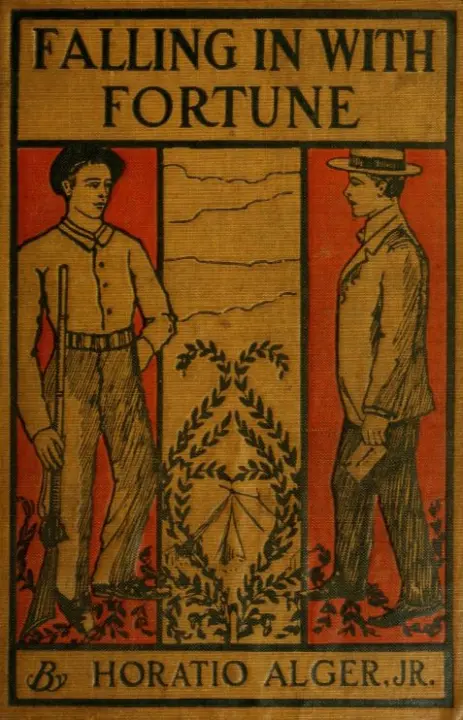
Horatio, Jr. Alger & Edward Stratemeyer
BEHIND THE BOOK
This eBook is for the use of anyone anywhere in the United States and most other parts of the world at no cost and with almost no restrictions whatsoever. You may copy it, give it away or re-use it under the terms of the Project Gutenberg License included with this eBook or online at www.gutenberg.org. If you are not located in the United States, you will have to check the laws of the country where you are located before using this eBook. Read the source licence.
The original source file, including credits and licence, is retained by this library. Request an original-format copy at no charge. Please include the book title and Project Gutenberg identifier #61470.
KEEP YOUR CURIOSITY GOING
Maurice Baring
W. B. (William Butler) Yeats
Edward Martyn

John Brougham & Charlotte Brontë
Marguerite Merington
Leonid Andreyev