
Life of Edwin Forrest, the American Tragedian. Volume 1 (of 2)
William Rounseville Alger & Horatio, Jr. Alger

THE CLASSIC COLLECTION · 1877
"Life of Edwin Forrest, the American Tragedian. Volume 2 (of 2)" by William Rounseville Alger is a historical account written in the late 19th century. The book explores the life and career of Edwin Forrest, one of America's most prominent actors in the 19th century, noting his impact on the dramatic arts as well as the public's and critics' reception of his performances. It delves into his struggles with criticism and the evolution of public perception, highlighting both the acclaim he received and the scorn from detractors. The beginning of this volume presents a rich discussion on the nature of newspaper criticism during Edwin Forrest's career, illustrating how different factions of critics regarded him. It outlines the complexities of dramatic art and the difficulties actors face in responding to public scrutiny. Additionally, it emphasizes Forrest's careful reading of critiques and his aspirations to improve his craft, as well as the influence of personal animosities and societal expectations on the perception of his work. The opening sets the stage for a nuanced exploration of Forrest's challenges and achievements in the theatrical world.
Introduction adapted from the source catalogue; source summaries may be automatically generated.
Free to read · English · 168,377 words · No account needed
MAKE TIME FOR A GOOD BOOK
On by default. Untick to stop anonymous reading totals. Each page counts after 10 seconds in view. How this works.
Anonymous counting is on unless you have switched it off.
“Whate’er the part in which his cast was laid, Self still, like oil, upon the surface played.”
Talma said, “In whatever sphere fate may have placed a man, the grand movements of the soul lift him into an ideal nature.” The greatness of every truly great actor shows itself in the general ideal which characterizes his embodiments. If he has any originality it will publish itself in his ideal. Now, while most actors are not only second-rate but also second-hand, Forrest certainly was original alike as man and as player. He was distinctively original in his personality, original and independent in the very make of his mind and heart. This subtle and striking originality of personal mind and genius was thoroughly leavened and animated by a distinctively American spirit, the spirit generated by the historic and material conditions of American society and the social and moral conditions of American life. He was original by inherited idiosyncrasy, original by his natural education, original by his self- moulding culture which resented and shed every authoritative interference with his freedom and every merely traditional dictation. He was original in going directly to the instructions of nature and in drawing directly from the revelations of his own soul. He was original in a homely intensity of feeling and in a broad and unsophisticated intelligence whose honest edges were never blunted by hypocritical conformity and falsehood. And above all, as an actor he exhibited his originality in a bearing or style of manners thoroughly democratic in its prevailing scornful repudiation of tricks or squeamish nicety, and a frank reliance on the simplicity of truth and nature in their naked power.
Now, precisely the crowning originality of Forrest as an actor, that which secures him a distinctive place in the historic evolution of the drama, is that while the ideals which the great actors before him impersonated were monarchical, aristocratic, or purely individual, he embodied the democratic ideal of the intrinsic independence and royalty of man. Give Kemble only the man to play, he was nothing; give him the paraphernalia of rank and station, he was imposing. But Forrest, a born democrat, his bare feet on the earth, his bare breast to his foes, his bare forehead to the sky, asked no foreign aid, no gilded toggery, no superstitious titles, to fill the theatre with his presence and thrill the crowd with his spell. There is an egotism of pride, an egotism of vanity, an egotism of conceit, all of which, based in want of sympathy, are contemptible and detestable. Forrest was remarkable for a tremendous and obstinate pride, but not for vanity or conceit; and his sympathy was as deep and quick as his pride, so that he was not an odious egotist, although he was imperious and resentful. Many distinguished players have trodden the stage as gentlemen, Forrest trod it as man. The ideal of detachment, authority throned in cold-blooded self-regard, has been often set forth. He exhibited the ideal of identification, burning honesty of passion and open fellowship. The former is the ideal of polite society. The latter is the ideal of unsophisticated humanity. Macready asserted himself in his characters; Forrest asserted his characters in himself. Both were self-attached, though in an opposite way, and thus missed the perfect triumph which Delsarte achieved by abolishing self and always resuscitating alive in its pure integrity the very truth of the characters he essayed. Macready as an elaborate and frigid representative of titular kings was a sovereign on the boards, a subject elsewhere. Forrest as an inborn representative of natural kings was a true sovereign in himself everywhere and always. The former by his petulant pride and pomp and his drilled exemption from the sway of the sympathies secured the approval of a sensitive and irritable nil admirari class. The latter by the fulness of his sympathies and his impassioned eloquence as the impersonator of oppressed races awakened the enthusiastic admiration of the people. A line, said an accomplished critic, drawn across the tops of the points of Macready would leave Forrest below in matters of mechanical detail, but would only cut the bases of his pyramids of power and passion. His chief rôles were all embodiments of the elemental vernacular of man in his natural virtue and glory rather than in the refinements of his choicest dialects. Always asserting the superiority of man to his accidents, he will be remembered in the history of the theatre as the greatest democrat that up to his time had ever stepped before the footlights. He had sincerity, eloquence, power, nobleness, sublimity. His want was beauty, charm. The epithets strong, fearless, heroic, grand, terrible, magnificent, were fully applicable to him; but the epithets bright, bold, brisk, romantic, winsome, graceful, poetic, were inapplicable. In a word, though abounding in the broad substance of sensibility and the warm breath of kindness, he lacked the artificial polish and finesse of etiquette; and consequently the under-current of dissent from his fame, the murmur of detraction, that followed him, was the resentment of the conventional society whose superfine code he neglected and scorned.
Your reading position is saved on this browser. Take it to another device with a library code. Reading pages adapt to text, rather than matching a printed edition.
William Rounseville Alger & Horatio, Jr. Alger

Horatio, Jr. Alger

Horatio, Jr. Alger
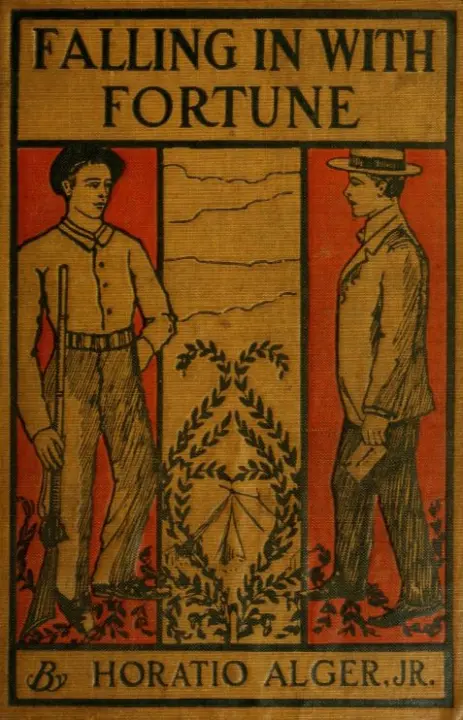
Horatio, Jr. Alger & Edward Stratemeyer
BEHIND THE BOOK
This eBook is for the use of anyone anywhere in the United States and most other parts of the world at no cost and with almost no restrictions whatsoever. You may copy it, give it away or re-use it under the terms of the Project Gutenberg License included with this eBook or online at www.gutenberg.org. If you are not located in the United States, you will have to check the laws of the country where you are located before using this eBook. Read the source licence.
The original source file, including credits and licence, is retained by this library. Request an original-format copy at no charge. Please include the book title and Project Gutenberg identifier #61470.
KEEP YOUR CURIOSITY GOING
Maurice Baring
W. B. (William Butler) Yeats
Edward Martyn

John Brougham & Charlotte Brontë
Marguerite Merington
Leonid Andreyev