THE CLASSIC COLLECTION✦Mercadet: A Comedy in Three ActsCLASSIC FREE BOOKS
Mercadet: A Comedy in Three Acts
Honoré de Balzac
THE CLASSIC COLLECTION · 1856
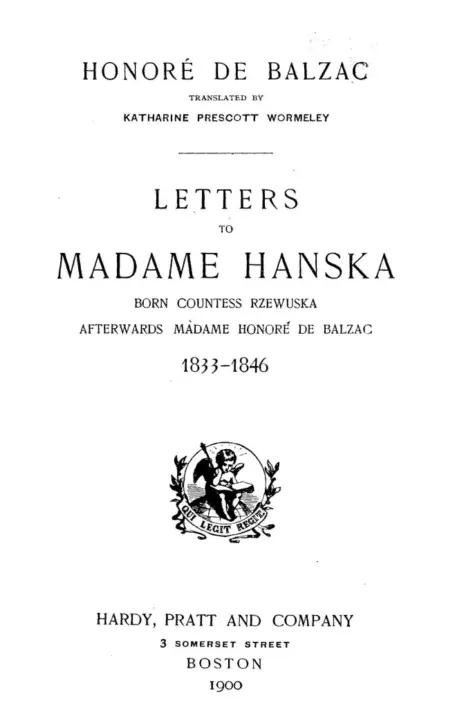
"Letters to Madame Hanska, born Countess Rzewuska, afterwards Madame Honoré de Balzac" by Honoré de Balzac is a collection of correspondence written from 1833 to 1846. It captures the intimate letters between Balzac and Madame Hanska, chronicling the evolution of their relationship, which ultimately led to their marriage. This correspondence provides a glimpse into Balzac's personal life, thoughts, and creative struggles, offering readers profound insights into his character and the emotional landscape he navigated as both a writer and lover. At the start of the collection, Balzac's letters reveal a heartfelt and romantic tone as he communicates with Madame Hanska, whom he refers to as "l'Étrangère." He expresses his admiration and deep emotional connection to her, treating the correspondence as a sanctuary away from the pressures of his literary career and personal challenges. Throughout the opening letters, he shares his artistic ambitions, struggles with debt, and his desire for recognition, while also reflecting on love, solitude, and the constant pursuit of happiness. The beginning sets the stage for their developing relationship, highlighting the intersection of romance and literary passion during a period fraught with turmoil for Balzac himself.
Introduction adapted from the source catalogue; source summaries may be automatically generated.
Free to read · English · 263,326 words · No account needed
MAKE TIME FOR A GOOD BOOK
On by default. Untick to stop anonymous reading totals. Each page counts after 10 seconds in view. How this works.
Anonymous counting is on unless you have switched it off.
I dined, as I told you I should in my last letter, with Nestor Roqueplan, on the last day of the year, at the illustrious Delphine's. We laughed as much as I am capable of laughing without you and far away from you. Delphine is really a queen of conversation; "that evening she was particularly sublime, sparkling, ravishing. Gautier was there also; I came away after a long talk with him; he had been assured there was no hurry about "Richard Cœur-d'Éponge," the theatre having more than enough on hand. Gautier and I may make our play together later. Such was the result of this dinner, the history of which is your due. Returning home, I met two or three bores, who tired me much. You will not believe that, for you seem ignorant that I like to have no one but you, and to see none but you in the world. But, dear countess, the sad thing is, that I cannot write a line, and I groan--
January 5, midnight.
Here is a strange thing! I received this morning your long letter, one day later than that of your daughter; this is a mystery, for both came from Marseille.
Oh! dearest, what a day I have had! atrocious, dreadful, awful! I had errands to do; I was to go to Froment-Meurice, then to M. Gavault, then to a ship-builder who is building a ship he is bent on naming for me, then to the newspaper offices, especially the "Presse." At midday, after breakfast, I went to the post; good! I received a fine thick letter, very heavy; my heart quivered with joy. Ah! I was happy! so happy that in the carriage from Passy to Paris I opened my letter a thousand times blessed, and read, and read! At last I reached the page dictated to you by the strange and inconceivable conduct of Madame A. and Koref; and after having read your crushing reflections I was thrown into consternation. I closed the letter and put it in my pocket. At first, any one might have seen my tears; then I was overcome by a sadness of which the following were the physical effects: Two inches of snow were on the pavements of Paris; I was in thin boots; so unhappy was I that I wanted air, I was choking in the fiacre. I stopped it, and got out in the rue de Rivoli and walked, walked, my feet in the snow, across all Paris, through crowded streets, seeing no one, among the carriages, noticing none of them; I went, I went, on and on, my face convulsed, like a madman. People stared at me. I marched from the rue de Rivoli to the back of the Hôtel de Ville among all those populous streets, not conscious of the crowd or the cold, or of anything. What hour was it? what weather? what season? what city? Where was I? Had any one questioned me I could not have answered him; I was senseless with pain. Sensibility, which is the blood of the soul, was flowing out of me in torrents through my wound. And this is what I was saying to myself: "I have never, in my life, uttered one indiscreet word; and here are the reasons of my silence: 1. honour and integrity; 2. certainty of injuring the object of my hopes; 3. certainty of rendering my liquidation impossible; 4. complete uncertainty as to the result of my wishes. And I am accused of ignoble speeches,--I, whose conduct is irreproachable!" To meet with this injustice, even involuntary, from you crushed me; I felt the blows of that club upon my head at every step. Koref is an infamous spy, an Austrian spy, well known as such; he is not received anywhere; I do not bow to him any longer; I scarcely answer him when he speaks to me. Madame A... is ignorant of this, she confides herself and talks of your interests and of my affairs to the most dangerous man I know! It is truly incredible! Moreover, Koref is allied with a very bad woman, a Madame de B... who spreads slanders, and spies as spies spy, even outside of politics, and merely to keep her hand in. Who knows if those people have not already made this the subject of a report? Who knows if Koref, too well known to be trusted any longer by the Austrian police, has not used Madame A.'s absurd confidences to get into the service of a hyperborean power? Ah! truly, Madame A. may have done us, without exaggeration, an incalculable injury! I, who already have suffered a great pecuniary loss through absurd cancans sent from Berlin, to have such sufferings, thanks to that woman, in addition!
Your reading position is saved on this browser. Take it to another device with a library code. Reading pages adapt to text, rather than matching a printed edition.
Honoré de Balzac
Honoré de Balzac
Honoré de Balzac
Honoré de Balzac
BEHIND THE BOOK
This eBook is for the use of anyone anywhere in the United States and most other parts of the world at no cost and with almost no restrictions whatsoever. You may copy it, give it away or re-use it under the terms of the Project Gutenberg License included with this eBook or online at www.gutenberg.org. If you are not located in the United States, you will have to check the laws of the country where you are located before using this eBook. Read the source licence.
The original source file, including credits and licence, is retained by this library. Request an original-format copy at no charge. Please include the book title and Project Gutenberg identifier #54466.
KEEP YOUR CURIOSITY GOING

David Patterson (Spirit) Hatch

David Patterson (Spirit) Hatch

David Patterson (Spirit) Hatch

Ralph Waldo Emerson

Maurice Baring

Oscar Wilde & James McNeill Whistler