THE CLASSIC COLLECTION✦Mercadet: A Comedy in Three ActsCLASSIC FREE BOOKS
Mercadet: A Comedy in Three Acts
Honoré de Balzac
THE CLASSIC COLLECTION · 1856
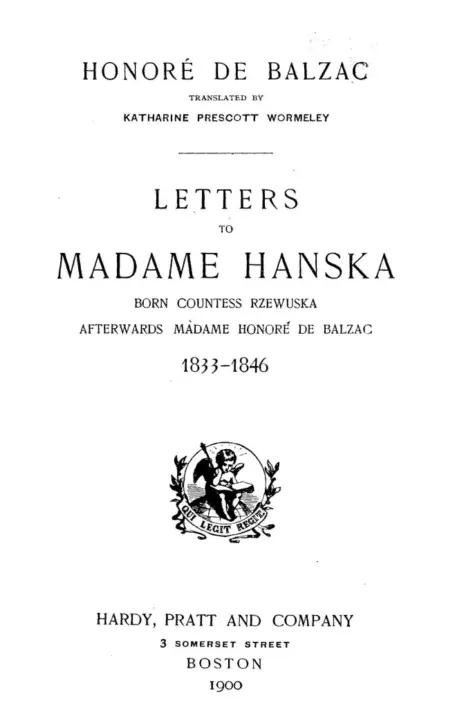
"Letters to Madame Hanska, born Countess Rzewuska, afterwards Madame Honoré de Balzac" by Honoré de Balzac is a collection of correspondence written from 1833 to 1846. It captures the intimate letters between Balzac and Madame Hanska, chronicling the evolution of their relationship, which ultimately led to their marriage. This correspondence provides a glimpse into Balzac's personal life, thoughts, and creative struggles, offering readers profound insights into his character and the emotional landscape he navigated as both a writer and lover. At the start of the collection, Balzac's letters reveal a heartfelt and romantic tone as he communicates with Madame Hanska, whom he refers to as "l'Étrangère." He expresses his admiration and deep emotional connection to her, treating the correspondence as a sanctuary away from the pressures of his literary career and personal challenges. Throughout the opening letters, he shares his artistic ambitions, struggles with debt, and his desire for recognition, while also reflecting on love, solitude, and the constant pursuit of happiness. The beginning sets the stage for their developing relationship, highlighting the intersection of romance and literary passion during a period fraught with turmoil for Balzac himself.
Introduction adapted from the source catalogue; source summaries may be automatically generated.
Free to read · English · 263,326 words · No account needed
MAKE TIME FOR A GOOD BOOK
On by default. Untick to stop anonymous reading totals. Each page counts after 10 seconds in view. How this works.
Anonymous counting is on unless you have switched it off.
CHAILLOT, January 20, 1838.
I am relieved of anxiety. I have your numbers 36 and 37. Number 35 has not reached me, remember that. Number 34 is dated October 6; number 36 December 10. So you did not leave me from October 6 to December 10 without a letter. Now, as I only receive at the end of January the 36 and 37, you can imagine how uneasy I have been, left two months without a word!
These two letters are pricked in every direction, stigmata of the fears inspired by the plague, and perhaps it is to an earlier fumigation that I owe the loss of number 35. In any case, I ought to tell you of this loss, as it explains the doleful letter I wrote you last. To me it was a grief that consumed all others--your silence. I am the object of such atrocious calumnies that I ended by thinking that you had been told of them, and had believed those monstrous things: that I had eaten human flesh, that I had married an Ellsler, or a fishwoman, that I was in prison, that--that--etc. I have, perhaps, enemies in the Ukraine. Distrust all that you hear of me from any but myself, for you have almost a journal of my life.
Now, as to the affair that takes me to the Mediterranean, it is neither marriage nor anything adventurous or silly. It is a serious and scientific affair about which it is impossible to say a word because I am pledged to secrecy. Whether it turns out well or ill, I risk nothing but a journey, which will always be a pleasure or a diversion for me.
You ask me how it is that, knowing all, observing and penetrating all, I can be duped and deceived. Alas! would you like me if I were never duped, if I were so prudent, so observing that no misfortunes ever happened to me? But, leaving the question of the heart aside, I will tell you the secret of this apparent contradiction. When a man becomes such an accomplished whist-player that he knows at the fifth card played where all the others are, do you think he does not like to put science aside and watch how the game will go by the laws of chance? Just so, dear and pious Catholic, God knew in advance that Eve would succumb, and he let her do so! But, putting aside that way of explaining the thing, here is another which you will like better. When, night and day, my strength and my faculties are strained to the utmost to compose, write, render, paint, remember; when I take my flight slowly, painfully, often wounded, across the mental fields of literary creation, how can I be at the same moment on the plane of material things? When Napoleon was at Essling he was not in Spain. Not to be deceived in life, in friendships, in business, in relations of all kinds, dear countess secluded and solitary, one must do nothing else than be purely and simply a financier, a man of the world, a man of business. I do see plainly enough that persons deceive me, and are going to do so, that such a man is betraying me, or will betray me, and depart carrying with him a portion of my fleece. But at that moment when I feel it, foresee it, know it, I am forced to go and fight elsewhere. I see it when I am being carried away by some necessity of a work or event, by a sketch that would be lost if I did not complete it. Often I am building a cot in the light of my burning houses. I have neither friends nor servants; all desert me; I know not why--or rather, I do know it too well; because no one likes or serves a man who works night and day, who does nothing for their profit, who stays where he is and obliges them to go to him, and whose power, if power there be, will have no fruition for twenty years; it is because that man has the personality of his toil, and that all personality is odious if it is not accompanied by power. Now that is enough to convince you that one must be an oyster (do you remember that?) or an angel to cling to such great human rocks. Oysters and angels are equally rare in humanity. Believe me, I see myself and things as they are; never did any man bear a more cruel burden than mine. Do not be surprised, therefore, to see me attach myself to those beings and those things that give me courage to live and go onward. Never blame me for taking the cordial that enables me to get one stage farther on my way.
Your reading position is saved on this browser. Take it to another device with a library code. Reading pages adapt to text, rather than matching a printed edition.
Honoré de Balzac
Honoré de Balzac
Honoré de Balzac
Honoré de Balzac
BEHIND THE BOOK
This eBook is for the use of anyone anywhere in the United States and most other parts of the world at no cost and with almost no restrictions whatsoever. You may copy it, give it away or re-use it under the terms of the Project Gutenberg License included with this eBook or online at www.gutenberg.org. If you are not located in the United States, you will have to check the laws of the country where you are located before using this eBook. Read the source licence.
The original source file, including credits and licence, is retained by this library. Request an original-format copy at no charge. Please include the book title and Project Gutenberg identifier #54466.
KEEP YOUR CURIOSITY GOING

David Patterson (Spirit) Hatch

David Patterson (Spirit) Hatch

David Patterson (Spirit) Hatch

Ralph Waldo Emerson

Maurice Baring

Oscar Wilde & James McNeill Whistler