THE CLASSIC COLLECTION✦Thorns of regretCLASSIC FREE BOOKS
Thorns of regret
Alex. McVeigh, Mrs. Miller
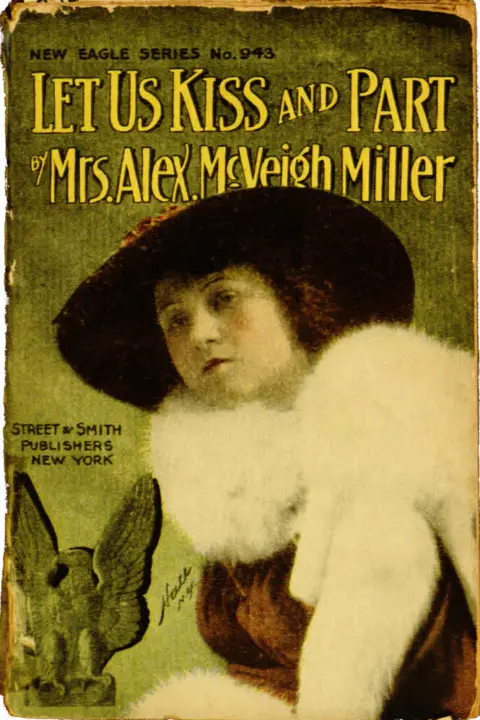
THE CLASSIC COLLECTION · 1897
"Let Us Kiss and Part; or, A Shattered Tie" by Mrs. Alex. McVeigh Miller is a romance novel written in the late 19th century. The story revolves around Leon and Verna Dalrymple, a young couple whose marriage, clouded by pride and the harsh realities of poverty, leads to their bitter separation. Their tumultuous relationship serves as the backdrop for the development of a deeper narrative, which ultimately centers around their daughter, Jessie, as she navigates a world filled with love, loss, and the search for her true identity. At the start of the story, the couple is depicted on the verge of a heartbreaking separation due to escalating tensions fueled by their dire financial situation. Verna, driven by desperation, threatens to return to her wealthy family and seek a divorce, leading to a pivotal moment where both characters feel the weight of their unresolved feelings. The narrative then shifts sixteen years later, introducing Jessie, who is left to fend for herself and her younger brothers after their parents' tragic choices. The opening sections create a rich context of love's complexities, the impacts of societal status, and the themes of longing and familial obligation, setting the stage for Jessie’s future encounters and the entanglements that will define her life.
Introduction adapted from the source catalogue; source summaries may be automatically generated.
Free to read · English · 78,286 words · No account needed
MAKE TIME FOR A GOOD BOOK
On by default. Untick to stop anonymous reading totals. Each page counts after 10 seconds in view. How this works.
Anonymous counting is on unless you have switched it off.
“I fear not. He had a presentiment of death, I believe, for he sent messages as from the dying to his friends in New York,” she sighed.
“Still, I would not give up hope. Many people have been known to survive terrible accidents,” he replied, and she wondered if he was thinking of all that had happened to him and Cora.
She sighed, and began to strum softly on the guitar some one had
offered for her accompaniments.
Then she sang, and the tremor in her voice made it all the sweeter. They hung spellbound on the liquid notes sweet as the nightingale.
“It is another Melba!” they cried in delight, but some were hushed into silence, their very heartstrings stirred by the divine strains.
When she stopped at last, all were clamorous for more, but she pleaded
weariness.
A low voice murmured in her ear:
“Just one more, please--the song you sang for your father the night I
first saw you.”
“I must have sung several,” she replied, and he answered:
“‘Love, I will love you ever!’”
The significant earnestness of the tone and words made her heart throb so quickly that the blood mantled her cheek with crimson. She made no answer, just swept the strings and sang the sweet old song, while his heart kept echoing the tender refrain:
“Love, I will love you ever,
Love, I will leave you never,
Faithful and true,
Ever to me precious to be,
Heart bound to heart,
Never to part,
Love, I will love you ever!”
She paused, and no one ventured to ask her to sing again. They wished to keep the last sweet strain in their hearts.
She turned her face up to the starry sky, and little by little they fell away from her side, comprehending that she preferred to be alone.
Soon no one was left but Laurier, and for some little time he kept silence. It was enough to be near her, to gaze on the lovely face upturned to the moonlit sky, to breathe the same air with her, and to wonder of what she was thinking with that pensive curve on her crimson lips, whether of her dead father, or a possible lover.
He started while a twinge of jealousy tore through his heart like red-hot iron. A lover! Oh, how he hated the thought!
Then another thought came to vex him.
To-morrow they would be parted. She was going out of his life to
unknown friends.
And she had shown no disposition to continue her acquaintance with him
beyond to-morrow.
Could he bear to lose her thus?
Your reading position is saved on this browser. Take it to another device with a library code. Reading pages adapt to text, rather than matching a printed edition.
Alex. McVeigh, Mrs. Miller
Alex. McVeigh, Mrs. Miller

Alex. McVeigh, Mrs. Miller

Alex. McVeigh, Mrs. Miller
BEHIND THE BOOK
This eBook is for the use of anyone anywhere in the United States and most other parts of the world at no cost and with almost no restrictions whatsoever. You may copy it, give it away or re-use it under the terms of the Project Gutenberg License included with this eBook or online at www.gutenberg.org. If you are not located in the United States, you will have to check the laws of the country where you are located before using this eBook. Read the source licence.
The original source file, including credits and licence, is retained by this library. Request an original-format copy at no charge. Please include the book title and Project Gutenberg identifier #66774.
KEEP YOUR CURIOSITY GOING
Coulson Kernahan

Maurice Baring
Frances Wright
Cécile Tormay

Frederic Jesup Stimson

W. H. P. (William Henry Pope) Jarvis