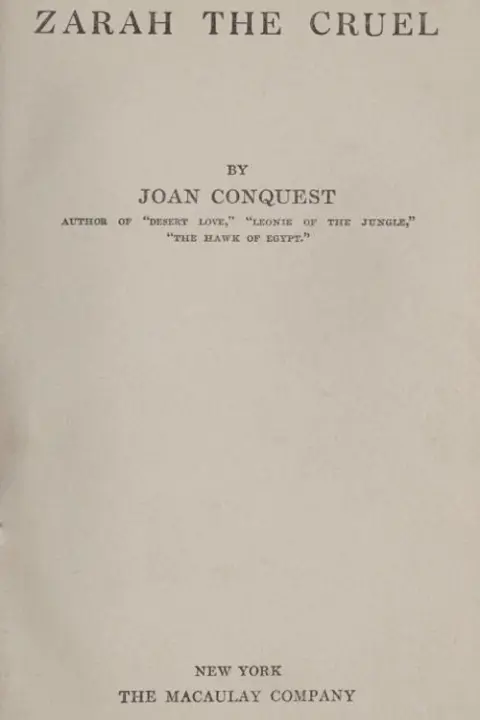
Zarah the Cruel
Joan Conquest
THE CLASSIC COLLECTION · 1921
"Leonie of the Jungle" by Joan Conquest is a novel written in the early 20th century. The story seems to revolve around the experiences of a young girl named Leonie, who exhibits unusual behavior, including sleepwalking and vivid dreams filled with exotic imagery, partly influenced by her Indian heritage. The interactions she has with adults and her delicate emotional state suggest underlying themes of childhood innocence, trauma, and the complexities of growing up. The opening of the novel introduces us to Leonie, a sensitive and imaginative seven-year-old girl who is upset over the death of her kitten. We see her communicate with the adults around her, particularly Sir Jonathan Cuxson, a brain specialist who appears to have a compassionate but firm demeanor. Throughout her interactions, Leonie's grief manifests in her imaginative tales of dreams that include tigers and a mysterious black woman. Her aunt, Lady Hetth, seems overwhelmed and anxious about Leonie's peculiarities, revealing both concern for her niece's well-being and her struggle with social expectations. The narrative hints at deeper issues related to Leonie's psyche and sets the stage for her emotional journey, underlining a stark contrast between the whimsical innocence of childhood and the more complex adult world surrounding her.
Introduction adapted from the source catalogue; source summaries may be automatically generated.
Free to read · English · 84,790 words · No account needed
MAKE TIME FOR A GOOD BOOK
On by default. Untick to stop anonymous reading totals. Each page counts after 10 seconds in view. How this works.
Anonymous counting is on unless you have switched it off.
When Leonie returned to Calcutta she found that the tale of her courageous act which had preceded her, and of which home and local papers had exhausted themselves in praise, had not served to endear her to that little white community, which suffers from social myopia, and the self-adjusted chains of what it most mistakenly calls caste.
Not likely that the feminine members of Jute, military, railway, or law circles would open their arms any wider to this young, and beautiful, widowed creature with the mop of naturally curling hair, now that, if so minded, she could verbally and positively flap one of the finest tiger skins that had ever come out of Bengal in their heat-stricken faces.
In fact some of the young ones as they wrestled with the nightly problem of their own dank, straight particular bit of woman's glory, would doubtless, if questioned, have upheld the Hindu custom of completely shaving the widowed head.
Many, in fact, had been the meetings of these younger mem-sahibs in bungalows, or flats, at Firpoes, or in clubs, where, under the pretext of criticising the latest fashions from overseas, they discussed the pros and cons of accepting this person into the haven of their Anglo-Indian bosom.
The elder ones kept out of the clatter, having suffered and fought in similar crises in their own day as had their mothers, and their mothers' mothers before them since the days before the mutiny; being moreover resigned to the corrugated appearance of their faces, and the, in consequence, perambulatory instincts of their lords.
"Her undies," said a woman who, with the excuse of borrowing a book, had essayed to spy out the land of Leonie's cabin. "I saw her running ribbons in them--the most ex-quisite crepe de Chine, hand embroidered and trimmed with real lace!"
"How de trop!" had answered a matron, whose household linge and personal lingerie showed complete only in the sections of finger napkins and undervests, as is the way of a careless, untidy woman's linen stock.
"Well, that's easily understood," chimed in a third. "After all she
is trade."
And the no's had carried it.
Wherefore, although in ignorance of the verdict, she did exactly what every other woman did, and went where they went, she most certainly did not have what one would call a good time. She loved the Maidan and golf at the Jodhpur Club, or Tollygunge, before breakfast; she cordially loathed shopping and duty calls; grudged the hours lost out of life in the daily afternoon siesta, and took part in dances, bridge, dinners, and all the usual monotonous effort to kill time, with the air of an indifferent, disgruntled statue.
Your reading position is saved on this browser. Take it to another device with a library code. Reading pages adapt to text, rather than matching a printed edition.
BEHIND THE BOOK
This eBook is for the use of anyone anywhere in the United States and most other parts of the world at no cost and with almost no restrictions whatsoever. You may copy it, give it away or re-use it under the terms of the Project Gutenberg License included with this eBook or online at www.gutenberg.org. If you are not located in the United States, you will have to check the laws of the country where you are located before using this eBook. Read the source licence.
The original source file, including credits and licence, is retained by this library. Request an original-format copy at no charge. Please include the book title and Project Gutenberg identifier #15841.
KEEP YOUR CURIOSITY GOING
Coulson Kernahan

Maurice Baring
Frances Wright
Cécile Tormay
Francis Greenleaf Allinson & Anne C. E. (Anne Crosby Emery) Allinson

Frederic Jesup Stimson