THE CLASSIC COLLECTION✦The school and societyCLASSIC FREE BOOKS
The school and society
John Dewey
THE CLASSIC COLLECTION · 1888
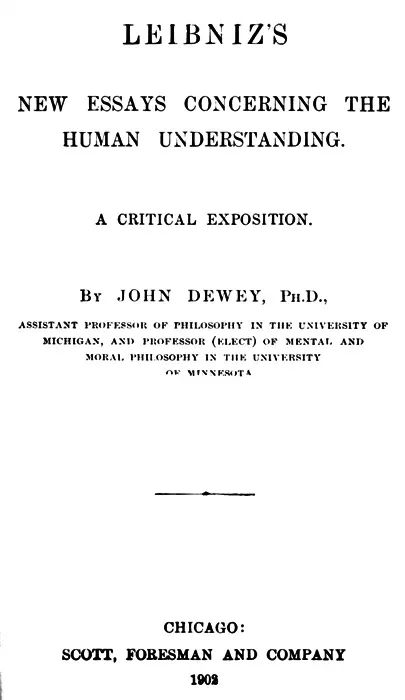
"Leibniz's New Essays Concerning the Human Understanding: A Critical Exposition" by John Dewey is a philosophical treatise written in the late 19th century. This work critically explores the ideas of Gottfried Wilhelm Leibniz, particularly focusing on his perspectives in "Nouveaux Essais" and examining the foundations of human understanding through rationalist philosophy. The text aims to connect Leibniz's thoughts with contemporary philosophical discussions while highlighting the significance of his ideas in the evolution of modern thought. The opening of the work provides a biographical sketch of Leibniz, illustrating the formative experiences that shaped his philosophical pursuits. Dewey discusses Leibniz's early education and intellectual development, emphasizing the influences of his family, mentors, and significant encounters with contemporary thinkers. The narrative weaves through Leibniz’s academic journey, highlighting his ventures into multiple disciplines, including law, mathematics, and philosophy, as a quest for a harmonious understanding of the universe, which foreshadows his later philosophical contributions. This exposition serves as a foundation for a deeper exploration of Leibniz's thought and its lasting impact on philosophy and science.
Introduction adapted from the source catalogue; source summaries may be automatically generated.
Free to read · English · 69,829 words · No account needed
MAKE TIME FOR A GOOD BOOK
On by default. Untick to stop anonymous reading totals. Each page counts after 10 seconds in view. How this works.
Anonymous counting is on unless you have switched it off.
So much for Leibniz's polemic. Its meaning is that space and time have significance only with reference to things and events, that they are the intellectual, the ideal side of these objects and occurrences, being the relations which give them order and unity. A space which is not the space of objects, which is not space in and through objects, is an inanity; it is not spirit, it is not matter; it is not a relation of either. It is nothingness magnified to infinity, and then erected into existence. And all for nothing; for it does not enable us to account for a single concrete fact of experience. For this we must have recourse to relations and orders of existence. Space is therefore to be defined as the order which makes it possible for objects to have situation; time as that which makes it possible for events to have dating,--not as if they were actually prior to them, and although nothings in themselves, yet capable of giving concrete determination to things, but as actually the relations themselves, and as ideally necessary for the coherent experience of co-existent objects and of connected events. As Leibniz puts it epigrammatically: "Space is the order of possible constants; time the order of inconstant possibilities."
We have finished the exposition of the views of Leibniz about matter and material facts. One question, however, remains to be discussed,--a question which Leibniz's contemporary critics would not allow him to pass over in silence, even had he been so disposed. What is the reality of matter, of motion, of space, and of time? Since they are, as Leibniz says, only phenomena, not absolute realities, what distinguishes them from dreams, from illusions? What distinguishes sensible phenomena from capricious fantasies, and gives them reality?
Leibniz begins his answer by pointing out that the mere fact that bodies are phenomena does not make them unreal. To say that anything is phenomenal is to say that it is sensible; but "the senses make no declaration regarding metaphysical matters" such as truth and reality. The senses, in a word, only inform us that the experiences are there for the senses, that they are sensible. What is the ultimate nature of the sensible or the phenomenal, what is their reality, is a question wholly outside the province of sense. The questions of ultimate nature, of reality, are questions of metaphysics, and hence are to be decided by the reason, not by the senses. And Leibniz goes on to say that the truthfulness of the senses, since it concerns only the sensible, consists in the reciprocal agreement of sensible facts, and in that we are not deceived in reasoning from one to another. An isolated sense-experience could not be said to be either true or false, real or illusory. It would be true that it was experienced, and that is all that could be said about it. But since our experiences are not thus separated, but have a certain order, there arises what we may call sensible reality and illusion. When the order between two facts remains the same "in different times and places and in the experience of different men," we call these facts real. If, however, our experience cannot be repeated by ourselves or by other men when the same conditions (that is, connections) are present, it is unreal, or false. It is thus "the relation of phenomena which guarantees truth of fact regarding sensible objects." Constancy, regularity, justify us in ascribing reality; chaotic change and lack of orderly connection are a sign of unreality. Even our dreams have a reality; for they have their connections and place in experience. If we understood their connections we should even be able to explain their apparent lack of connection with the rest of experience. Leibniz thinks that both the Academicians and Sceptics and their opponents erred in attempting to find greater reality in sensible things than that of regular phenomena. Since our observations and judgments upon sensible phenomena are of such a nature that we can predict future phenomena and prepare for them, we have all the reality in them that can be had or asked for. Even if it be granted possible (as it must be on this basis) that, metaphysically speaking, sense-experience is only a connected dream, it yet has a sufficient reality; for we are not deceived in the measures taken with reference to phenomena, provided that we act on the ground of their observed harmonies and relations. Thus while we are obliged to admit that our senses inform us that there are hard, passive, extended, indivisible things, not perfectly continuous and not intellectual in their nature, and we know on metaphysical grounds that this information is not correct, we cannot say that our senses deceive us, for sense makes no statements regarding such matters. It is our reason that errs if it takes the information that the senses give as if it were a declaration of reason itself. Sensible things have all the reality necessary for this range of experience,--practical,--such regularity of co-existence and sequence as allows us to act without being led astray.
Your reading position is saved on this browser. Take it to another device with a library code. Reading pages adapt to text, rather than matching a printed edition.
John Dewey
John Dewey
John Dewey
John Dewey
BEHIND THE BOOK
This eBook is for the use of anyone anywhere in the United States and most other parts of the world at no cost and with almost no restrictions whatsoever. You may copy it, give it away or re-use it under the terms of the Project Gutenberg License included with this eBook or online at www.gutenberg.org. If you are not located in the United States, you will have to check the laws of the country where you are located before using this eBook. Read the source licence.
The original source file, including credits and licence, is retained by this library. Request an original-format copy at no charge. Please include the book title and Project Gutenberg identifier #40957.
KEEP YOUR CURIOSITY GOING

David Patterson (Spirit) Hatch
Coulson Kernahan

Ralph Waldo Emerson
Frances Wright

Edwin Abbott Abbott

Joseph Droz