THE CLASSIC COLLECTION✦The school and societyCLASSIC FREE BOOKS
The school and society
John Dewey
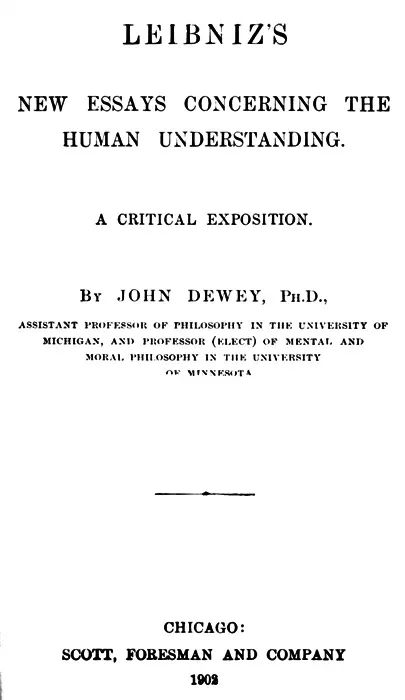
THE CLASSIC COLLECTION · 1888
"Leibniz's New Essays Concerning the Human Understanding: A Critical Exposition" by John Dewey is a philosophical treatise written in the late 19th century. This work critically explores the ideas of Gottfried Wilhelm Leibniz, particularly focusing on his perspectives in "Nouveaux Essais" and examining the foundations of human understanding through rationalist philosophy. The text aims to connect Leibniz's thoughts with contemporary philosophical discussions while highlighting the significance of his ideas in the evolution of modern thought. The opening of the work provides a biographical sketch of Leibniz, illustrating the formative experiences that shaped his philosophical pursuits. Dewey discusses Leibniz's early education and intellectual development, emphasizing the influences of his family, mentors, and significant encounters with contemporary thinkers. The narrative weaves through Leibniz’s academic journey, highlighting his ventures into multiple disciplines, including law, mathematics, and philosophy, as a quest for a harmonious understanding of the universe, which foreshadows his later philosophical contributions. This exposition serves as a foundation for a deeper exploration of Leibniz's thought and its lasting impact on philosophy and science.
Introduction adapted from the source catalogue; source summaries may be automatically generated.
Free to read · English · 69,829 words · No account needed
MAKE TIME FOR A GOOD BOOK
On by default. Untick to stop anonymous reading totals. Each page counts after 10 seconds in view. How this works.
Anonymous counting is on unless you have switched it off.
What is true of all men is true of philosophers, and of Leibniz among them. Speaking generally, what they are unconsciously and fundamentally, they are through absorption of their antecedents and surroundings. What they are consciously and reflectively, they are through their reaction upon the influence of heredity and environment. But there is a spiritual line of descent and a spiritual atmosphere; and in speaking of a philosopher, it is with this intellectual heredity and environment, rather than with the physical, that we are concerned. Leibniz was born into a period of intellectual activity the most teeming with ideas, the most fruitful in results, of any, perhaps, since the age of Pericles. We pride ourselves justly upon the activity of our own century, and in diffusion of intellectual action and wide-spread application of ideas the age of Leibniz could not compare with it. But ours is the age of diffusion and application, while his was one of fermentation and birth.
Such a period in its earlier days is apt to be turbid and unsettled. There is more heat of friction than calm light. And such had been the case in the hundred years before Leibniz. But when he arrived at intellectual maturity much of the crudity had disappeared. The troubling of the waters of thought had ceased; they were becoming clarified. Bacon, Hobbes, Descartes, each had crystallized something out of that seething and chaotic mass of new ideas which had forced itself into European consciousness. Men had been introduced into a new world, and the natural result had been feelings of strangeness, and the vagaries of intellectual wanderings. But by the day of Leibniz the intellectual bearings had been made out anew, the new mental orientation had been secured.
The marks of this "new spiritual picture of the universe" are everywhere to be seen in Leibniz. His philosophy is the dawning consciousness of the modern world. In it we see the very conception and birth of the modern interpretation of the world. The history of thought is one continuous testimony to the ease with which we become hardened to ideas through custom. Ideas are constantly precipitating themselves out of the realm of ideas into that of ways of thinking and of viewing the universe. The problem of one century is the axiom of another. What one generation stakes its activity upon investigating is quietly taken for granted by the next. And so the highest reach of intellectual inspiration in the sixteenth century is to-day the ordinary food of thought, accepted without an inquiry as to its source, and almost without a suspicion that it has a recent historic origin. We have to go to Bacon or to Leibniz to see the genesis and growth of those ideas which to-day have become materialized into axiomatic points of view and into hard-and-fast categories of thought. In reading Leibniz the idea comes over us in all its freshness that there was a time when it was a discovery that the world is a universe, made after one plan and of one stuff. The ideas of inter-relation, of the harmony of law, of mutual dependence and correspondence, were not always the assumed starting-points of thought; they were once the crowning discoveries of a philosophy aglow and almost intoxicated with the splendor of its far-reaching generalizations. I take these examples of the unity of the world, the continuity and interdependence of all within it, because these are the ideas which come to their conscious and delighted birth in the philosophy of Leibniz. We do not put ourselves into the right attitude for understanding his thought until we remember that these ideas--the commonest tools of our thinking--were once new and fresh, and in their novelty and transforming strangeness were the products of a philosophic interpretation of experience. Except in that later contemporary of Leibniz, the young and enthusiastic Irish idealist, Berkeley, I know of no historic thinker in whom the birth-throes (joyous, however) of a new conception of the world are so evident as in Leibniz. But while in Berkeley what we see is the young man carried away and astounded by the grandeur and simplicity of a "new way of ideas" which he has discovered, what we see in Leibniz is the mature man penetrated throughout his being with an idea which in its unity answers to the unity of the world, and which in its complexity answers, tone to tone, to the complex harmony of the world.
Your reading position is saved on this browser. Take it to another device with a library code. Reading pages adapt to text, rather than matching a printed edition.
John Dewey
John Dewey
John Dewey
John Dewey
BEHIND THE BOOK
This eBook is for the use of anyone anywhere in the United States and most other parts of the world at no cost and with almost no restrictions whatsoever. You may copy it, give it away or re-use it under the terms of the Project Gutenberg License included with this eBook or online at www.gutenberg.org. If you are not located in the United States, you will have to check the laws of the country where you are located before using this eBook. Read the source licence.
The original source file, including credits and licence, is retained by this library. Request an original-format copy at no charge. Please include the book title and Project Gutenberg identifier #40957.
KEEP YOUR CURIOSITY GOING

David Patterson (Spirit) Hatch
Coulson Kernahan

Ralph Waldo Emerson
Frances Wright

Edwin Abbott Abbott

Joseph Droz