THE CLASSIC COLLECTION✦The school and societyCLASSIC FREE BOOKS
The school and society
John Dewey
THE CLASSIC COLLECTION · 1888
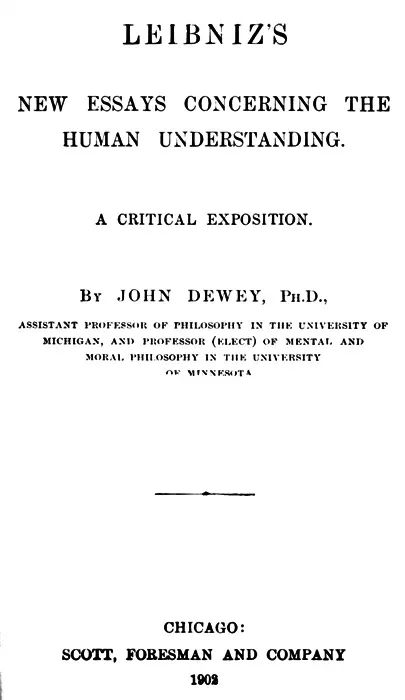
"Leibniz's New Essays Concerning the Human Understanding: A Critical Exposition" by John Dewey is a philosophical treatise written in the late 19th century. This work critically explores the ideas of Gottfried Wilhelm Leibniz, particularly focusing on his perspectives in "Nouveaux Essais" and examining the foundations of human understanding through rationalist philosophy. The text aims to connect Leibniz's thoughts with contemporary philosophical discussions while highlighting the significance of his ideas in the evolution of modern thought. The opening of the work provides a biographical sketch of Leibniz, illustrating the formative experiences that shaped his philosophical pursuits. Dewey discusses Leibniz's early education and intellectual development, emphasizing the influences of his family, mentors, and significant encounters with contemporary thinkers. The narrative weaves through Leibniz’s academic journey, highlighting his ventures into multiple disciplines, including law, mathematics, and philosophy, as a quest for a harmonious understanding of the universe, which foreshadows his later philosophical contributions. This exposition serves as a foundation for a deeper exploration of Leibniz's thought and its lasting impact on philosophy and science.
Introduction adapted from the source catalogue; source summaries may be automatically generated.
Free to read · English · 69,829 words · No account needed
MAKE TIME FOR A GOOD BOOK
On by default. Untick to stop anonymous reading totals. Each page counts after 10 seconds in view. How this works.
Anonymous counting is on unless you have switched it off.
We are thus introduced, from a new point of view and in a more concrete way, to the conception of pre-established harmony. The activity of one, the energy which gives the law to the other and makes it subordinate in the hierarchy of monads, is conceived necessarily as spirit, as soul; that which receives, which is rendered subordinate by the activity of the other, is body. The pre-established harmony is the fact that they are so related that one can receive the law of its activity from the other. Leibniz is without doubt partially responsible for the ordinary misconception of his views upon this point by reason of the illustration which he was accustomed to use; namely, of two clocks so constructed that without any subsequent regulation each always kept perfect time with the other,--as much so as if there were some actual physical connection between them. This seems to put soul and body, spirit and matter, as two co-ordinate substances, on the same level, with such natural opposition between them that some external harmony must arrange some unity of action. In causing this common idea of his theory of pre-established harmony, Leibniz has paid the penalty for attempting to do what he often reproves in others,--imagining or presenting in sensible form what can only be thought. But his other explanations show clearly enough that the pre-established harmony expresses, not a relation between two parallel substances, but a condition of dependence of lower forms of activity upon the higher for the law of their existence and activity,--in modern terms, it expresses the fact that phenomena are conditioned upon noumena; that material facts get their significance and share of reality through their relation to spirit.
We may sum up what has been said about matter as an element in the monad, or as a metaphysical principle, as follows: The existence of matter is not only not opposed to the fundamental ideas of Leibniz, but is a necessary deduction from them. It is a necessity of the principle of continuity; for this requires an infinity of monads, alike indeed in the universal law of their being, but unlike, each to each, in the specific coloring or manifestation of this law. The principle of organic unity requires that there be as many real beings as possible participating in and contributing to it. It is necessary, again, in order that there may be reciprocal influence or connection among the monads. Were it not for the material element in the monad, each would be a God; if each were thus infinite and absolute, there would be so many principles wholly independent and isolated. The principle of harmony would be violated. So much for the necessity of the material factor. As to its nature, it is a principle of passivity; that is, of ideal receptivity, of conformity to a law apparently not self-imposed, but externally laid down. This makes matter equivalent to a phenomenon; that is to say, to the having of confused, imperfect, inadequate ideas. To say that matter is correlative to confused ideas is to say that there is no recognition of its relation to self or to spirit. As Leibniz sometimes puts it, since there is an infinity of beings in the universe, each one of which exercises an ideal influence upon every other one of the series, it is impossible that this other one should realize their full meaning; they appear only as confused ideas, or as matter. To use language which Leibniz indeed does not employ, but which seems to convey his thought, the spirit, not seeing them as they really are, does not find itself in them. But matter is thus not only the confused manifestation or phenomenon of spirit, it is also its potentiality. Passivity is always relative. It does not mean complete lack of activity; that, as Leibniz says, is nothingness, and matter is not a form of nothingness. Leibniz even speaks of it as passive power. That is to say, there is an undeveloped or incomplete activity in what appears as matter, and this may be,--if we admit an infinity of time,--must be developed. When developed it manifests itself as it really is, as spirit. Confused ideas, as Leibniz takes pains to state, are not a genus of ideas antithetical to distinct; they differ only in degree or grade. They are on their way to become distinct, or else they are distinct ideas which have fallen back into an "involved" state of being. Matter, therefore, is not absolutely opposed to spirit,--on the one hand because it is the manifestation, the phenomenon, of spirit; on the other, because it is the potentiality of spirit, capable of sometime realizing the whole activity implied in it, but now latent.
Your reading position is saved on this browser. Take it to another device with a library code. Reading pages adapt to text, rather than matching a printed edition.
John Dewey
John Dewey
John Dewey
John Dewey
BEHIND THE BOOK
This eBook is for the use of anyone anywhere in the United States and most other parts of the world at no cost and with almost no restrictions whatsoever. You may copy it, give it away or re-use it under the terms of the Project Gutenberg License included with this eBook or online at www.gutenberg.org. If you are not located in the United States, you will have to check the laws of the country where you are located before using this eBook. Read the source licence.
The original source file, including credits and licence, is retained by this library. Request an original-format copy at no charge. Please include the book title and Project Gutenberg identifier #40957.
KEEP YOUR CURIOSITY GOING

David Patterson (Spirit) Hatch
Coulson Kernahan

Ralph Waldo Emerson
Frances Wright

Edwin Abbott Abbott

Joseph Droz