THE CLASSIC COLLECTION✦Frank Merriwell’s dangerCLASSIC FREE BOOKS
Frank Merriwell’s danger
Burt L. Standish
THE CLASSIC COLLECTION · 1914
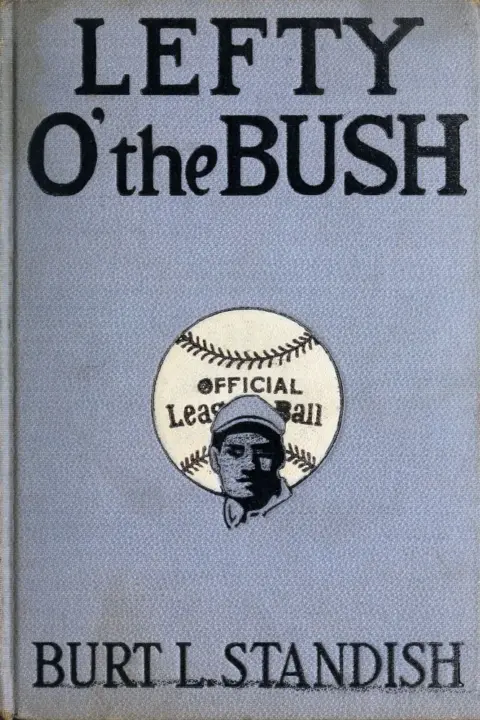
"Lefty o' the Training Camp" by Burt L. Standish is a sports novel written in the early 20th century. It follows star southpaw Lefty Locke through spring training as he helps rebuild a Big League club, scouts a promising young pitcher, and clashes with a volatile rival whose behavior hints at deeper intrigue. Baseball action mixes with questions of character, loyalty, and team chemistry, centering on Lefty, manager Jack Kennedy, the hotheaded Nelson Savage, and newcomer Gene Temple.
The opening of the story sets off with a heated train-car debate where Lefty defends organized baseball against a loudmouthed critic who proves to be bush-league pitcher Nelson Savage; tempers flare until a conductor cools things down. Summoned to his manager’s farm, Lefty learns the team’s captain is ill, forcing urgent roster moves; he recommends young Gene Temple to shore up the pitching staff while Kennedy bets on the talented but unstable Savage. In New Jersey, Lefty secures Temple’s rights, glimpses Savage acting suspiciously in a nearby house, then meets Temple—who denies knowing Savage—before a puzzling station encounter shows Savage suddenly contrite and likable. At the Southern training camp, Kennedy vows to keep Savage sober, but Savage turns surly and threatening; Lefty later hears Savage and (he believes) Temple talking secretly in the dark, only to find Temple apparently elsewhere and an old teammate arriving with a tipsy Savage—leaving Lefty unsure who’s telling the truth and what game is being played.
Introduction adapted from the source catalogue; source summaries may be automatically generated.
Free to read · English · 59,624 words · No account needed
MAKE TIME FOR A GOOD BOOK
On by default. Untick to stop anonymous reading totals. Each page counts after 10 seconds in view. How this works.
Anonymous counting is on unless you have switched it off.
“That’s the game!” cried McCormick, the visiting captain. “Get into it, Rick. Here’s where we pull in a little old run or two. On your toes, Irish.”
It was an excellent opportunity for a squeeze play, and as Allaire hurried to the plate the infielders closed in, ready to go after the ball the instant it was dumped into the diamond.
Savage, evidently believing that the squeeze would be attempted, handed up a shoot, high and close. Allaire made a foul, and Olds was fully halfway down the line before he could pull himself up and turn back to the sack.
Returning to third, Olds edged off toward the plate, knees bent, every
muscle tense.
Savage flashed a glance at him, then got into position to pitch. He did not start to deliver the ball, however, but, suddenly stepping toward third, whipped it to Palsifer.
Three times Savage drove Olds back to the cushion, but when again he pitched, the runner stretched his legs for the plate. Unfortunately for him, Allaire simply popped a little fly into the pitcher’s hands, and Savage, taking his time, threw it to third for a double.
The abrupt termination of the inning brought a grim smile to the lips of Jack Kennedy, who, resting on one knee, with arms doubled under his chest in a characteristic attitude, had been watching the progress of the game. To him the result of the contest was of no importance whatever. It was simply an opportunity to size up his players. Savage had done nothing extraordinary, but he had kept his head and used it, and that satisfied the manager for the present.
Buck Liddell, the slender, wiry, rather handsome pitcher for the Tigers, bore himself in a confident manner, with just a trace of self-consciousness. His wavy blond hair, worn rather long, had a way of trailing down now and then over his forehead, to be tossed back by a jerk of his head, or swept aside with a quick movement of his hand.
“Reckon he’s some bear with the Atlanta dames,” chuckled Joe Welsh, as he stepped to the plate.
“Regular matinée idol,” agreed Kid Lewis, swinging a couple of bats.
Liddell nonchalantly sent a couple of sizzlers across to the first baseman while the catcher was adjusting his mask and wind pad. They fairly smoked, denoting that he had speed, at least. A moment later he toed the slab, swung his arm in a wide sweep, balanced himself on one foot for an instant, and shot over one which Welsh missed by inches.
Your reading position is saved on this browser. Take it to another device with a library code. Reading pages adapt to text, rather than matching a printed edition.
Burt L. Standish

Burt L. Standish

Burt L. Standish
Burt L. Standish
BEHIND THE BOOK
This eBook is for the use of anyone anywhere in the United States and most other parts of the world at no cost and with almost no restrictions whatsoever. You may copy it, give it away or re-use it under the terms of the Project Gutenberg License included with this eBook or online at www.gutenberg.org. If you are not located in the United States, you will have to check the laws of the country where you are located before using this eBook. Read the source licence.
The original source file, including credits and licence, is retained by this library. Request an original-format copy at no charge. Please include the book title and Project Gutenberg identifier #77754.
KEEP YOUR CURIOSITY GOING
Coulson Kernahan

Maurice Baring
Frances Wright
Cécile Tormay

Frederic Jesup Stimson

W. H. P. (William Henry Pope) Jarvis