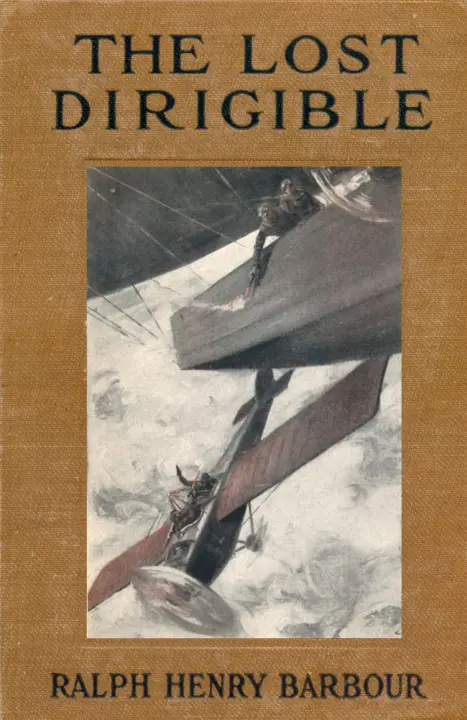
The lost dirigible
Ralph Henry Barbour
THE CLASSIC COLLECTION · 1915
"Left Tackle Thayer" by Ralph Henry Barbour is a young adult novel written during the early 20th century. Set in a prep school environment, the story revolves around the character Clinton Boyd Thayer, a Southern boy who navigates the challenges of fitting into a new school while also striving to make a name for himself in football. The narrative explores themes of friendship, adaptation, and the spirit of competition. The opening of "Left Tackle Thayer" introduces us to Clint, who has just arrived at Brimfield Academy, feeling lonesome and homesick despite the beauty of his surroundings. As he sits in the grandstand watching the athletic field, he is approached by Amory "Amy" Byrd, a colorful and exuberant fellow student who quickly befriends Clint. Their lively conversation brings humor to the narrative as Amy offers insights into the school life and the prospect of football. Throughout the chapter, we see Clint's initial struggles with feeling out of place while also getting a glimpse into the potential for camaraderie and adventure that awaits him at Brimfield.
Introduction adapted from the source catalogue; source summaries may be automatically generated.
Free to read · English · 65,846 words · No account needed
MAKE TIME FOR A GOOD BOOK
On by default. Untick to stop anonymous reading totals. Each page counts after 10 seconds in view. How this works.
Anonymous counting is on unless you have switched it off.
"What's that awful noise?" asked Clint startledly, looking up from his
book.
It was the evening of the second day of school and Clint and Amy Byrd were preparing lessons at opposite sides of the green-topped table in Number 14 Torrence.
"That," replied Amy, leaning back until his chair protested and viewing his room-mate under the shade of the drop-light, "is music."
"Music!" Clint listened incredulously. From the next room, by way of opened windows and transoms, came the most lugubrious wails he thought he had ever listened to. "It--it's a fiddle, isn't it?" he demanded.
Amy nodded. "More respectfully, a violin. More correctly a viol-din. (The joke is not new.) What you are listening to with such evident delight are the sweet strains of Penny Durkin's violin." Amy looked at the alarm clock which decorated a corner of his chiffonier. "Penny is twelve minutes ahead of time. He's not supposed to play during study-hour, you see, and unless I'm much mistaken he will be so informed before the night is much--"
"Hey, Penny! Cut it out, old top!"
From somewhere down the corridor the anguished wail floated, followed an instant later by sounds counterfeiting the howling of an unhappy dog. Threats and pleas mingled.
"Penny! For the love of Mike!"
"Set your watch back, Penny!"
"Shut up, you idiot! Study's not over!"
"Call an officer, please!"
But Pennington Durkin was making too much noise on his instrument to hear the remonstrances at first, and it was not until some impatient neighbour sallied forth and pounded frantically at the portal of Number 13 that the wailing ceased. Then,
"What is it?" asked Durkin mildly.
"It's only ten minutes to nine, Penny. Your clock's fast again. Shut up
or we'll kill you!"
"Oh!" said Penny surprisedly. "Are you sure? I set my watch--"
"Oh, forget it! You say that every night," was the wearied response. "How the dickens do you think anyone's going to study with that noise going on?"
"I'm very sorry, really," responded Penny, "If I'd known--"
"You never do know, Penny!" The youth outside strode back to his room and slammed the door and quiet prevailed once more. Amy smiled.
"Poor Penny," he said. "He suffers much in the cause of Art. I refuse to study any more. Close up shop, Clint, and let's talk. Now that you've been with us a whole day, what do you think of us? Do you approve of this institution of learning, old man?"
"I think I'm going to like it," replied Clint soberly.
"I do hope so," murmured Amy anxiously. "Still, any little changes you'd
like made--"
Your reading position is saved on this browser. Take it to another device with a library code. Reading pages adapt to text, rather than matching a printed edition.
Ralph Henry Barbour
Ralph Henry Barbour
Ralph Henry Barbour
Ralph Henry Barbour
BEHIND THE BOOK
This eBook is for the use of anyone anywhere in the United States and most other parts of the world at no cost and with almost no restrictions whatsoever. You may copy it, give it away or re-use it under the terms of the Project Gutenberg License included with this eBook or online at www.gutenberg.org. If you are not located in the United States, you will have to check the laws of the country where you are located before using this eBook. Read the source licence.
The original source file, including credits and licence, is retained by this library. Request an original-format copy at no charge. Please include the book title and Project Gutenberg identifier #13542.
KEEP YOUR CURIOSITY GOING
Coulson Kernahan

Maurice Baring
Frances Wright
Cécile Tormay

Frederic Jesup Stimson

W. H. P. (William Henry Pope) Jarvis