
Last letters from the living dead man
David Patterson (Spirit) Hatch
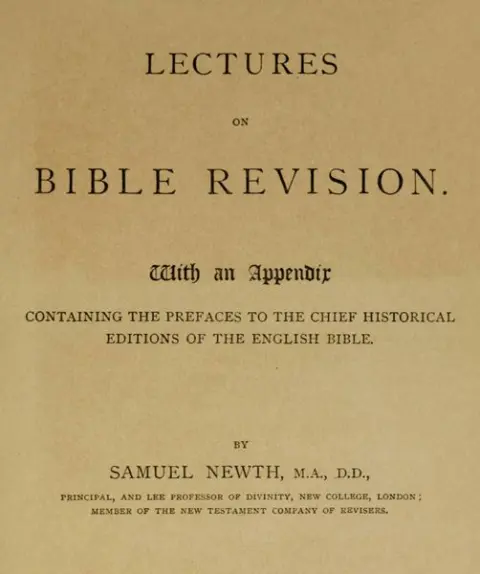
THE CLASSIC COLLECTION · 1881
"Lectures on Bible Revision" by Samuel Newth is a scholarly examination written in the late 19th century. The text focuses on the significance of biblical revisions, particularly the need for an updated understanding of the English Bible in light of historical and linguistic changes. It serves as a resource for Sunday-school and Bible-class teachers to navigate the complexities of these revisions and engage thoughtfully with their communities. The opening of the work introduces the author's aim to clarify the distinctions between the substance and form of Scripture, urging readers to acknowledge that while the truths contained in the Bible are eternal, the language and translations are subject to change. Newth emphasizes that reverence for the Scriptures should focus on the underlying truths rather than the specific wording, which has evolved over time. He reflects on historical translations and revisions, illustrating how the English Bible has transformed through various interpreters and linguistic shifts, underscoring the necessity of ongoing revision to maintain its relevance and accuracy for contemporary readers.
Introduction adapted from the source catalogue; source summaries may be automatically generated.
Free to read · English · 79,829 words · No account needed
MAKE TIME FOR A GOOD BOOK
On by default. Untick to stop anonymous reading totals. Each page counts after 10 seconds in view. How this works.
Anonymous counting is on unless you have switched it off.
2. “To limit as far as possible the expression of such alterations to the language of the Authorized and earlier English versions.”
3. “Each Company to go twice over the portion to be revised, once provisionally, the second time finally, and on principles of voting as hereinafter is provided.”
4. “That the Text to be adopted be that for which the evidence is decidedly preponderating; and that when the Text so adopted differs from that from which the Authorized Version was made, the alteration be indicated in the margin.”
5. “To make or retain no change in the Text on the second and final revision by each Company, except two-thirds of those present approve of the same, but on the first revision to decide by simple majorities.”
6. “In every case of proposed alteration that may have given rise to discussion, to defer the voting thereupon till the next Meeting, whensoever the same shall be required by one-third of those present at the Meeting, such intended vote to be announced in the notice for the next Meeting.”
7. “To revise the headings of chapters, pages, paragraphs, italics,
and punctuation.”
8. “To refer on the part of each Company, when considered desirable, to Divines, Scholars, and Literary Men, whether at home or abroad, for their opinions.”
To these it was added, that the work of each Company be communicated to the other as it is completed, in order that there may be as little deviation from uniformity in language as possible.
Of the Scholars invited to join the Companies four[107] declined for various reasons, and one[108] was prevented by illness from taking part in the work. The two Companies when formed consisted of the following Members.
Dr. W. L. Alexander, Professor of Theology in the Congregational Theological Hall, Edinburgh.
Dr. E. H. Browne, Bishop of Ely.[109]
Mr. O. T. Chenery, Lord Almoner’s Professor of Arabic, Oxford.
Dr. A. B. Davidson, Professor of Hebrew, Free Church College,
Edinburgh.
Dr. Benjamin Davies, Professor of Hebrew, Baptist College, Regent’s
Park.
Dr. P. Fairbairn, Principal of Free Church College, Glasgow.
Dr. F. Field.
Dr. Ginsburg.
Dr. F. W. Gotch, Principal of the Baptist College, Bristol.
Rev. B. Harrison, Archdeacon of Maidstone.
Dr. A. C. Hervey, Bishop of Bath and Wells.
Dr. J. Jebb, Canon of Hereford.
Dr. W. Kay, late Principal of Bishop’s College, Calcutta.
Dr. Stanley Leathes, Professor of Hebrew, King’s College, London.
Rev. J. McGill, Professor of Oriental Languages, St. Andrews.
Dr. A. Ollivant, Bishop of Llandaff.
Dr. R Payne Smith, Regius Professor of Divinity, Oxford.[110]
Dr. J. J. S. Perowne, Professor of Hebrew, St. Davids College,
Lampeter.[111]
Rev. E. H. Plumptre,[112] Professor of New Testament Exegesis, King’s
College, London.
Your reading position is saved on this browser. Take it to another device with a library code. Reading pages adapt to text, rather than matching a printed edition.
BEHIND THE BOOK
This eBook is for the use of anyone anywhere in the United States and most other parts of the world at no cost and with almost no restrictions whatsoever. You may copy it, give it away or re-use it under the terms of the Project Gutenberg License included with this eBook or online at www.gutenberg.org. If you are not located in the United States, you will have to check the laws of the country where you are located before using this eBook. Read the source licence.
The original source file, including credits and licence, is retained by this library. Request an original-format copy at no charge. Please include the book title and Project Gutenberg identifier #42514.
KEEP YOUR CURIOSITY GOING
David Patterson (Spirit) Hatch

David Patterson (Spirit) Hatch

David Patterson (Spirit) Hatch
Cécile Tormay

Moritz Busch
John L. Ransom