
Last letters from the living dead man
David Patterson (Spirit) Hatch
THE CLASSIC COLLECTION · 1881
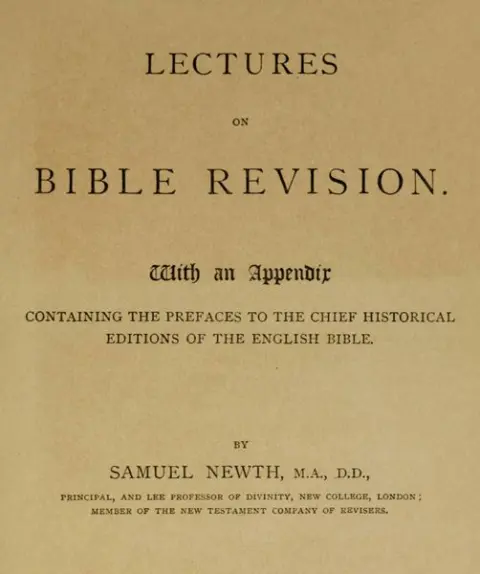
"Lectures on Bible Revision" by Samuel Newth is a scholarly examination written in the late 19th century. The text focuses on the significance of biblical revisions, particularly the need for an updated understanding of the English Bible in light of historical and linguistic changes. It serves as a resource for Sunday-school and Bible-class teachers to navigate the complexities of these revisions and engage thoughtfully with their communities. The opening of the work introduces the author's aim to clarify the distinctions between the substance and form of Scripture, urging readers to acknowledge that while the truths contained in the Bible are eternal, the language and translations are subject to change. Newth emphasizes that reverence for the Scriptures should focus on the underlying truths rather than the specific wording, which has evolved over time. He reflects on historical translations and revisions, illustrating how the English Bible has transformed through various interpreters and linguistic shifts, underscoring the necessity of ongoing revision to maintain its relevance and accuracy for contemporary readers.
Introduction adapted from the source catalogue; source summaries may be automatically generated.
Free to read · English · 79,829 words · No account needed
MAKE TIME FOR A GOOD BOOK
On by default. Untick to stop anonymous reading totals. Each page counts after 10 seconds in view. How this works.
Anonymous counting is on unless you have switched it off.
The second cause to which reference has been made is, of course, much slower in its operation, but though slow it is certain; and sooner or later every version, whensoever and by whomsoever made, must call for revision, because of the changes to which all language is subject. Words which were once in common use pass altogether out of currency, and are utterly unintelligible save to a learned few. Other words change their meaning, and give to the sentences in which they occur a different and sometimes an alien sense to that which they formerly conveyed. Others again, while retaining fundamentally their original sense, become limited in their range of application, and when used in other connections than those to which they are thus confined by custom, become grotesque and disturb the mind of the reader by the strange associations which they suggest.
How many words found in our Bibles have, since 1611, passed out of general use the following list will show. Most of these are wholly without meaning, even to an educated reader; a few survive as local provincialisms, and a few also are still employed in the technical vocabulary of certain arts or professions. All are out of place in a book intended for universal use.
Assay. Deut. iv. 34; Job iv. 2; Acts ix. 26, &c.
Attent. 2 Chron. vi. 40.
Bestead. Isa. viii. 21.
Blain. Exod. ix. 9, 10.
Bolled. Exod. ix. 31.
[Brickle. Wisd. xv. 13.]
Brigandine. Jer. xlvi. 4; li. 3.
Bruit. Jer. x. 22; Nah. iii. 19.
Calamus. Exod. xxx. 23; Cant. iv. 14; Exek. xxvii. 19.
Camphire. Cant. i. 14; iv. 13.
Causey. 1 Chron. xxvi. 18.
Chanel-bone. Job xxxi. 22, marg.
Chapiter. Exod. xxxvi. 38, &c.
Chapman. 2 Chron. ix. 14.
Chaws. Ezek. xxix. 4.
[Cithern. 1 Macc. iv. 54.]
Cockatrice. Isa. xi. 8, &c.
Collops. Job xv. 27.
Confection. Exod. xxx. 35.
Coney. Lev. xi. 5, &c.
To Convent. Jer. xlix. 19, marg.
Cotes. 2 Chron. xxxii. 28.
To Couch. Dent, xxxiii. 13.
Countervail. Esth. vii. 4.
Daysman. Job ix. 33.
[Dehort. 1 Macc. ix. 9.]
Delicates. Jer. li. 34.
Dredge. Job xxiv. 6, marg.
Dure. Matt. xiii. 21.
Earing. Gen. xlv. 6.
Endirons. Ezek. xl. 43, marg.
Flue-net. Hab. i. 15, marg.
Gier eagle. Lev. xi. 18.
Gorget. 1 Sam. xvii. 6, marg.
Habergeon. Exod. xxviii. 32; xxxix. 23, &c.
Helve. Deut. xix. 5.
Hough. Josh. xi. 6, 9.
Implead. Acts xix. 38.
Jewry. Dan. v. 13; John vii. 1.
Knop. Exod. xxv. 31, &c.
Leasing. Ps. iv. 2; v. 6.
Makebate. 2 Tim. iii. 3, marg.
Muffler. Isa. iii. 19.
Neesing. Job xli. 18.
Ossifrage. Lev. xi. 13.
Ouches. Exod. xxviii. 11, &c.
Pilled. Gen. xxx. 37.
Prelation. 1 Cor. xiii., heading.
Purtenance. Exod. xii. 9.
Ravin. Gen. xlix. 27.
Rereward. Num. x. 25, &c.
Scall. Lev. xiii. 30.
Scrabble. 1 Sam. xxi. 13.
A Settle. Ezek. xliii. 14, &c.
Silverling. Isa. vii. 23.
Sith. Ezek. xxxv. 6.
Tabering. Nah. ii. 7.
Tache. Exod. xxvi. 6.
Throughaired. Jer. xxii. 14, marg.
Thrum. Isa. xxxviii. 12, marg.
Viol. Isa. v. 12.
Wimple. Isa. iii. 22.
Your reading position is saved on this browser. Take it to another device with a library code. Reading pages adapt to text, rather than matching a printed edition.
BEHIND THE BOOK
This eBook is for the use of anyone anywhere in the United States and most other parts of the world at no cost and with almost no restrictions whatsoever. You may copy it, give it away or re-use it under the terms of the Project Gutenberg License included with this eBook or online at www.gutenberg.org. If you are not located in the United States, you will have to check the laws of the country where you are located before using this eBook. Read the source licence.
The original source file, including credits and licence, is retained by this library. Request an original-format copy at no charge. Please include the book title and Project Gutenberg identifier #42514.
KEEP YOUR CURIOSITY GOING
David Patterson (Spirit) Hatch

David Patterson (Spirit) Hatch

David Patterson (Spirit) Hatch
Cécile Tormay

Moritz Busch
John L. Ransom