
Last letters from the living dead man
David Patterson (Spirit) Hatch
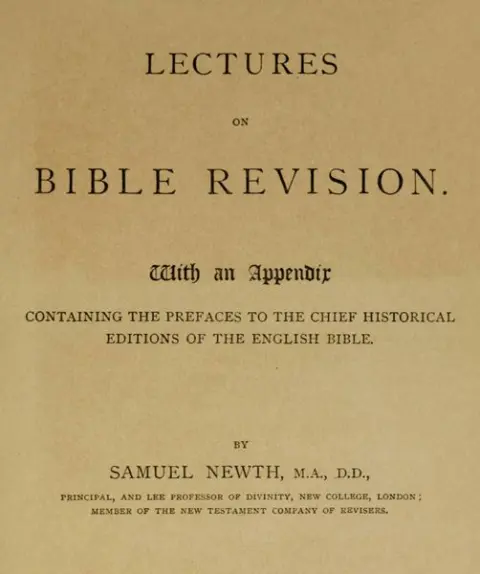
THE CLASSIC COLLECTION · 1881
"Lectures on Bible Revision" by Samuel Newth is a scholarly examination written in the late 19th century. The text focuses on the significance of biblical revisions, particularly the need for an updated understanding of the English Bible in light of historical and linguistic changes. It serves as a resource for Sunday-school and Bible-class teachers to navigate the complexities of these revisions and engage thoughtfully with their communities. The opening of the work introduces the author's aim to clarify the distinctions between the substance and form of Scripture, urging readers to acknowledge that while the truths contained in the Bible are eternal, the language and translations are subject to change. Newth emphasizes that reverence for the Scriptures should focus on the underlying truths rather than the specific wording, which has evolved over time. He reflects on historical translations and revisions, illustrating how the English Bible has transformed through various interpreters and linguistic shifts, underscoring the necessity of ongoing revision to maintain its relevance and accuracy for contemporary readers.
Introduction adapted from the source catalogue; source summaries may be automatically generated.
Free to read · English · 79,829 words · No account needed
MAKE TIME FOR A GOOD BOOK
On by default. Untick to stop anonymous reading totals. Each page counts after 10 seconds in view. How this works.
Anonymous counting is on unless you have switched it off.
2. The Names of the Prophets and the Holy Writers, with the other Names of the Text to be retained, as nigh as may be, accordingly as they were vulgarly used.
3. The old Ecclesiastical Words to be kept; viz., the word Church not to be translated Congregation, &c.
4. When a Word hath divers significations, that to be kept which hath been most commonly used by the most of the Ancient Fathers, being agreeable to the Propriety of the Place, and the Analogy of the Faith.
5. The division of the Chapters to be altered, either not at all, or as little as may be, if necessity so require.
6. No Marginal Notes at all to be affixed, but only for the explanation of the Hebrew or Greek Words, which cannot without some circumlocution, so briefly and fitly be exprest in the Text.
7. Such Quotations of Places to be marginally set down, as shall serve for the fit reference of one Scripture to another.
8. Every particular Man of each Company, to take the same Chapter or Chapters, and having translated or amended them severally by himself, where he thinketh good, all to meet together, confer what they have done, and agree for their parts what shall stand.
9. As any one Company hath despatched any one Book in this manner, they shall send it to the rest, to be considered of seriously and judiciously, for his Majesty is very careful in this point.
10. If any Company, upon the review of the Book so sent, doubt or differ upon any Place, to send them word thereof; Note the place, and withal send the Reasons; to which if they consent not, the difference to be compounded at the General Meeting, which is to be of the chief Persons of each Company at the end of the Work.
11. When any Place of special obscurity is doubted of, Letters to be directed, by Authority, to send to any Learned Man in the Land, for his judgment of such a Place.
12. Letters to be sent from every Bishop, to the rest of his Clergy, admonishing them of this Translation in hand; and to move and charge, as many as being skilful in the Tongues; and having taken pains in that kind, to send his particular Observations to the Company, either at Westminster, Cambridg, or Oxford.
13. The Directors in each Company to be the Deans of Westminster and Chester for that place; and the King’s Professors in the Hebrew or Greek in either University.
14. These Translations to be used, when they agree better with the Text than the Bishops’ Bible; viz., Tindall’s, Matthew’s, Coverdale’s, Whitchurch’s,[44] Geneva.
Your reading position is saved on this browser. Take it to another device with a library code. Reading pages adapt to text, rather than matching a printed edition.
BEHIND THE BOOK
This eBook is for the use of anyone anywhere in the United States and most other parts of the world at no cost and with almost no restrictions whatsoever. You may copy it, give it away or re-use it under the terms of the Project Gutenberg License included with this eBook or online at www.gutenberg.org. If you are not located in the United States, you will have to check the laws of the country where you are located before using this eBook. Read the source licence.
The original source file, including credits and licence, is retained by this library. Request an original-format copy at no charge. Please include the book title and Project Gutenberg identifier #42514.
KEEP YOUR CURIOSITY GOING
David Patterson (Spirit) Hatch

David Patterson (Spirit) Hatch

David Patterson (Spirit) Hatch
Cécile Tormay

Moritz Busch
John L. Ransom