
Last letters from the living dead man
David Patterson (Spirit) Hatch
THE CLASSIC COLLECTION · 1881
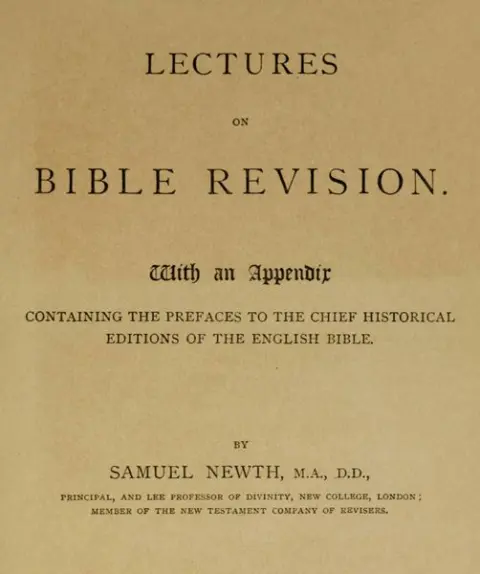
"Lectures on Bible Revision" by Samuel Newth is a scholarly examination written in the late 19th century. The text focuses on the significance of biblical revisions, particularly the need for an updated understanding of the English Bible in light of historical and linguistic changes. It serves as a resource for Sunday-school and Bible-class teachers to navigate the complexities of these revisions and engage thoughtfully with their communities. The opening of the work introduces the author's aim to clarify the distinctions between the substance and form of Scripture, urging readers to acknowledge that while the truths contained in the Bible are eternal, the language and translations are subject to change. Newth emphasizes that reverence for the Scriptures should focus on the underlying truths rather than the specific wording, which has evolved over time. He reflects on historical translations and revisions, illustrating how the English Bible has transformed through various interpreters and linguistic shifts, underscoring the necessity of ongoing revision to maintain its relevance and accuracy for contemporary readers.
Introduction adapted from the source catalogue; source summaries may be automatically generated.
Free to read · English · 79,829 words · No account needed
MAKE TIME FOR A GOOD BOOK
On by default. Untick to stop anonymous reading totals. Each page counts after 10 seconds in view. How this works.
Anonymous counting is on unless you have switched it off.
[67] The LXX. and Vulgate are here right; so also Wycliffe, who, translating from the Latin, renders, “Seven trompes, whos vse is in the iubile.”
[68] Wycliffe, “Stronge men seseden in Yrael.”
[69] Here again the LXX., Vulgate, and Wycliffe are right. Wycliffe renders, “of whom shulen be alle the best thingis of Yrael.”
[70] The LXX., Vulgate, Wycliffe, the Great Bible, the Genevan, and the Bishops’, all give the true sense.
[71] In their rendering of verse 3 the Revisers of 1611 have followed the Genevan. Of the older versions, the Great Bible best renders this verse, “All my delyte is upon the saynctes that are in the earth, and upon suche as excell in vertue.”
[72] The Vulgate leads the way in this error.
[73] Tyndale, the Great Bible, and the Genevan render correctly.
[74] So the Rheims, “Why do you also trangresse the commaundement of God for your tradition?”
[75] So Wycliffe, “for they ben feithful and loued, the whiche ben parceners of benefice;” and the Rheims, “because they be faithful and beloued which are partakers of the benefite.”
[76] Here all the older versions go wrong.
[77] The first four books of the Annals of Tacitus are found only in a single MS. (the Medicean) of the eleventh century. The nine books of the Letters of Pliny the Younger are found complete in one MS. only, of the tenth century; this also is in the Medicean Library.
[78] From the Latin uncia, an inch.
[79] In some MSS. called palimpsests, the more ancient, and to us the more valuable, writing has been partially washed away, in order that the vellum might be used again for some more recent work. In these cases it is exceedingly difficult to decipher, beneath the later and darker writing, the traces of the older writing; indeed, not unfrequently the characters are so faded that they cannot be read at all until revived by some chemical preparation. The Ephraem Codex is a MS. of this kind.
[80] Commonly referred to under the symbol א, the Hebrew letter, Aleph.
[81] Referred to as B.
[82] Referred to as A.
[83] Referred to as C.
[84] Referred to as D of the Gospels.
[85] Referred to as D of the Epistles.
[86] The License for its publication was not granted until March 20, 1520.
[87] Namely, his sole authority for the Apocalypse.
[88] He had previously published two smaller editions (16mo), one in 1546,
and another in 1549.
[89] Now called the Codex Regius, and denoted by L.
[90] The collation of the eight Parisian MSS. was done for him by his son Henry, then a youth of eighteen.
[91] At Geneva, whither he had deemed it prudent to remove shortly after the publication of his celebrated edition of the Greek New Testament.
[92] Works, vol. vi. p. 194.
Your reading position is saved on this browser. Take it to another device with a library code. Reading pages adapt to text, rather than matching a printed edition.
BEHIND THE BOOK
This eBook is for the use of anyone anywhere in the United States and most other parts of the world at no cost and with almost no restrictions whatsoever. You may copy it, give it away or re-use it under the terms of the Project Gutenberg License included with this eBook or online at www.gutenberg.org. If you are not located in the United States, you will have to check the laws of the country where you are located before using this eBook. Read the source licence.
The original source file, including credits and licence, is retained by this library. Request an original-format copy at no charge. Please include the book title and Project Gutenberg identifier #42514.
KEEP YOUR CURIOSITY GOING
David Patterson (Spirit) Hatch

David Patterson (Spirit) Hatch

David Patterson (Spirit) Hatch
Cécile Tormay

Moritz Busch
John L. Ransom