
Last letters from the living dead man
David Patterson (Spirit) Hatch
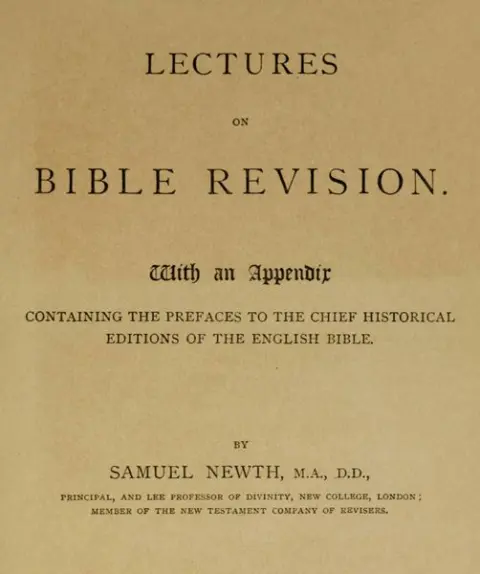
THE CLASSIC COLLECTION · 1881
"Lectures on Bible Revision" by Samuel Newth is a scholarly examination written in the late 19th century. The text focuses on the significance of biblical revisions, particularly the need for an updated understanding of the English Bible in light of historical and linguistic changes. It serves as a resource for Sunday-school and Bible-class teachers to navigate the complexities of these revisions and engage thoughtfully with their communities. The opening of the work introduces the author's aim to clarify the distinctions between the substance and form of Scripture, urging readers to acknowledge that while the truths contained in the Bible are eternal, the language and translations are subject to change. Newth emphasizes that reverence for the Scriptures should focus on the underlying truths rather than the specific wording, which has evolved over time. He reflects on historical translations and revisions, illustrating how the English Bible has transformed through various interpreters and linguistic shifts, underscoring the necessity of ongoing revision to maintain its relevance and accuracy for contemporary readers.
Introduction adapted from the source catalogue; source summaries may be automatically generated.
Free to read · English · 79,829 words · No account needed
MAKE TIME FOR A GOOD BOOK
On by default. Untick to stop anonymous reading totals. Each page counts after 10 seconds in view. How this works.
Anonymous counting is on unless you have switched it off.
[26] Strype also tells us that the expenses of publication were borne chiefly by John Bodley, father of Sir Thomas Bodley, the founder of the Bodleian Library at Oxford.--Life of Parker, p. 206.
[27] It is very pleasant to read that, notwithstanding this, Parker joined with Grindal, Bishop of London, in pleading for an extension of the patent granted to Bodley, in order to enable him to publish the new edition of the Genevan referred to above. Writing, March 9th, 1565, to Cecil, the Queen’s Secretary, the Archbishop and Bishop say, “That they thought so well of the first Impression, and the Review of those who had since travelled therein, that they wisht it would please him to be a Means, that Twelve Years longer Term might be by Special Privilege granted him, in consideration of the Charges by him and his Associates in the first Impression, and the Review sithence sustained. And that tho’ one other special Bible for the Churches were meant by them to be set forth, as convenient Time and Leisure hereafter should permit, yet should it nothing hinder, but rather do much good, to have Diversity of Translations and Readings.”--STRYPE, Life of Parker, p. 207, Folio Edition.
[28] See Appendix G.
[29] Pagninus was a learned Dominican, who published at Lyons, in 1528, a new translation in Latin of the Old and New Testaments.
[30] STRYPE, Life of Parker, Appendix, p. 139.
[31] Ibid, p. 399.
[32] In an attack made upon Protestant versions of the Scriptures by Thomas Ward, in the reign of James II., or three-quarters of a century after the publication of the Authorized Version, the writer selects his examples from Genevan Bibles of the years 1562, 1577, and 1579, and speaks of this Bible as “well known in England even to this day, as being yet in many men’s hands.”--Errata to the Protestant Bible, p. 19, ed. 1737.
[33] The Old Testament was not published till long afterwards, when the College was once more settled at Douai. It is hence called the Douai Bible. The first volume was published in 1609, and the second in 1610. In the preface it is stated that the translation was made “about thirtie yeares since.”
[34] Amongst the former are advent, allegory, anathema, assumption, calumniate, co-operate, evangelize, eunuch, gratis, holocaust, neophyte, paraclete, pentecost, victim. Amongst the latter are agnition, azymes, commessation, condigne, contristate, depositum, donaries, exinanited, parasceue, pasche, prefinition, loaves of proposition, repropitiate, superedified.
[35] Compare the word “leasowes,” still used in some parts of the country
for “meadows.”
Your reading position is saved on this browser. Take it to another device with a library code. Reading pages adapt to text, rather than matching a printed edition.
BEHIND THE BOOK
This eBook is for the use of anyone anywhere in the United States and most other parts of the world at no cost and with almost no restrictions whatsoever. You may copy it, give it away or re-use it under the terms of the Project Gutenberg License included with this eBook or online at www.gutenberg.org. If you are not located in the United States, you will have to check the laws of the country where you are located before using this eBook. Read the source licence.
The original source file, including credits and licence, is retained by this library. Request an original-format copy at no charge. Please include the book title and Project Gutenberg identifier #42514.
KEEP YOUR CURIOSITY GOING
David Patterson (Spirit) Hatch

David Patterson (Spirit) Hatch

David Patterson (Spirit) Hatch
Cécile Tormay

Moritz Busch
John L. Ransom