
Last letters from the living dead man
David Patterson (Spirit) Hatch
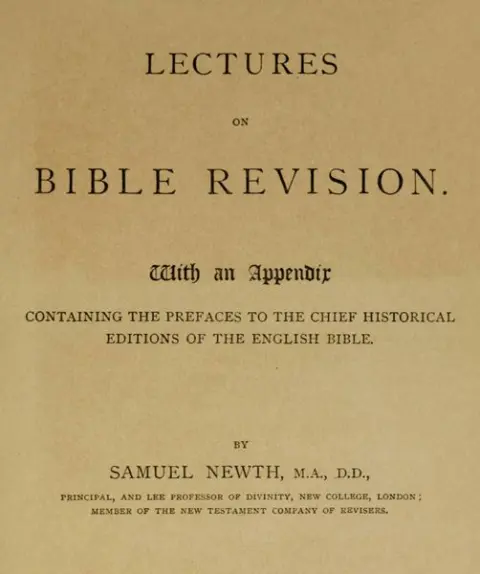
THE CLASSIC COLLECTION · 1881
"Lectures on Bible Revision" by Samuel Newth is a scholarly examination written in the late 19th century. The text focuses on the significance of biblical revisions, particularly the need for an updated understanding of the English Bible in light of historical and linguistic changes. It serves as a resource for Sunday-school and Bible-class teachers to navigate the complexities of these revisions and engage thoughtfully with their communities. The opening of the work introduces the author's aim to clarify the distinctions between the substance and form of Scripture, urging readers to acknowledge that while the truths contained in the Bible are eternal, the language and translations are subject to change. Newth emphasizes that reverence for the Scriptures should focus on the underlying truths rather than the specific wording, which has evolved over time. He reflects on historical translations and revisions, illustrating how the English Bible has transformed through various interpreters and linguistic shifts, underscoring the necessity of ongoing revision to maintain its relevance and accuracy for contemporary readers.
Introduction adapted from the source catalogue; source summaries may be automatically generated.
Free to read · English · 79,829 words · No account needed
MAKE TIME FOR A GOOD BOOK
On by default. Untick to stop anonymous reading totals. Each page counts after 10 seconds in view. How this works.
Anonymous counting is on unless you have switched it off.
[Sidenote: A satisfaction to our brethren.] And to the same effect say we, that we are so far off from condemning any of their labours that travelled before us in this kind, either in this land, or beyond sea, either in King Henry’s time, or King Edward’s, (if there were any translation, or correction of a translation, in his time,) or Queen Elizabeth’s of ever renowned memory, that we acknowledge them to have been raised up of God for the building and furnishing of his Church, and that they deserve to be had of us and of posterity in everlasting remembrance. The judgment of Aristotle is worthy and well known: [Sidenote: Arist. 2. Metaphys. cap. 1.] If Timotheus had not been, we had not had much sweet musick: But if Phrynis (Timotheus’ master) had not been, we had not had Timotheus. Therefore blessed be they, and most honoured be their name, that break the ice, and give the onset upon that which helpeth forward to the saving of souls. Now what can be more available thereto, than to deliver God’s book unto God’s people in a tongue which they understand? Since of an hidden treasure, and of a fountain that is sealed, there is no profit, as Ptolemy Philadelph wrote to the Rabbins or masters of the Jews, as witnesseth Epiphanius: [Sidenote: St. Epiphan. loco ante citato. St. August. lib. 19. De civit. Dei, cap. 7.] and as St. Augustine saith, A man had rather be with his dog than with a stranger (whose tongue is strange unto him.) Yet for all that, as nothing is begun and perfected at the same time, and the latter thoughts are thought to be the wiser: so, if we building upon their foundation that went before us, and being holpen by their labours, do endeavour to make that better which they left so good; no man, we are sure, hath cause to mislike us; they, we persuade ourselves, if they were alive, would thank us. The vintage of Abiezer, that strake the stroke: yet the gleaning of grapes of Ephraim was not to be despised. See Judges viii. 2. [Sidenote: 2 Kin. 13. 18, 19.] Joash the king of Israel did not satisfy himself till he had smitten the ground three times; and yet he offended the Prophet for giving over then. Aquila, of whom we spake before, translated the Bible as carefully and as skilfully as he could; and yet he thought good to go over it again, and then it got the credit with the Jews, to be called κατ’ ἀκρίβειαν, that is, accurately done, as St. Hierome witnesseth. [Sidenote: St. Hieron. in Ezech. cap. 3.] How many books of profane learning have been gone over again and again, by the same translators, by others? Of one and the same book of Aristotle’s Ethicks there are extant not so few as six or seven several translations. Now if this cost may be bestowed upon the gourd, which affordeth us a little shade, and which to day flourisheth, but to morrow is cut down; what may we bestow, nay, what ought we not to bestow, upon the vine, the fruit whereof maketh glad the conscience of man, and the stem whereof abideth for ever? And this is the word of God, which we translate. [Sidenote: Jer. 23. 28.] What is the chaff to the wheat? saith the Lord. Tanti vitreum, quanti verum margaritum! (saith Tertullian.) [Sidenote: Tertull. ad Martyr. Si tanti vilissimum vitrum, quanti preciosissimum margaritum! Hier. ad Salvin.] If a toy of glass be of that reckoning with us, how ought we to value the true pearl! Therefore let no man’s eye be evil, because his Majesty’s is good; neither let any be grieved, that we have a Prince that seeketh the increase of the spiritual wealth of Israel; (let Sanballats and Tobiahs do so, which therefore do bear their just reproof;) but let us rather bless God from the ground of our heart for working this religious care in him to have the translations of the Bible maturely considered of and examined. For by this means it cometh to pass, that whatsoever is sound already, (and all is sound for substance in one or other of our editions, and the worst of ours far better than their authentick vulgar) the same will shine as gold more brightly, being rubbed and polished; also, if any thing be halting, or superfluous, or not so agreeable to the original, the same may be corrected, and the truth set in place. And what can the King command to be done, that will bring him more true honour than this? And wherein could they that have been set a work approve their duty to the King, yea, their obedience to God, and love to his Saints, more, than by yielding their service, and all that is within them, for the furnishing of the work? But besides all this, they were the principal motives of it, and therefore ought least to quarrel it. For the very historical truth is, that upon the importunate petitions of the Puritanes at his Majesty’s coming to this crown, the conference at Hampton-court having been appointed for hearing their complaints, when by force of reason they were put from all other grounds, they had recourse at the last to this shift, that they could not with good conscience subscribe to the communion book, since it maintained the Bible as it was there translated, which was, as they said, a most corrupted translation. And although this was judged to be but a very poor and empty shift, yet even hereupon did his Majesty begin to bethink himself of the good that might ensue by a new translation, and presently after gave order for this translation which is now presented unto thee. Thus much to satisfy our scrupulous brethren.
Your reading position is saved on this browser. Take it to another device with a library code. Reading pages adapt to text, rather than matching a printed edition.
BEHIND THE BOOK
This eBook is for the use of anyone anywhere in the United States and most other parts of the world at no cost and with almost no restrictions whatsoever. You may copy it, give it away or re-use it under the terms of the Project Gutenberg License included with this eBook or online at www.gutenberg.org. If you are not located in the United States, you will have to check the laws of the country where you are located before using this eBook. Read the source licence.
The original source file, including credits and licence, is retained by this library. Request an original-format copy at no charge. Please include the book title and Project Gutenberg identifier #42514.
KEEP YOUR CURIOSITY GOING
David Patterson (Spirit) Hatch

David Patterson (Spirit) Hatch

David Patterson (Spirit) Hatch
Cécile Tormay

Moritz Busch
John L. Ransom