
Last letters from the living dead man
David Patterson (Spirit) Hatch
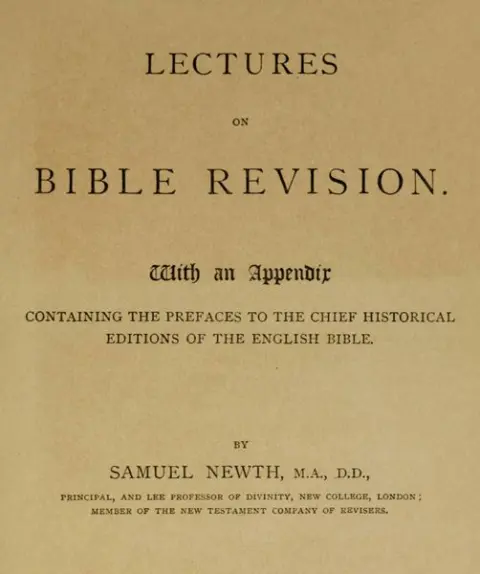
THE CLASSIC COLLECTION · 1881
"Lectures on Bible Revision" by Samuel Newth is a scholarly examination written in the late 19th century. The text focuses on the significance of biblical revisions, particularly the need for an updated understanding of the English Bible in light of historical and linguistic changes. It serves as a resource for Sunday-school and Bible-class teachers to navigate the complexities of these revisions and engage thoughtfully with their communities. The opening of the work introduces the author's aim to clarify the distinctions between the substance and form of Scripture, urging readers to acknowledge that while the truths contained in the Bible are eternal, the language and translations are subject to change. Newth emphasizes that reverence for the Scriptures should focus on the underlying truths rather than the specific wording, which has evolved over time. He reflects on historical translations and revisions, illustrating how the English Bible has transformed through various interpreters and linguistic shifts, underscoring the necessity of ongoing revision to maintain its relevance and accuracy for contemporary readers.
Introduction adapted from the source catalogue; source summaries may be automatically generated.
Free to read · English · 79,829 words · No account needed
MAKE TIME FOR A GOOD BOOK
On by default. Untick to stop anonymous reading totals. Each page counts after 10 seconds in view. How this works.
Anonymous counting is on unless you have switched it off.
[Sidenote: The highest personages have been calumniated C. Cæsar. Plutarch.] If we will descend to latter times, we shall find many the like examples of such kind, or rather unkind, acceptance. The first Roman Emperor did never do a more pleasing deed to the learned, nor more profitable to posterity, for conserving the record of times in true supputation, than when he corrected the Calendar, and ordered the year according to the course of the sun: and yet this was imputed to him for novelty, and arrogancy, and procured to him great obloquy. [Sidenote: Constantine.] So the first Christened Emperor (at the least wise, that openly professed the faith himself, and allowed others to do the like,) for strengthening the empire at his great charges, and providing for the Church, as he did, got for his labour the name Pupillus, as who would say, a wasteful Prince, that had need of a guardian or overseer. [Sidenote: Aurel. Vict. Theodosius. Zosimus.] So the best Christened Emperor, for the love that he bare unto peace, thereby to enrich both himself and his subjects, and because he did not seek war, but find it, was judged to be no man at arms, (though indeed he excelled in feats of chivalry, and shewed so much when he was provoked,) and condemned for giving himself to his ease, and to his pleasure. [Sidenote: Justinian.] To be short, the most learned Emperor of former times, (at the least the greatest politician,) what thanks had he for cutting off the superfluities of the laws, and digesting them into some order and method? This, that he hath been blotted by some to be an Epitomist, that is, one that extinguished worthy whole volumes, to bring his abridgements into request. This is the measure that hath been rendered to excellent Princes in former times, cum bene facerent, male audire, for their good deeds to be evil spoken of. Neither is there any likelihood that envy and malignity died and were buried with the ancient. No, no, the reproof of Moses taketh hold of most ages, [Sidenote: Num. 32. 14. Eccles. 1. 9.] You are risen up in your fathers’ stead, an increase of sinful men. What is that that hath been done? that which shall be done: and there is no new thing under the sun, saith the wise man. And St. Stephen, As your fathers did, so do ye. [Sidenote: Acts 7. 51. His Majesty’s constancy, notwithstanding calumniation, for the survey of the English translation. Αὐτὸς καὶ παῖδες, καὶ παίδων πάντοτε παῖδες.] This, and more to this purpose, his Majesty that now reigneth (and long, and long, may he reign, and his offspring for ever, Himself, and children, and children’s children always!) knew full well, according to the singular wisdom given unto him by God, and the rare learning and experience that he hath attained unto; namely, That whosoever attempteth any thing for the publick, (especially if it pertain to religion, and to the opening and clearing of the word of God,) the same setteth himself upon a stage to be glouted upon by every evil eye; yea, he casteth himself headlong upon pikes, to be gored by every sharp tongue. For he that meddleth with men’s religion in any part meddleth with their custom, nay, with their freehold; and though they find no content in that which they have, yet they cannot abide to hear of altering. Notwithstanding his royal heart was not daunted or discouraged for this or that colour, but stood resolute, as a statue immovable, and an anvil not easy to be beaten into plates, as one saith; [Sidenote: Ὣσπερ τις ἀνδρὰς ἀπερίτρεπτος] he knew who had chosen him to be a soldier, or rather a captain; and [Sidenote: καὶ ἄκμων ἀνήλατος, Suidas.] being assured that the course which he intended made much for the glory of God, and the building up of his Church, he would not suffer it to be broken off for whatsoever speeches or practices. It doth certainly belong unto kings, yea, it doth specially belong unto them, to have care of religion, yea, to know it aright, yea, to profess it zealously, yea, to promote it to the uttermost of their power. This is their glory before all nations which mean well, and this will bring unto them a far most excellent weight of glory in the day of the Lord Jesus. For the Scripture saith not in vain, [Sidenote: 1 Sam. 2. 30.] Them that honour me I will honour: neither was it a vain word that Eusebius delivered long ago, [Sidenote: θεοσέβεια, Eusebius, lib. 10. cap. 8.] That piety toward God was the weapon, and the only weapon, that both preserved Constantine’s person, and avenged him of his enemies.
Your reading position is saved on this browser. Take it to another device with a library code. Reading pages adapt to text, rather than matching a printed edition.
BEHIND THE BOOK
This eBook is for the use of anyone anywhere in the United States and most other parts of the world at no cost and with almost no restrictions whatsoever. You may copy it, give it away or re-use it under the terms of the Project Gutenberg License included with this eBook or online at www.gutenberg.org. If you are not located in the United States, you will have to check the laws of the country where you are located before using this eBook. Read the source licence.
The original source file, including credits and licence, is retained by this library. Request an original-format copy at no charge. Please include the book title and Project Gutenberg identifier #42514.
KEEP YOUR CURIOSITY GOING
David Patterson (Spirit) Hatch

David Patterson (Spirit) Hatch

David Patterson (Spirit) Hatch
Cécile Tormay

Moritz Busch
John L. Ransom