
Last letters from the living dead man
David Patterson (Spirit) Hatch
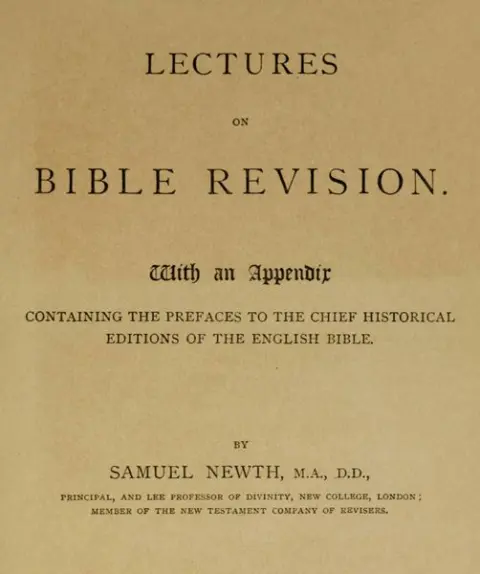
THE CLASSIC COLLECTION · 1881
"Lectures on Bible Revision" by Samuel Newth is a scholarly examination written in the late 19th century. The text focuses on the significance of biblical revisions, particularly the need for an updated understanding of the English Bible in light of historical and linguistic changes. It serves as a resource for Sunday-school and Bible-class teachers to navigate the complexities of these revisions and engage thoughtfully with their communities. The opening of the work introduces the author's aim to clarify the distinctions between the substance and form of Scripture, urging readers to acknowledge that while the truths contained in the Bible are eternal, the language and translations are subject to change. Newth emphasizes that reverence for the Scriptures should focus on the underlying truths rather than the specific wording, which has evolved over time. He reflects on historical translations and revisions, illustrating how the English Bible has transformed through various interpreters and linguistic shifts, underscoring the necessity of ongoing revision to maintain its relevance and accuracy for contemporary readers.
Introduction adapted from the source catalogue; source summaries may be automatically generated.
Free to read · English · 79,829 words · No account needed
MAKE TIME FOR A GOOD BOOK
On by default. Untick to stop anonymous reading totals. Each page counts after 10 seconds in view. How this works.
Anonymous counting is on unless you have switched it off.
By grace, that is to say by favour, we are plucked out of Adam, the ground of all evil, and graffed in Christ the root of all goodness. In Christ, God loved us, his elect and chosen, before the world began, and reserved us unto the knowledge of his Son and of his holy gospel; and when the gospel is preached to us, he openeth our hearts, and giveth us grace to believe, and putteth the Spirit of Christ in us, and we know him as our Father most merciful; and we consent to the law, and love it inwardly in our heart, and desire to fulfil it, and sorrow because we cannot; which will (sin we of frailty never so much) is sufficient till more strength be given us; the blood of Christ hath made satisfaction for the rest; the blood of Christ hath obtained all things for us of God. Christ is our satisfaction, Redeemer, Deliverer, Saviour, from vengeance and wrath. Observe and mark in Paul’s, Peter’s, and John’s epistles, and in the gospel, what Christ is unto us.
By faith are we saved only in believing the promises. And though faith be never without love and good works, yet is our saving imputed neither to love nor unto good works, but unto faith only. For love and works are under the law, which requireth perfection, and the ground and fountain of the heart, and damneth all imperfectness. Now is faith under the promises, which condemn not; but give all grace, mercy, favour, and whatsoever is contained in the promises.
Righteousness is divers; blind reason imagines many manner of righteousness. There is, in like manner, the justifying of ceremonies, some imagine them their own selves, some counterfeit other, saying, in their blind reason, Such holy persons did thus and thus, and they were holy men, therefore if I do so likewise I shall please God; but they have no answer of God that that pleaseth. The Jews seek righteousness in their ceremonies; which God gave unto them, not to justify, but to describe and paint Christ unto them; of which Jews testifieth Paul, saying how that they have affection to God, but not after knowledge; for they go about to stablish their own justice, and are not obedient to the justice of righteousness that cometh of God. The cause is verily that except a man cast away his own imagination and reason, he cannot perceive God, and understand the virtue and power of the blood of Christ. There is the righteousness of works, as I said before, when the heart is away and feeleth not how the law is spiritual and cannot be fulfilled, but from the bottom of the heart, as the just ministration of all manner of laws, and the observing of them, and moral virtues wherein philosophers put their felicity and blessedness--which all are nothing in the sight of God. There is a full righteousness, when the law is fulfilled from the ground of the heart. This had neither Peter nor Paul in this life perfectly, but sighed after it. They were so far forth blessed in Christ, that they hungered and thirsted after it. Paul had this thirst; he consented to the law of God, that it ought so to be, but he found another lust in his members, contrary to the lust and desire of his mind, and therefore cried out, saying, “Oh, wretched man that I am; who shall deliver me from this body of death? thanks be to God through Jesus Christ.” The righteousness that before God is of value, is to believe the promises of God, after the law hath confounded the conscience: as when the temporal law ofttimes condemneth the thief or murderer, and bringeth him to execution, so that he seeth nothing before him but present death, and then cometh good tidings, a charter from the king, and delivereth him. Likewise when God’s law hath brought the sinner into knowledge of himself, and hath confounded his conscience and opened unto him the wrath and vengeance of God; then cometh good tidings. The Evangelion showeth unto him the promises of God in Christ, and how Christ hath purchased pardon for him, hath satisfied the law for him, and appeased the wrath of God. And the poor sinner believeth, laudeth, and thanketh God through Christ, and breaketh out into exceeding inward joy and gladness, for that he hath escaped so great wrath, so heavy vengeance, so fearful and so everlasting a death. And he henceforth is an hungered and athirst after more righteousness, that he might fulfil the law; and mourneth continually, commending his weakness unto God in the blood of our Saviour, Christ Jesus.
Your reading position is saved on this browser. Take it to another device with a library code. Reading pages adapt to text, rather than matching a printed edition.
BEHIND THE BOOK
This eBook is for the use of anyone anywhere in the United States and most other parts of the world at no cost and with almost no restrictions whatsoever. You may copy it, give it away or re-use it under the terms of the Project Gutenberg License included with this eBook or online at www.gutenberg.org. If you are not located in the United States, you will have to check the laws of the country where you are located before using this eBook. Read the source licence.
The original source file, including credits and licence, is retained by this library. Request an original-format copy at no charge. Please include the book title and Project Gutenberg identifier #42514.
KEEP YOUR CURIOSITY GOING
David Patterson (Spirit) Hatch

David Patterson (Spirit) Hatch

David Patterson (Spirit) Hatch
Cécile Tormay

Moritz Busch
John L. Ransom