
The Aftermath; Or, Gleanings from a Busy Life Called upon the outer cover, for purposes of sale, Caliban’s Guide to Letters
Hilaire Belloc
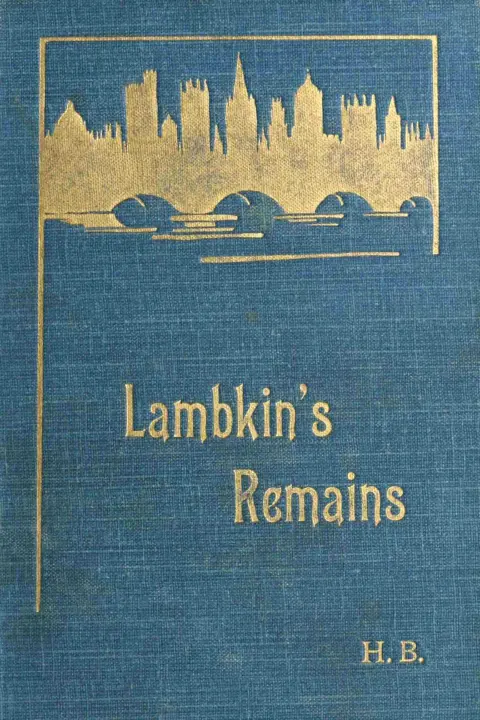
THE CLASSIC COLLECTION · 1900
"Lambkin's Remains" by Hilaire Belloc is a collection of essays, sermons, and speeches that appear to have been written in the late 19th century. The work features the posthumous writings of Josiah Abraham Lambkin, a Fellow of Burford College, and reflects on his life, thoughts, and the community of Oxford University. The collection's topics span from personal reflections to societal observations, hinting at Lambkin's character as a dedicated scholar and a deeply reflective individual. The opening of "Lambkin's Remains" sets the stage for the life and intellectual contributions of Josiah Lambkin, introducing him as a significant, albeit underappreciated, figure in his academic context. It starts with a dedicatory ode that emphasizes the author's bond with his friends and their shared experiences in Oxford. Belloc's preface provides insight into Lambkin's modesty and the profound influence he had on those around him, highlighting anecdotes from his life as a scholar and educator. This initial portrayal establishes a warm, nostalgic tone, inviting readers to explore Lambkin's thoughts and the intricate web of friendships and societal commentary that permeate his works.
Introduction adapted from the source catalogue; source summaries may be automatically generated.
Free to read · English · 25,420 words · No account needed
MAKE TIME FOR A GOOD BOOK
On by default. Untick to stop anonymous reading totals. Each page counts after 10 seconds in view. How this works.
Anonymous counting is on unless you have switched it off.
[54] The late Hon. John Tupton, the amiable colonial who purchased Marlborough House and made so great a stir in London some years ago.
[55] Mrs. Tupton, senior, a woman whose heroic struggles in the face of extreme poverty were a continual commentary on the awful results of our so-called perfected Penal System.
[56] There is great doubt upon the exactitude of this. In his lifetime Tupton often spoke of “the poor tenement house in New York where I was born,” and in a letter he alludes to “my birth at sea in the steerage of a Liner.”
[57] This was perhaps the origin of a phrase which may be found scattered with profusion throughout Lambkin’s works.
[58] Mr. Lambkin did not give the derivation of this word.
[59] “Alii igni infamiae vitam alii fugâ dederunt.”--Tacitus, In Omnes Caesares, I. viii. 7.
[60] The italicised words were omitted in the article.
[61] The full title of the translation is “The Roman Sandal: Its growth, development and decay. Its influence on society and its position in the liturgy of the Western Church.”
[62] Nephew of Mr. Child, the former editor; grandson of Mr. Pilgrim, the founder; and father of the present editor of Culture.
[63] Mr. Cook criticises this sentence. It is a point upon which friends may “agréer à différer.”
[64] Author of Psychologie de l’Absurde.
[65] Professor of Micro-graphy at Bonn.
[66] This was rather severe, as M. Bischoff had spent some years in a
Maison de Santé.
[67] An example of these occasional difficulties in style, due to the eagerness of which I have spoken.
[68] The meaning of this sentence is made clear thus: They (subject) twitted (predicate), with-his-qualifications (adverbially “how”), over--the--port (adverbially “where and when”), him (object).
[69] Mr. Lambkin loved to pass a quiet hour over the MSS. in the Bodleian, and would quote familiarly the rare lines of Chaucer, especially, among the mediæval poets.
[70] This sentence is an admirable example of Lambkin’s later manner.
[71] Raphael.
[72] P. 347, “The impetuosity of the action ill-suits with what is known of Lambkin.” It is all very well for the editor of Great Dead Men to say that this apologises for the misfortune; that apology does not excuse the imputation of impetuosity (forsooth!) to a man whose every gesture was restrained.
[73] Better known perhaps as an author than as a cleric. He met his end in a shocking manner in a railway accident. His life was, however, insured, and he had upon him a copy of Golden Deeds.
[74] Beeker’s A Torch for the Chapell; or the Nonconformists
out-done. Folio, 1663, p. 71.
[75] Referring to the edict on Buttoned Boots of Romulus Augustulus: a
very shameless injustice.
Your reading position is saved on this browser. Take it to another device with a library code. Reading pages adapt to text, rather than matching a printed edition.
Hilaire Belloc
Hilaire Belloc
Hilaire Belloc
Hilaire Belloc
BEHIND THE BOOK
This eBook is for the use of anyone anywhere in the United States and most other parts of the world at no cost and with almost no restrictions whatsoever. You may copy it, give it away or re-use it under the terms of the Project Gutenberg License included with this eBook or online at www.gutenberg.org. If you are not located in the United States, you will have to check the laws of the country where you are located before using this eBook. Read the source licence.
The original source file, including credits and licence, is retained by this library. Request an original-format copy at no charge. Please include the book title and Project Gutenberg identifier #66103.
KEEP YOUR CURIOSITY GOING

David Patterson (Spirit) Hatch

David Patterson (Spirit) Hatch

David Patterson (Spirit) Hatch
Coulson Kernahan

Ralph Waldo Emerson

Maurice Baring