
The Aftermath; Or, Gleanings from a Busy Life Called upon the outer cover, for purposes of sale, Caliban’s Guide to Letters
Hilaire Belloc
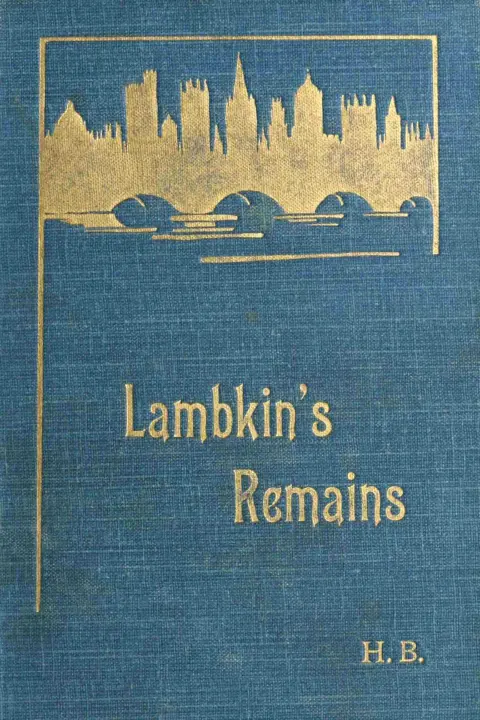
THE CLASSIC COLLECTION · 1900
"Lambkin's Remains" by Hilaire Belloc is a collection of essays, sermons, and speeches that appear to have been written in the late 19th century. The work features the posthumous writings of Josiah Abraham Lambkin, a Fellow of Burford College, and reflects on his life, thoughts, and the community of Oxford University. The collection's topics span from personal reflections to societal observations, hinting at Lambkin's character as a dedicated scholar and a deeply reflective individual. The opening of "Lambkin's Remains" sets the stage for the life and intellectual contributions of Josiah Lambkin, introducing him as a significant, albeit underappreciated, figure in his academic context. It starts with a dedicatory ode that emphasizes the author's bond with his friends and their shared experiences in Oxford. Belloc's preface provides insight into Lambkin's modesty and the profound influence he had on those around him, highlighting anecdotes from his life as a scholar and educator. This initial portrayal establishes a warm, nostalgic tone, inviting readers to explore Lambkin's thoughts and the intricate web of friendships and societal commentary that permeate his works.
Introduction adapted from the source catalogue; source summaries may be automatically generated.
Free to read · English · 25,420 words · No account needed
MAKE TIME FOR A GOOD BOOK
On by default. Untick to stop anonymous reading totals. Each page counts after 10 seconds in view. How this works.
Anonymous counting is on unless you have switched it off.
[27] Mr. Buffin. I know him well. His uncle is Lord Glenaltamont, one of the most charming and cultured of our new peers.
[28] See especially “Hypnotism,” being the researches of the Research Society (xiv. vols., London, 1893), and “Superstitions of the Past, especially the belief in the Influence of Sleep upon Spells,” by Dr. Beradini. Translated by Mrs. Blue. (London: Tooby & Co., 1895.)
[29] Bk. I. or Bk. IV.
[30] “Amo dormire. Sed nunquam dormio post nonas horas nam episcopus sum et volo dare bonum exemplum fidelibus.” App. Sid. Epistol., Bk. III., Epist. 26. (Libermach’s edition. Berlin, 1875.) It has the true ring of the fifth century.
[31] So Herrick, in his famous epigram on Buggins. A learned prelate of my acquaintance would frequently quote this.
[32] The same lines occur in several other poets. Notably Tupper and
Montgomery.
[33] See “Private Memoirs of the Court of Geo. III. and the Regent,” by
Mrs. Fitz-H----t.
[34] See further, The Morning Star of England, in “Stirrers of the Nations Series,” by the Rev. H. Turmsey, M.A. Also Foes and Friends of John of Gaunt, by Miss Matchkin.
[35] “Latin Proses,” 3s. 6d. net. Jason and Co., Piccadilly.
[36] Now doing his duty to the Empire nobly as a cattle-man in
Minnesota.
[37] Everyone will remember the striking article on this author in The Christian Home for July, 1886. It was from Lambkin’s pen.
[38] Lambkin was, when he wrote this letter, fully twenty-six years of
age.
[39] Only a playful term of course.
[40] A considerable discussion has arisen as to the meaning of this.
[41] A jocular allusion.
[42] “Sicut ut homo qui”--my readers will fill in the rest.
[43] The note of exclamation is my own.
[44] Author of Prussian Morals.
[45] These are almost the exact words that appeared in the subsequent and over-rated book of Théophile Gauthier: “Rien ne mène à rien cependant tout arrive.”
[46] It was by my suggestion (quorum pars parva fui) that was added the motto “They that go down to the sea in ships, they see the wonders of the Lord.”
[47] Livorno in Italian.
[48] Or “have given rise.” Myself and my colleagues attempted (or had attempted) to determine this point. But there can be little doubt that the version we arrived at is right both in grammar and in fact. The MS. is confused.
[49] Though posted in Gravesend this letter appears to have been written between London and the Estuary. Some say in Dead Man’s Reach.
[50] This passage was set for the Latin Prose in the Burford Scholarship of 1875. It was won by Mr. Hurt, now Chaplain of the Wainmakers’ Guild.
[51] Normans.
[52] Hastings.
[53] These letters were never printed till now.
Your reading position is saved on this browser. Take it to another device with a library code. Reading pages adapt to text, rather than matching a printed edition.
Hilaire Belloc
Hilaire Belloc
Hilaire Belloc
Hilaire Belloc
BEHIND THE BOOK
This eBook is for the use of anyone anywhere in the United States and most other parts of the world at no cost and with almost no restrictions whatsoever. You may copy it, give it away or re-use it under the terms of the Project Gutenberg License included with this eBook or online at www.gutenberg.org. If you are not located in the United States, you will have to check the laws of the country where you are located before using this eBook. Read the source licence.
The original source file, including credits and licence, is retained by this library. Request an original-format copy at no charge. Please include the book title and Project Gutenberg identifier #66103.
KEEP YOUR CURIOSITY GOING

David Patterson (Spirit) Hatch

David Patterson (Spirit) Hatch

David Patterson (Spirit) Hatch
Coulson Kernahan

Ralph Waldo Emerson

Maurice Baring