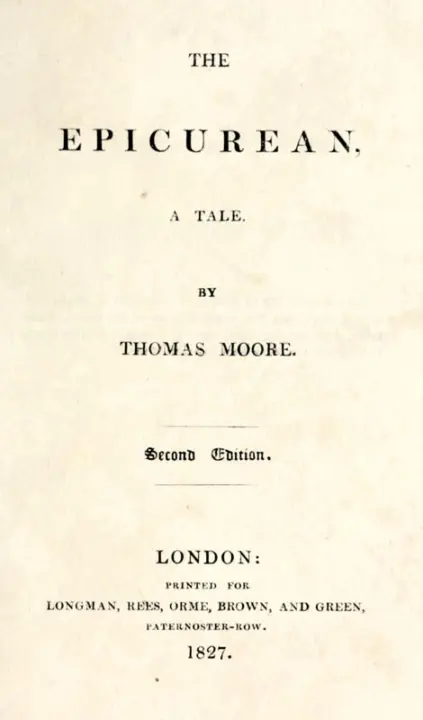
The Epicurean: A Tale
Thomas Moore
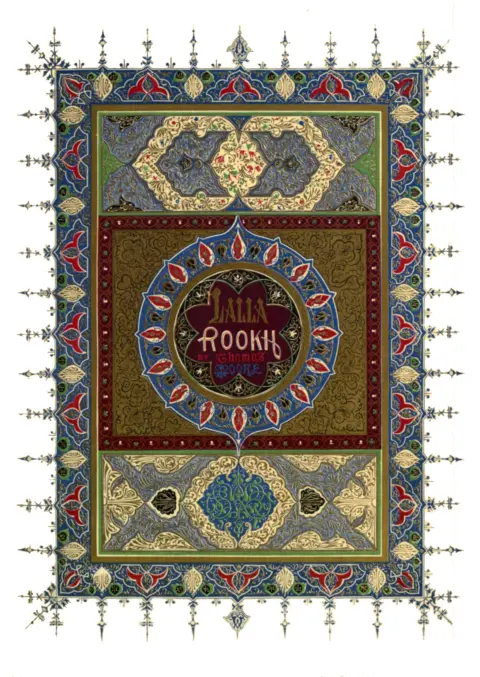
THE CLASSIC COLLECTION · 1817
"Lalla Rookh: An Oriental romance" by Thomas Moore is a romantic work first published in 1817. The poem follows Princess Lalla Rookh, daughter of Mughal emperor Aurangzeb, as she journeys to marry the King of Bukhara. Along the way, she falls in love with Feramorz, a poet in her entourage who entertains her with four enchanting tales. The work blends a frame narrative with interpolated poems set in sumptuous Eastern settings, exploring themes of love, disguise, and identity in a world of Persian splendor.
Introduction adapted from the source catalogue; source summaries may be automatically generated.
Free to read · English · 77,115 words · No account needed
MAKE TIME FOR A GOOD BOOK
On by default. Untick to stop anonymous reading totals. Each page counts after 10 seconds in view. How this works.
Anonymous counting is on unless you have switched it off.
“The Arabians call the mandrake ‘the Devil’s candle,’ on account of its shining appearance in the night.”—Richardson.
Footnote 288:
p. 249.—Of the still Halls of ISHMONIE.
For an account of Ishmonie, the petrified city in Upper Egypt, where it is said there are many statues of men, women, &c. to be seen to this day, see Perry’s View of the Levant.
Footnote 289:
p. 250.—And ne’er did saint of ISSA gaze.—Jesus.
Footnote 290:
p. 251.—The death-flames that beneath him burn’d!
The Ghebers say that when Abraham, their great Prophet, was thrown into the fire by order of Nimrod, the flame turned instantly into “a bed of roses, where the child sweetly reposed.”—Tavernier.
Of their other Prophet, Zoroaster, there is a story told in Dion Prusæus, Orat. 36, that the love of wisdom and virtue leading him to a solitary life upon a mountain, he found it one day all in a flame, shining with celestial fire, out of which he came without any harm, and instituted certain sacrifices to God, who, he declared, then appeared to him.—See Patrick on Exodus, iii. 2.
Footnote 291:
p. 254.—A ponderous sea-horn hung, and blew.
“The shell called Siiankos, common to India, Africa, and the Mediterranean, and still used in many parts as a trumpet for blowing alarms or giving signals: it sends forth a deep and hollow sound.”—Pennant.
Footnote 292:
p. 255.—And the white ox-tails stream’d behind.
“The finest ornament for the horses is made of six large flying tassels of long white hair, taken out of the tails of wild oxen, that are to be found in some places of the Indies.”—Thevenot.
Footnote 293:
p. 257.—Sweet as the angel ISRAFIL’S.
“The angel Israfil, who has the most melodious voice of all God’s
creatures.”—Sale.
Footnote 294:
p. 261.—Wound slow, as through GOLCONDA’S vale.
See Hoole upon the Story of Sinbad.
Footnote 295:
p. 265.—From the wild covert where he lay.
“In this thicket upon the banks of the Jordan several sorts of wild beasts are wont to harbour themselves, whose being washed out of the covert by the overflowings of the river gave occasion to that allusion of Jeremiah, he shall come up like a lion from the swelling of Jordan.”—Maundrell’s Aleppo.
Footnote 296:
p. 275.—Like the wind of the south o’er a summer lute blowing.
“This wind (the Samoor) so softens the strings of lutes, that they can never be tuned while it lasts.”—Stephen’s Persia.
Footnote 297:
p. 275.—With nought but the sea-star to light up her tomb.
Your reading position is saved on this browser. Take it to another device with a library code. Reading pages adapt to text, rather than matching a printed edition.
BEHIND THE BOOK
This eBook is for the use of anyone anywhere in the United States and most other parts of the world at no cost and with almost no restrictions whatsoever. You may copy it, give it away or re-use it under the terms of the Project Gutenberg License included with this eBook or online at www.gutenberg.org. If you are not located in the United States, you will have to check the laws of the country where you are located before using this eBook. Read the source licence.
The original source file, including credits and licence, is retained by this library. Request an original-format copy at no charge. Please include the book title and Project Gutenberg identifier #76794.
KEEP YOUR CURIOSITY GOING
Coulson Kernahan

Maurice Baring
Frances Wright
Cécile Tormay

Frederic Jesup Stimson

W. H. P. (William Henry Pope) Jarvis