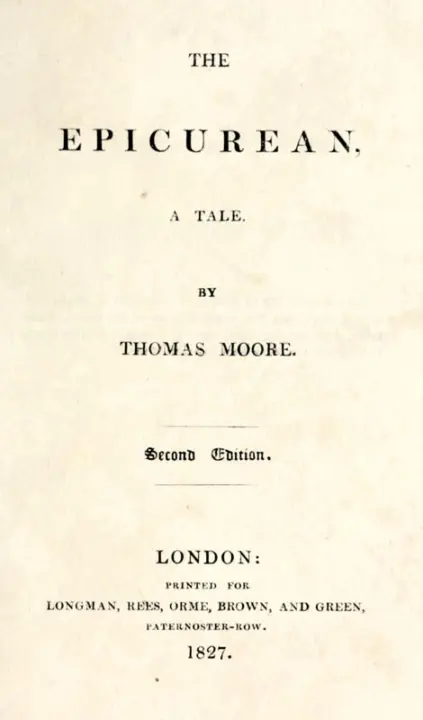
The Epicurean: A Tale
Thomas Moore
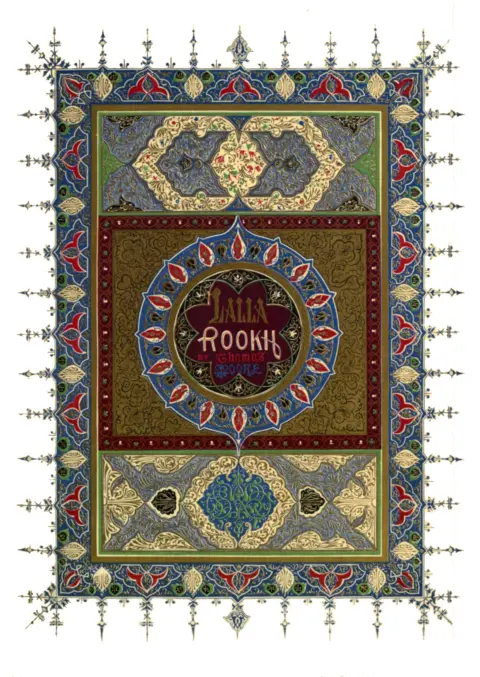
THE CLASSIC COLLECTION · 1817
"Lalla Rookh: An Oriental romance" by Thomas Moore is a romantic work first published in 1817. The poem follows Princess Lalla Rookh, daughter of Mughal emperor Aurangzeb, as she journeys to marry the King of Bukhara. Along the way, she falls in love with Feramorz, a poet in her entourage who entertains her with four enchanting tales. The work blends a frame narrative with interpolated poems set in sumptuous Eastern settings, exploring themes of love, disguise, and identity in a world of Persian splendor.
Introduction adapted from the source catalogue; source summaries may be automatically generated.
Free to read · English · 77,115 words · No account needed
MAKE TIME FOR A GOOD BOOK
On by default. Untick to stop anonymous reading totals. Each page counts after 10 seconds in view. How this works.
Anonymous counting is on unless you have switched it off.
p. 219.—Shooting around their jasper fount.
“The Empress of Jehan-Guire used to divert herself with feeding tame fish in her canals, some of which were many years afterwards known by fillets of gold, which she caused to be put round them.”—Harris.
Footnote 275:
p. 219.—To tell her ruby rosary.
“Le Tespih, qui est un chapelet composé de 99 petites boules d’agate, de jaspe, d’ambre, de corail, ou d’autre matière précieuse. J’en ai vu un superbe au Seigneur Jerpos; il étoit de belles et grosses perles parfaites et égales, estimé trente mille piastres.”—Toderini.
Footnote 276:
p. 223.—Like meteor brands as if throughout.
The meteors that Pliny calls “faces.”
Footnote 277:
p. 224.—The Star of EGYPT whose proud light.
“The brilliant Canopus, unseen in European climates.”—Brown.
Footnote 278:
p. 224.—In the White Islands of the West.
See Wilford’s learned Essays on the Sacred Isles in the West.
Footnote 279:
p. 225.—Sparkles, as ’twere that lightning-gem.
A precious stone of the Indies, called by the ancients Ceraunium, because it was supposed to be found in places where thunder had fallen. Tertullian says it has a glittering appearance, as if there had been fire in it; and the author of the Dissertation in Harris’s Voyages supposes it to be the opal.
Footnote 280:
p. 227.—Their garb—the leathern belt that wraps.
D’Herbelot, art. Agduani.
Footnote 281:
p. 227.—Each yellow vest—that rebel hue.
“The Guebres are known by a dark yellow colour, which the men affect in their clothes.”—Thevenot.
Footnote 282:
p. 227.—The Tartar fleece upon their caps.
“The Kolah or cap, worn by the Persians, is made of the skin of the sheep of Tartary.”—Waring.
Footnote 283:
p. 234.—Open her bosom’s glowing veil.
A frequent image among the Oriental poets. “The nightingales warbled their enchanting notes, and rent the thin veils of the rosebud and the rose.”—Jami.
Footnote 284:
p. 237.—The sorrowful tree, Nilica.—“Blossoms of the sorrowful Nyctanthes give a durable colour to silk.”—Remarks on the Husbandry of Bengal, p. 200. Nilica is one of the Indian names of this flower.—Sir W. Jones. The Persians call it Gul.—Carreri.
Footnote 285:
p. 239.—That cooling feast the traveller loves.
“In parts of Kerman, whatever dates are shaken from the trees by the wind they do not touch, but leave them for those who have not any, or for travellers.”—Ebn Haukal.
Footnote 286:
p. 240.—The Searchers of the Grave appear.
The two terrible angels Monkir and Nakir, who are called “the Searchers of the Grave” in the “Creed of the orthodox Mahometans” given by Ockley, vol. ii.
Footnote 287:
p. 240.—The mandrake’s charnel leaves at night.
Your reading position is saved on this browser. Take it to another device with a library code. Reading pages adapt to text, rather than matching a printed edition.
BEHIND THE BOOK
This eBook is for the use of anyone anywhere in the United States and most other parts of the world at no cost and with almost no restrictions whatsoever. You may copy it, give it away or re-use it under the terms of the Project Gutenberg License included with this eBook or online at www.gutenberg.org. If you are not located in the United States, you will have to check the laws of the country where you are located before using this eBook. Read the source licence.
The original source file, including credits and licence, is retained by this library. Request an original-format copy at no charge. Please include the book title and Project Gutenberg identifier #76794.
KEEP YOUR CURIOSITY GOING
Coulson Kernahan

Maurice Baring
Frances Wright
Cécile Tormay

Frederic Jesup Stimson

W. H. P. (William Henry Pope) Jarvis