
Life of Harriet Beecher Stowe Compiled From Her Letters and Journals by Her Son Charles Edward Stowe
Harriet Beecher Stowe
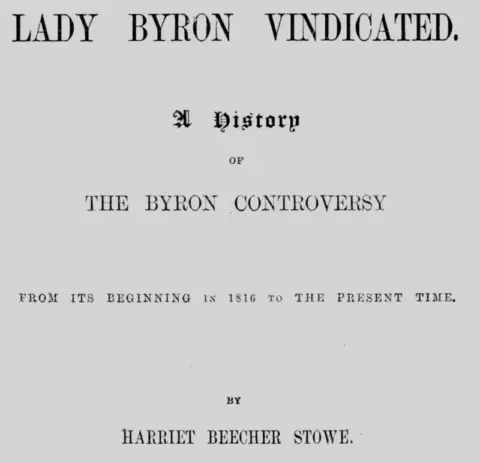
THE CLASSIC COLLECTION · 1870
"Lady Byron Vindicated: A History of the Byron Controversy" by Harriet Beecher Stowe is a historical account written in the late 19th century. The book aims to defend Lady Byron's reputation against the slanders and accusations that emerged during and after her marriage to Lord Byron, particularly focusing on the controversies surrounding their separation and subsequent events. Stowe seeks to present a comprehensive narrative that counters the allegations made against Lady Byron and establishes her innocence and integrity. The opening of the book sets a somber tone as Stowe reflects on the public discourse surrounding Lady Byron, highlighting the distress and slander that her character has endured. Stowe reveals her motivation for writing the account, which is driven by a deep sense of justice and concern for her friend's legacy. She asserts that the attacks on Lady Byron's reputation were orchestrated by Lord Byron himself and claims that these defamatory narratives have reached a peak even after Lady Byron's death. By establishing this context, Stowe prepares the groundwork for a detailed examination of the Byron controversy, promising to present evidence and testimonies that will vindicate Lady Byron in the eyes of the world.
Introduction adapted from the source catalogue; source summaries may be automatically generated.
Free to read · English · 99,630 words · No account needed
MAKE TIME FOR A GOOD BOOK
On by default. Untick to stop anonymous reading totals. Each page counts after 10 seconds in view. How this works.
Anonymous counting is on unless you have switched it off.
'"I am a very incompetent judge of the impression which the last canto of 'Childe Harold' may produce on the minds of indifferent readers. It contains the usual trace of a conscience restlessly awake; though his object has been too long to aggravate its burden, as if it could thus be oppressed into eternal stupor. I will hope, as you do, that it survives for his ultimate good. It was the acuteness of his remorse, impenitent in its character, which so long seemed to demand from my compassion to spare every resemblance of reproach, every look of grief, which might have said to his conscience, 'You have made me wretched.' I am decidedly of opinion that he is responsible. He has wished to be thought partially deranged, or on the brink of it, to perplex observers, and prevent them from tracing effects to their real causes through all the intricacies of his conduct. I was, as I told you, at one time the dupe of his acted insanity, and clung to the former delusions in regard to the motives that concerned me personally, till the whole system was laid bare. He is the absolute monarch of words, and uses them, as Bonaparte did lives, for conquest, without more regard to their intrinsic value; considering them only as ciphers, which must derive all their import from the situation in which he places them, and the ends to which he adapts them with such consummate skill. Why, then, you will say, does he not employ them to give a better colour to his own character? Because he is too good an actor to over-act, or to assume a moral garb which it would be easy to strip off. In regard to his poetry, egotism is the vital principle of his imagination, which it is difficult for him to kindle on any subject with which his own character and interests are not identified: but by the introduction of fictitious incidents, by change of scene or time, he has enveloped his poetical disclosures in a system impenetrable except to a very few; and his constant desire of creating a sensation makes him not averse to be the object of wonder and curiosity, even though accompanied by some dark and vague suspicions. Nothing has contributed more to the misunderstanding of his real character than the lonely grandeur in which he shrouds it, and his affectation of being above mankind, when he exists almost in their voice. The romance of his sentiments is another feature of this mask of state. I know no one more habitually destitute of that enthusiasm he so beautifully expresses, and to which he can work up his fancy chiefly by contagion. I had heard he was the best of brothers, the most generous of friends; and I thought such feelings only required to be warmed and cherished into more diffusive benevolence. Though these opinions are eradicated, and could never return but with the decay of my memory, you will not wonder if there are still moments when the association of feelings which arose from them soften and sadden my thoughts. But I have not thanked you, dearest Lady Anne, for your kindness in regard to a principal object,--that of rectifying false impressions. I trust you understand my wishes, which never were to injure Lord Byron in any way: for, though he would not suffer me to remain his wife, he cannot prevent me from continuing his friend; and it was from considering myself as such that I silenced the accusations by which my own conduct might have been more fully justified. It is not necessary to speak ill of his heart in general: it is sufficient that to me it was hard and impenetrable; that my own must have been broken before his could have been touched. I would rather represent this as my misfortune than as his guilt; but surely that misfortune is not to be made my crime! Such are my feelings: you will judge how to act. His allusions to me in 'Childe Harold' are cruel and cold, but with such a semblance as to make me appear so, and to attract all sympathy to himself. It is said in this poem that hatred of him will be taught as a lesson to his child. I might appeal to all who have ever heard me speak of him, and still more to my own heart, to witness that there has been no moment when I have remembered injury otherwise than affectionately and sorrowfully. It is not my duty to give way to hopeless and wholly unrequited affection; but, so long as I live, my chief struggle will probably be not to remember him too kindly. I do not seek the sympathy of the world; but I wish to be known by those whoso opinion is valuable, and whose kindness is dear to me. Among such, my dear Lady Anne, you will ever be remembered by your truly affectionate,
Your reading position is saved on this browser. Take it to another device with a library code. Reading pages adapt to text, rather than matching a printed edition.
Harriet Beecher Stowe

Harriet Beecher Stowe
Harriet Beecher Stowe

Harriet Beecher Stowe
BEHIND THE BOOK
This eBook is for the use of anyone anywhere in the United States and most other parts of the world at no cost and with almost no restrictions whatsoever. You may copy it, give it away or re-use it under the terms of the Project Gutenberg License included with this eBook or online at www.gutenberg.org. If you are not located in the United States, you will have to check the laws of the country where you are located before using this eBook. Read the source licence.
The original source file, including credits and licence, is retained by this library. Request an original-format copy at no charge. Please include the book title and Project Gutenberg identifier #44791.
KEEP YOUR CURIOSITY GOING
Cécile Tormay

Moritz Busch
John L. Ransom
Frances Wright
Cécile Tormay

Mabel Potter Daggett