
Life of Harriet Beecher Stowe Compiled From Her Letters and Journals by Her Son Charles Edward Stowe
Harriet Beecher Stowe
THE CLASSIC COLLECTION · 1870
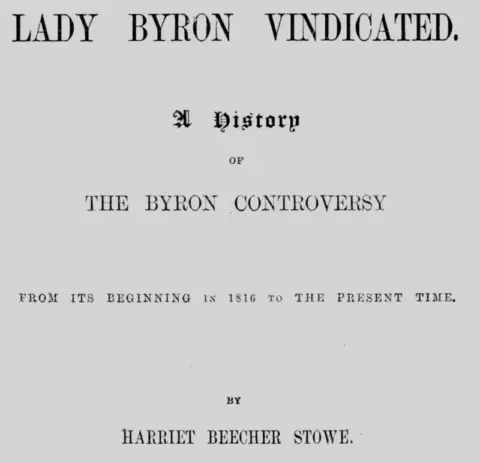
"Lady Byron Vindicated: A History of the Byron Controversy" by Harriet Beecher Stowe is a historical account written in the late 19th century. The book aims to defend Lady Byron's reputation against the slanders and accusations that emerged during and after her marriage to Lord Byron, particularly focusing on the controversies surrounding their separation and subsequent events. Stowe seeks to present a comprehensive narrative that counters the allegations made against Lady Byron and establishes her innocence and integrity. The opening of the book sets a somber tone as Stowe reflects on the public discourse surrounding Lady Byron, highlighting the distress and slander that her character has endured. Stowe reveals her motivation for writing the account, which is driven by a deep sense of justice and concern for her friend's legacy. She asserts that the attacks on Lady Byron's reputation were orchestrated by Lord Byron himself and claims that these defamatory narratives have reached a peak even after Lady Byron's death. By establishing this context, Stowe prepares the groundwork for a detailed examination of the Byron controversy, promising to present evidence and testimonies that will vindicate Lady Byron in the eyes of the world.
Introduction adapted from the source catalogue; source summaries may be automatically generated.
Free to read · English · 99,630 words · No account needed
MAKE TIME FOR A GOOD BOOK
On by default. Untick to stop anonymous reading totals. Each page counts after 10 seconds in view. How this works.
Anonymous counting is on unless you have switched it off.
The late Lady Anne Barnard, who died in 1825, a contemporary and friend of Burke, Windham, Dundas, and a host of the wise and good of that generation, and remembered in letters as the authoress of 'Auld Robin Gray,' had known the late Lady Byron from infancy, and took a warm interest in her; holding Lord Byron in corresponding repugnance, not to say prejudice, in consequence of what she believed to be his harsh and cruel treatment of her young friend. I transcribe the following passages, and a letter from Lady Byron herself (written in 1818) from ricordi, or private family memoirs, in Lady Anne's autograph, now before me. I include the letter, because, although treating only in general terms of the matter and causes of the separation, it affords collateral evidence bearing strictly upon the point of the credibility of the charge now in question:--
'The separation of Lord and Lady Byron astonished the world, which believed him a reformed man as to his habits, and a becalmed man as to his remorses. He had written nothing that appeared after his marriage till the famous "Fare thee well," which had the power of compelling those to pity the writer who were not well aware that he was not the unhappy person he affected to be. Lady Byron's misery was whispered soon after her marriage and his ill usage, but no word transpired, no sign escaped, from her. She gave birth, shortly, to a daughter; and when she went, as soon as she was recovered, on a visit to her father's, taking her little Ada with her, no one knew that it was to return to her lord no more. At that period, a severe fit of illness had confined me to bed for two months. I heard of Lady Byron's distress; of the pains he took to give a harsh impression of her character to the world. I wrote to her, and entreated her to come and let me see and hear her, if she conceived my sympathy or counsel could be any comfort to her. She came; but what a tale was unfolded by this interesting young creature, who had so fondly hoped to have made a young man of genius and romance (as she supposed) happy! They had not been an hour in the carriage which conveyed them from the church, when, breaking into a malignant sneer, "Oh! what a dupe you have been to your imagination! How is it possible a woman of your sense could form the wild hope of reforming me? Many are the tears you will have to shed ere that plan is accomplished. It is enough for me that you are my wife for me to hate you! If you were the wife of any other man, I own you might have charms," &c. I who listened was astonished. "How could you go on after this," said I, "my dear? Why did you not return to your father's?" "Because I had not a conception he was in earnest; because I reckoned it a bad jest, and told him so,--that my opinions of him were very different from his of himself, otherwise he would not find me by his side. He laughed it over when he saw me appear hurt: and I forgot what had passed, till forced to remember it. I believe he was pleased with me, too, for a little while. I suppose it had escaped his memory that I was his wife." But she described the happiness they enjoyed to have been unequal and perturbed. Her situation, in a short time, might have entitled her to some tenderness; but she made no claim on him for any. He sometimes reproached her for the motives that had induced her to marry him: all was "vanity, the vanity of Miss Milbanke carrying the point of reforming Lord Byron! He always knew her inducements; her pride shut her eyes to his: he wished to build up his character and his fortunes; both were somewhat deranged: she had a high name, and would have a fortune worth his attention,--let her look to that for his motives!"--"O Byron, Byron!" she said, "how you desolate me!" He would then accuse himself of being mad, and throw himself on the ground in a frenzy, which she believed was affected to conceal the coldness and malignity of his heart,--an affectation which at that time never failed to meet with the tenderest commiseration. I could find by some implications, not followed up by me, lest she might have condemned herself afterwards for her involuntary disclosures, that he soon attempted to corrupt her principles, both with respect to her own conduct and her latitude for his. She saw the precipice on which she stood, and kept his sister with her as much as possible. He returned in the evenings from the haunts of vice, where he made her understand he had been, with manners so profligate! "O the wretch!" said I. "And had he no moments of remorse?" "Sometimes he appeared to have them. One night, coming home from one of his lawless parties, he saw me so indignantly collected, and bearing all with such a determined calmness, that a rush of remorse seemed to come over him. He called himself a monster, though his sister was present, and threw himself in agony at my feet. I could not--no--I could not forgive him such injuries. He had lost me for ever! Astonished at the return of virtue, my tears, I believe, flowed over his face, and I said, 'Byron, all is forgotten: never, never shall you hear of it more!' He started up, and, folding his arms while he looked at me, burst into laughter. 'What do you mean?' said I. 'Only a philosophical experiment; that's all,' said he. 'I wished to ascertain the value of your resolutions.'" I need not say more of this prince of duplicity, except that varied were his methods of rendering her wretched, even to the last. When her lovely little child was born, and it was laid beside its mother on the bed, and he was informed he might see his daughter, after gazing at it with an exulting smile, this was the ejaculation that broke from him: "Oh, what an implement of torture have I acquired in you!" Such he rendered it by his eyes and manner, keeping her in a perpetual alarm for its safety when in his presence. All this reads madder than I believe he was: but she had not then made up her mind to disbelieve his pretended insanity, and conceived it best to intrust her secret with the excellent Dr. Baillie; telling him all that seemed to regard the state of her husband's mind, and letting his advice regulate her conduct. Baillie doubted of his derangement; but, as he did not reckon his own opinion infallible, he wished her to take precautions as if her husband were so. He recommended her going to the country, but to give him no suspicion of her intentions of remaining there, and, for a short time, to show no coldness in her letters, till she could better ascertain his state. She went, regretting, as she told me, to wear any semblance but the truth. A short time disclosed the story to the world. He acted the part of a man driven to despair by her inflexible resentment and by the arts of a governess (once a servant in the family) who hated him. "I will give you," proceeds Lady Anne, "a few paragraphs transcribed from one of Lady Byron's own letters to me. It is sorrowful to think, that, in a very little time, this young and amiable creature, wise, patient, and feeling, will have her character mistaken by every one who reads Byron's works. To rescue her from this, I preserved her letters; and, when she afterwards expressed a fear that any thing of her writings should ever fall into hands to injure him (I suppose she meant by publication), I safely assured her that it never should. But here this letter shall be placed, a sacred record in her favour, unknown to herself":--
Your reading position is saved on this browser. Take it to another device with a library code. Reading pages adapt to text, rather than matching a printed edition.
Harriet Beecher Stowe

Harriet Beecher Stowe
Harriet Beecher Stowe

Harriet Beecher Stowe
BEHIND THE BOOK
This eBook is for the use of anyone anywhere in the United States and most other parts of the world at no cost and with almost no restrictions whatsoever. You may copy it, give it away or re-use it under the terms of the Project Gutenberg License included with this eBook or online at www.gutenberg.org. If you are not located in the United States, you will have to check the laws of the country where you are located before using this eBook. Read the source licence.
The original source file, including credits and licence, is retained by this library. Request an original-format copy at no charge. Please include the book title and Project Gutenberg identifier #44791.
KEEP YOUR CURIOSITY GOING
Cécile Tormay

Moritz Busch
John L. Ransom
Frances Wright
Cécile Tormay

Mabel Potter Daggett