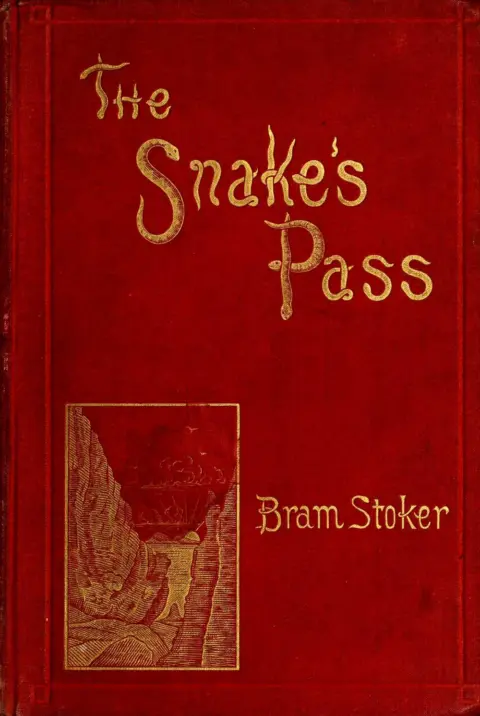
The Snake’s Pass
Bram Stoker
THE CLASSIC COLLECTION · 1908
"Lady Athlyne" by Bram Stoker is a romance novel written in 1908. When a mysterious young suitor pursues Joy, her father deems him suspicious and unacceptable. But Joy's aunt, Miss Judith Hayes, embodies the spirit of "The New Woman"—defying patriarchal authority to unite two young people she believes are meant for each other. Through secret letters and careful orchestration, she works to bring the lovers together, challenging Victorian social conventions in this tale of romance and rebellion.
Introduction adapted from the source catalogue; source summaries may be automatically generated.
Free to read · English · 113,849 words · No account needed
MAKE TIME FOR A GOOD BOOK
On by default. Untick to stop anonymous reading totals. Each page counts after 10 seconds in view. How this works.
Anonymous counting is on unless you have switched it off.
Man’s unconscious action is a strange thing. Athlyne had just heard words which took from him a strain under which he had suffered for a whole week of waiting and watching; words which promised him the opportunity for which he had longed for many weeks. His nerves had been strung to tension so high that now it would seem only natural if the relief sent him into a sort of delirium. But he quietly lit a cigar, taking care that it was properly cut and properly lit, and smoked luxuriously as he moved across the garden and into the street. Joy from her window saw him go, and her admiration of his ease and self possession and magnificent self-reliance sent fresh thrills through her flesh.
When Athlyne went out of the garden he had evidently made up his mind, consciously or unconsciously, to some other point in connection with the motor for he visited such shops as were open and made some purchases--caps, veils, cloaks and such like gear suitable for the use of a tall young lady. These he took with him in a hired carriage to the hotel at Bowness, where he added them to certain others already sent from London. Then he told the chauffeur to give the car a careful overhauling so that it be in perfect order, and went for a stroll up the Lake.
Shortly he was in a mental and physical tumult; the period which had elapsed since he heard the news of Colonel Ogilvie’s coming departure had been but the prelude to the storm. At first he could not think; he had no words, no sequence of ideas, not even vague intentions. He had only sensations; and these though they moved and concentrated every nerve in his body were without even physical purpose. He went like one in a dream. But in the background of his mind was a fact which stood out firm and solid like the profile of a mountain seen against the glow of a western sunset. Joy would be alone to-morrow; the opportunity he waited for was at last at hand! The recognition of this seemed to pull him together, to set all his faculties working simultaneously; and as each had a different method the tumult was in reducing them to unison--in achieving one resultant from all the varying forces. Gradually out of the chaos came the first clear intent: he must so master the whole subject that when the opportunity had come he should be able to avail himself of it to the full. From this he proceeded to weigh the various possibilities, till gradually he began to realise what vague purpose had been behind his wish to have his automobile in perfect working order. It did not even occur to him that with such machinery at his command he might try to carry her off, either without her consent or with it. All that he wanted in the first instance was to have fitting opportunity of discovering how Joy regarded him. The last twenty-four hours had opened to his mind such glorious possibilities that every word she had said, every look on her eloquent face (though such looks had manifestly not been intended for him) had a place in a chain which linked her heart to his. “Look at me!” “I am glad I asked you to look at me!” though spoken to her father seemed to have another significance. It was as though an eager thought had at last found expression. “Good night! Good night, beloved!” though ostensibly spoken to the twilight was breathed with such fervour, with such languishing eyes and with such soft pouting of scarlet lips that it seemed impossible that it should have other than a human objective. These thoughts swept the man into a glow of passion. He was young and strong and ardent, and he loved the woman with all his heart; with all his soul; with all the strength of human passion. It is a mistake to suppose--as some abstract thinkers seem to do always, and most people at some moment of purely spiritual exaltation--that the love of a man and a woman each for the other is, even at its very highest, devoid of physical emotion. The original Creator did not manifestly so intend. The world of thought is an abstract world whose inner shrine is where soul meets soul. The world of life is the world of the heart, and its beating is the sway of the pendulum between soul and flesh. The world of flesh is the real world; wrought of physical atoms in whose recurrent groupings is the elaborated scheme of nature. Into this world has been placed Man to live and rule. To this end his body is fixed with various powers and complications and endurances; with weaknesses and impulses and yieldings; with passions to animate, with desires to attract, and animosities to repel. And as the final crowning of this wondrous work, the last and final touch of the Creator’s hand, Sex for the eternal renewing of established forces. How can souls be drawn to souls when such are centred in bodies which mutually repel? How can the heart quicken its beats when it may not come near enough to hear the answering throb? No! If physical attraction be not somewhere, naught can develop. Judy, the outspoken, had once almost horrified a little group of matrons who were discussing the interest which a certain young cleric was beginning to take in one of the young female parishioners. When one of them said, somewhat sanctimoniously, that his interest was only in the salvation of her immortal soul, that he was too good a man to ever think of falling in love as ordinary men do, the vivacious old maid replied:
Your reading position is saved on this browser. Take it to another device with a library code. Reading pages adapt to text, rather than matching a printed edition.
BEHIND THE BOOK
This eBook is for the use of anyone anywhere in the United States and most other parts of the world at no cost and with almost no restrictions whatsoever. You may copy it, give it away or re-use it under the terms of the Project Gutenberg License included with this eBook or online at www.gutenberg.org. If you are not located in the United States, you will have to check the laws of the country where you are located before using this eBook. Read the source licence.
The original source file, including credits and licence, is retained by this library. Request an original-format copy at no charge. Please include the book title and Project Gutenberg identifier #65799.
KEEP YOUR CURIOSITY GOING
Coulson Kernahan

Maurice Baring
Frances Wright
Cécile Tormay

Frederic Jesup Stimson

W. H. P. (William Henry Pope) Jarvis