Things to be Remembered in Daily Life With Personal Experiences and Recollections
John Timbs
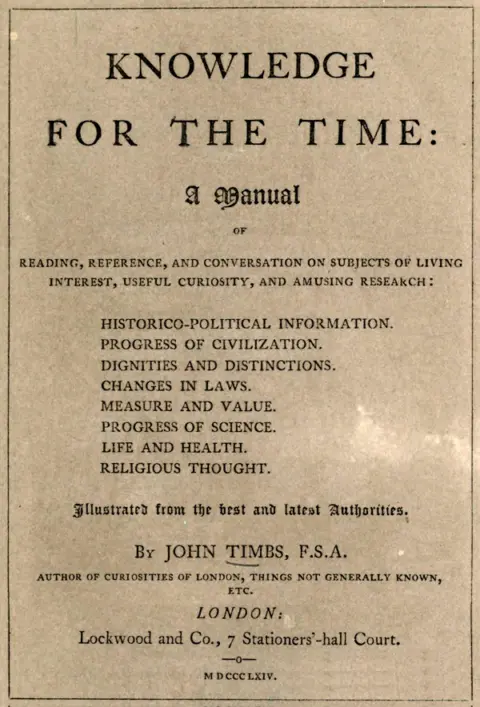
THE CLASSIC COLLECTION · 1864
"Knowledge for the Time" by John Timbs is a manual designed for reading, reference, and conversation, likely written in the mid-19th century. The work aims to present a wide host of information on a variety of topics, from historical and political knowledge to advancements in science and a survey of contemporary thought. Timbs offers insights gathered from reliable sources, intending to enrich the reader's understanding of the current state of affairs and historical events. The opening of the manual lays out its premise by emphasizing the importance of contemporary history and the increasing appreciation for accounts written by those who have directly witnessed events. Timbs stresses that the book aims to correct misunderstandings of the past with insights from the present. He discusses the nature of knowledge and its mixed character, advocating for a broad understanding that encompasses various fields. Through structured summaries and anecdotes, he seeks to make the volume useful for both casual readers and more in-depth researchers, ensuring the dissemination of concise, engaging information on subjects of great interest and utility.
Introduction adapted from the source catalogue; source summaries may be automatically generated.
Free to read · English · 140,561 words · No account needed
MAKE TIME FOR A GOOD BOOK
On by default. Untick to stop anonymous reading totals. Each page counts after 10 seconds in view. How this works.
Anonymous counting is on unless you have switched it off.
There were in Ireland at the time of the Census of 1861, 1,105,536 persons who spoke Irish. 163,275 of them spoke Irish only; the other 942,261 spoke both Irish and English. Of those who spoke Irish only, 3,075 were in the civic districts and 160,200 in the rural districts. That the number is declining is obvious from the circumstance that the proportion under 20 years of age was less than a third. 77,818 were in Connaught (in a population of less than a million), 62,039 in Munster, 23,180 in Ulster, only 238 in all Leinster.
Our Colonial Empire.
The Colonies of Great Britain comprise altogether 3,350,000 square miles, and cost us for management 3,350,000l. per annum, or just about a pound a mile. They have an aggregate revenue of 11,000,000l., and owe among them 27,000,000l., or just two years and a half’s income. They import goods to the amount of 60,000,000l. yearly--half from ourselves, and half from all the rest of the world. They export produce to the value of 50,000,000l., of which three-fifths come to this kingdom; and all this is done by a population which is under 10,000,000 in the aggregate, and of which only 5,000,000 are whites. Add to these figures, says the Spectator, 900,000 square miles for India, and 200,000,000 of people with a trade of 71,000,000l., and we have a result that the Queen reigns ever nearly one-third of the land of the earth, and nearly a fourth of its population. If a British vizier under the Emperor should, as it seems probable, rule China, Englishmen will directly control more than half the human race!
Our Colonies may be grouped or classed as North American, Australian, Mediterranean, Atlantic, West Indian, Eastern, and African. In extent of territory no Colonies approach those of Australia. The palm of debt belongs to Canada, that of cost to the Mediterranean settlements, that of commerce to the Australian Colonies again. This great show of trade is owing to the precious character of their produce. Of the gross exports of 50,000,000l. they claim 22,000,000l., and cost little or nothing for garrisons all the while. In 1860, 250,000l. paid the entire military expenditure on this group of our dependencies; but New Zealand, which only stood at 100,000l. then, is probably not managed for that figure now. We can see but little trace of its gold-fields in the return before us, which throws all the weight upon New South Wales and Victoria. The former of these settlements exported in 1860 produce to the value of 5,000,000l.; the latter (and here come the gold-ships) no less than 13,000,000l. worth of goods. Three-fourths of this, too, came to England, whereas in the export-trade of New South Wales three-fourths went to foreign countries. Victoria also imported very largely from us, as did the other Colonies of the group, standing, in the whole, for more than half the sum total of this column.
Your reading position is saved on this browser. Take it to another device with a library code. Reading pages adapt to text, rather than matching a printed edition.
John Timbs
John Timbs
John Timbs
John Timbs
BEHIND THE BOOK
This eBook is for the use of anyone anywhere in the United States and most other parts of the world at no cost and with almost no restrictions whatsoever. You may copy it, give it away or re-use it under the terms of the Project Gutenberg License included with this eBook or online at www.gutenberg.org. If you are not located in the United States, you will have to check the laws of the country where you are located before using this eBook. Read the source licence.
The original source file, including credits and licence, is retained by this library. Request an original-format copy at no charge. Please include the book title and Project Gutenberg identifier #49524.
KEEP YOUR CURIOSITY GOING

Charles G. (Charles Griffith) Ross
Hannah Webster Foster

Emily Lawless
Edwin Hamlin Carr

Charles De Lano Hine
Andrew Ure