Things to be Remembered in Daily Life With Personal Experiences and Recollections
John Timbs
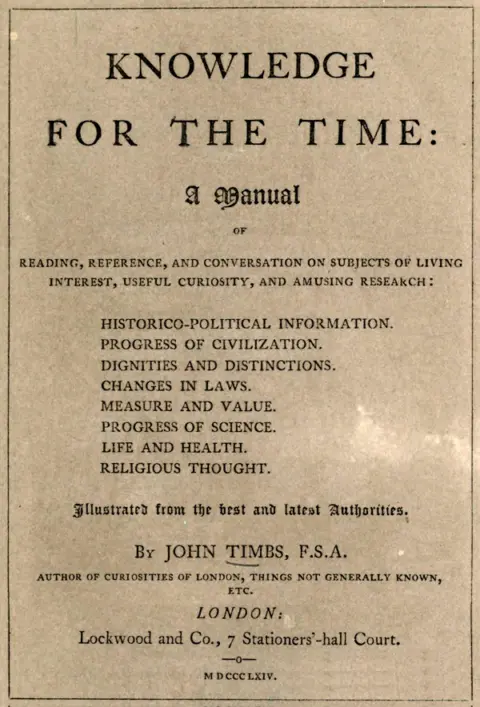
THE CLASSIC COLLECTION · 1864
"Knowledge for the Time" by John Timbs is a manual designed for reading, reference, and conversation, likely written in the mid-19th century. The work aims to present a wide host of information on a variety of topics, from historical and political knowledge to advancements in science and a survey of contemporary thought. Timbs offers insights gathered from reliable sources, intending to enrich the reader's understanding of the current state of affairs and historical events. The opening of the manual lays out its premise by emphasizing the importance of contemporary history and the increasing appreciation for accounts written by those who have directly witnessed events. Timbs stresses that the book aims to correct misunderstandings of the past with insights from the present. He discusses the nature of knowledge and its mixed character, advocating for a broad understanding that encompasses various fields. Through structured summaries and anecdotes, he seeks to make the volume useful for both casual readers and more in-depth researchers, ensuring the dissemination of concise, engaging information on subjects of great interest and utility.
Introduction adapted from the source catalogue; source summaries may be automatically generated.
Free to read · English · 140,561 words · No account needed
MAKE TIME FOR A GOOD BOOK
On by default. Untick to stop anonymous reading totals. Each page counts after 10 seconds in view. How this works.
Anonymous counting is on unless you have switched it off.
Nothing can be more erroneous than the notion that the despot, though he may himself oppress his people, can prevent others from doing the same. He is cheated by his subordinates, and they cheat the people.--Archbishop Whately.
True Source of Civilization.
The killing of animals for food is, after all, merely the resource of the savage, and domesticated animals and cultivated plants are indispensable to the earliest advances of civilization. It may be safely averred, says Mr. Craufurd, that no people ever attained any great civilization without, for example, the possession of some cereal, and without having domesticated the horse, or the ox, or the buffalo. No evidence exists of a people emerging from barbarism whose food consisted of the cocoa-nut, the banana, the date, the bread-fruit, sago, the potato, the yam, or the batata. Such articles are too easily produced, require too little skill and ingenuity to raise; and when they fail, there is nothing to fall back upon--nothing between the people cultivating them and starvation. The higher, too, the cereal the better, wheat standing at the top of the list in temperate regions, and rice in warm ones. Thus, the cereals of Egypt, nurtured by the mud of the Nile, created a respectable civilization among a very inferior race. It was because the Egyptians, says Mr. Craufurd, besides the date, possessed wheat, barley, pulse, and the ox, and that nature dressed and irrigated their country, that the Egyptians became numerous and civilized.
The Lowest Civilization.
The South Sea Islanders who scalded their fingers in Captain Cook’s tea-kettle, and to whom pottery and warm water were luxuries also, were certainly low in the scale of civilization, but they were not nearly so low as the Terra del Fuegans at this moment. Mr. Darwin describes the state of these wretched creatures as the extreme of misery, and as affording him the most curious and interesting spectacle he had ever beheld. “I could not have believed,” says he, “how wide was the difference between savage and civilized men.” Their land, we should remember, is a land of rain, sleet, snow, and storms, unsheltered from the cold of the South Pole, and one thick murky mass of forest. The “climate (where gale succeeds gale, with rain, hail, and sleet) seems blacker than anywhere else. In the Straits of Magellan, looking due south from Port Famine, the distant channels between the mountains appear, from their gloominess, to lead beyond the confines of the world.” In this terrestrial limbo live human beings who are clad, for this inclement temperature, in a single otter-skin, which they lace across their breast by strings, and, according as the wind blows, shift from side to side. He pictures the state of these poor creatures at night, some half-a-dozen of them sleeping together naked on the wet ground coiled up like animals. “Whenever it is low water they must rise to pick shellfish from the rocks; and the women, winter and summer, either dive to collect sea-eggs, or sit patiently in their canoes, and with a baited hair-line jerk out small fish. If a seal is killed, or the floating carcass of a putrid whale is discovered, they are feasts. Such miserable food is assisted by a few tasteless berries and fungi.” Mr. Snow, who brings us our latest reports from the Fuegans, visited them in 1855. At present, however, their condition in the scale of humanity is almost as low as it can be; for though they possess the capacity of kindling a fire by the friction of two sticks (an accomplishment of which, by the way, all savages that we know of are capable), and though they can form canoes by hollowing out logs of wood, they cultivate no plant and domesticate no animal, and have, as we see, no other art of civilized life.--Times journal.
Your reading position is saved on this browser. Take it to another device with a library code. Reading pages adapt to text, rather than matching a printed edition.
John Timbs
John Timbs
John Timbs
John Timbs
BEHIND THE BOOK
This eBook is for the use of anyone anywhere in the United States and most other parts of the world at no cost and with almost no restrictions whatsoever. You may copy it, give it away or re-use it under the terms of the Project Gutenberg License included with this eBook or online at www.gutenberg.org. If you are not located in the United States, you will have to check the laws of the country where you are located before using this eBook. Read the source licence.
The original source file, including credits and licence, is retained by this library. Request an original-format copy at no charge. Please include the book title and Project Gutenberg identifier #49524.
KEEP YOUR CURIOSITY GOING

Charles G. (Charles Griffith) Ross
Hannah Webster Foster

Emily Lawless
Edwin Hamlin Carr

Charles De Lano Hine
Andrew Ure