Things to be Remembered in Daily Life With Personal Experiences and Recollections
John Timbs
THE CLASSIC COLLECTION · 1864
"Knowledge for the Time" by John Timbs is a manual designed for reading, reference, and conversation, likely written in the mid-19th century. The work aims to present a wide host of information on a variety of topics, from historical and political knowledge to advancements in science and a survey of contemporary thought. Timbs offers insights gathered from reliable sources, intending to enrich the reader's understanding of the current state of affairs and historical events. The opening of the manual lays out its premise by emphasizing the importance of contemporary history and the increasing appreciation for accounts written by those who have directly witnessed events. Timbs stresses that the book aims to correct misunderstandings of the past with insights from the present. He discusses the nature of knowledge and its mixed character, advocating for a broad understanding that encompasses various fields. Through structured summaries and anecdotes, he seeks to make the volume useful for both casual readers and more in-depth researchers, ensuring the dissemination of concise, engaging information on subjects of great interest and utility.
Introduction adapted from the source catalogue; source summaries may be automatically generated.
Free to read · English · 140,561 words · No account needed
MAKE TIME FOR A GOOD BOOK
On by default. Untick to stop anonymous reading totals. Each page counts after 10 seconds in view. How this works.
Anonymous counting is on unless you have switched it off.
Periods and Conditions of Life,--Age of the People, 233.--The Human Heart,--The Sense of Hearing, 234.--Care of the Teeth,--On Blindness, 235.--Sleeping and Dreaming, 236.--Position in Sleeping,--Hair suddenly changing Colour, 237.--Consumption not hopeless, 238.--Change of Climate,--Perfumes, 239.--Cure for Yellow Fever,--Nature’s Ventilation, 240.--Artificial Ventilation,--Worth of Fresh Air, 241.--Town and Country, 243.--Recreations of the People,--The Druids and their Healing Art, 244.--Remedies for Cancer, 245.--Improved Surgery,--Restoration of a Fractured Leg, 246.--The Original “Dr. Sangrado,”--False Arts advancing true, 247.--Brief History of Medicine, 248.--What has Science done for Medicine? 249.--Element of Physic in Medical Practice, 250.--Physicians’ Fees,--Prevention of Pitting in Small-pox, 251.--Underneath the Skin, 252.--Relations of Mind and Organization, 253.--Deville, the Phrenologist, 254.--“Seeing is believing,” 255.--Causes of Insanity, 256.--Brain-Disease, 257.--The Half-mad, 258.--Motives for Suicide,--Remedy for Poisoning, 259.--New Remedy for Wounds,--Compensation for Wounds,--The Best Physician, 260.--The Uncertainty of Human Life, 262.
Moveable Feasts,--Christmas, 266.--Doubt about Religion, 267.--Our Age of Doubt, 270.--A Hint to Sceptics,--What is Egyptology? 271.--Jerusalem and Nimroud, 272.--What is Rationalism? 273.--What is Theology? 274.--Religious Forebodings, 275.--Folly of Atheism,--The First Congregational Church in England, 276.--Innate Ideas, and Pre-existence of Souls, 277.--Sabbath of Professional Men, 278.--“In the Beginning,” 279.--The last Religious Martyrs in England,--Liberty of Conscience, 281.--Awful Judgments,--Christian Education,--The Book of Psalms, 283.--The Book of Job, 285.
Great Precedence Question 287
Historico-Political Information.
Politics not yet a Science.
Mr. Buckle, in his thoughtful History of Civilization, remarks: “In the present state of knowledge, Politics, so far from being a science, is one of the most backward of all the arts; and the only safe course for the legislator is to look upon his craft as consisting in the adaptation of temporary contrivances to temporary emergencies. His business is to follow the age, and not at all to attempt to lead it. He should be satisfied with studying what is passing around him, and should modify his schemes, not according to the notions he has inherited from his fathers, but according to the actual exigencies of his own time. For he may rely upon it that the movements of society have now become so rapid that the wants of one generation are no measure of the wants of another; and that men, urged by a sense of their own progress, are growing weary of idle talk about the wisdom of their ancestors, and are fast discarding those trite and sleepy maxims which have hitherto imposed upon them, but by which they will not consent to be much longer troubled.”
The Philosopher and the Historian.
Your reading position is saved on this browser. Take it to another device with a library code. Reading pages adapt to text, rather than matching a printed edition.
John Timbs
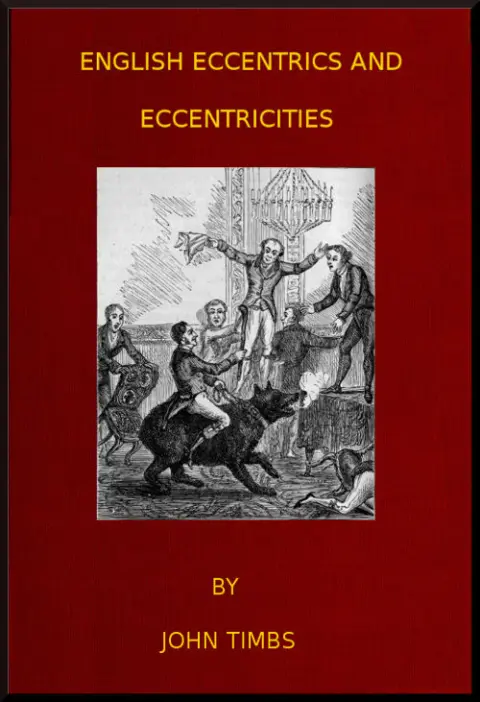
John Timbs
John Timbs
John Timbs
BEHIND THE BOOK
This eBook is for the use of anyone anywhere in the United States and most other parts of the world at no cost and with almost no restrictions whatsoever. You may copy it, give it away or re-use it under the terms of the Project Gutenberg License included with this eBook or online at www.gutenberg.org. If you are not located in the United States, you will have to check the laws of the country where you are located before using this eBook. Read the source licence.
The original source file, including credits and licence, is retained by this library. Request an original-format copy at no charge. Please include the book title and Project Gutenberg identifier #49524.
KEEP YOUR CURIOSITY GOING

Charles G. (Charles Griffith) Ross
Hannah Webster Foster

Emily Lawless
Edwin Hamlin Carr

Charles De Lano Hine
Andrew Ure