
The lost dirigible
Ralph Henry Barbour
THE CLASSIC COLLECTION · 1909
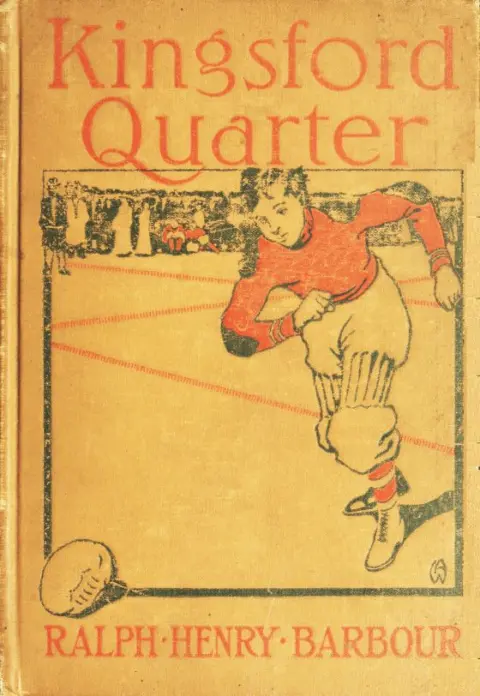
"Kingsford, Quarter" by Ralph Henry Barbour is a novel written in the early 20th century. This coming-of-age story revolves around a young protagonist, Evan Kingsford, as he navigates the challenges and camaraderie of life at Riverport School, a boys' boarding school. The narrative explores themes of friendship, identity, and the trials of adapting to new environments, particularly through Evan's experiences with his roommate Rob Langton and the other students. The opening of the book introduces Evan as he arrives at the school, encumbered by his heavy luggage and the anxiety of being a newcomer. After a somewhat comical encounter with an older student, Frank Hopkins, Evan is warmly welcomed into his new room by Rob, who quickly becomes a friend. As they bond over shared interests like football and the rigors of school life, fleeting references are made to the boys' personalities and interactions, hinting at the novel's mix of humor and schoolboy adventures. The chapter effectively sets the stage for Evan's journey of self-discovery and the relationships he will form during his time at Riverport.
Introduction adapted from the source catalogue; source summaries may be automatically generated.
Free to read · English · 56,679 words · No account needed
MAKE TIME FOR A GOOD BOOK
On by default. Untick to stop anonymous reading totals. Each page counts after 10 seconds in view. How this works.
Anonymous counting is on unless you have switched it off.
That dinner was worth waiting for, worth all the trouble and weariness it had entailed. They sat around the smoldering fire, balancing tin plates on their knees, with cups of steaming hot coffee and buttered rolls and doughnuts and salt and pepper-boxes dotting the immediate landscape, and did full justice to it. Malcolm’s opinion of his culinary ability was justified by results. The steak was just right, Jelly’s chops were cooked to a turn, the two precious eggs were perfectly fried and the coffee――well, perhaps the coffee was a trifle muddy, but it was hot and it was drinkable and there were no criticisms. The potatoes belied their outward appearance and were surprisingly white and mealy when opened. Jelly had forgotten to provide himself with plate, cup, knife, fork or spoon and ate his dinner from a flat stone, using borrowed implements and his fingers by turns. Malcolm shared his tin cup with him.
“Have a piece of chop, Rob?” asked Jelly.
“No, thanks.”
“I wish you would. I had some of your steak.”
“What kind of chops are they?”
“I――I think they’re veal. Anyhow, there isn’t much taste to them.”
“Then of course they’re veal,” laughed Malcolm. “Evan, I’ll bet you didn’t get all the potatoes out; we’re shy four or five.”
“Here’s one if you want it. I got all I could find. How’s the coffee
holding out, Rob?”
Rob seized the pot and shook it.
“Plenty here, I guess. Pass your cup.”
“It’s always well to shake it about a bit,” said Malcolm dryly. “It makes it so nice and clear.”
“Oh, don’t be so fussy. Any one seen the canned cow? And the sugar? Thanks. Jelly, you got my spoon?”
“Yes, I’m eating egg with it. Want it?”
“Well, scarcely,” replied Evan. “Let me take yours, Rob. These are dandy doughnuts, fellows.”
“They’re crullers,” said Jelly indistinctly by reason of the crowded condition of his mouth. “Cook said so.”
“What’s the difference between a cruller and a doughnut, anyway?” asked
Evan.
“A doughnut is a cruller with a hole through it,” answered Malcolm.
“It’s a doughnut with a college education,” amended Rob.
“That’s an old one,” scoffed Malcolm.
“Doughnuts and crullers are just the same,” said Jelly. “It just depends where they live what they’re called. In some places they call them fried-cakes.”
“Well, I call them fine,” said Evan, biting into his second one. “A cruller by any other name would taste as good.”
“Suppose you toss a couple over here,” suggested Malcolm, “if you don’t want them all.”
Your reading position is saved on this browser. Take it to another device with a library code. Reading pages adapt to text, rather than matching a printed edition.
Ralph Henry Barbour
Ralph Henry Barbour

Ralph Henry Barbour

Ralph Henry Barbour
BEHIND THE BOOK
This eBook is for the use of anyone anywhere in the United States and most other parts of the world at no cost and with almost no restrictions whatsoever. You may copy it, give it away or re-use it under the terms of the Project Gutenberg License included with this eBook or online at www.gutenberg.org. If you are not located in the United States, you will have to check the laws of the country where you are located before using this eBook. Read the source licence.
The original source file, including credits and licence, is retained by this library. Request an original-format copy at no charge. Please include the book title and Project Gutenberg identifier #57740.
KEEP YOUR CURIOSITY GOING
Cécile Tormay

Moritz Busch
Coulson Kernahan
John L. Ransom

Maurice Baring
Frances Wright