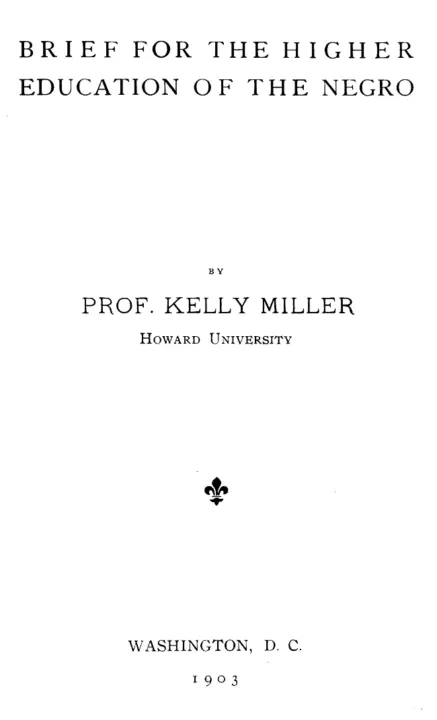
Brief for the higher education of the negro
Kelly Miller
THE CLASSIC COLLECTION · 1919
"Kelly Miller's History of the World War for Human Rights" by Kelly Miller is a historical account written in the early 20th century. This work provides a detailed exploration of World War I with a particular focus on the contributions of Black soldiers in the conflict and the broader implications for human rights and democracy. The book aims to highlight the pivotal roles played by African American troops and the significance of their service in the context of fighting against autocracy and for freedom. The opening of the book sets the tone for an extensive examination of the war and its impact, discussing the far-reaching changes it wrought on civilization. It introduces the main theme of the Negro's involvement in the war, particularly asserting their loyalty and bravery throughout the conflict. Miller plans to present a logical and passionate analysis of the Black contribution to the war, suggesting that their actions during this pivotal historical moment would influence future discussions surrounding civil rights and citizenship in America. By outlining the historical context and highlighting the valor of Black soldiers, the text immediately frames the significance of their contributions against the backdrop of a global struggle for democracy and human rights.
Introduction adapted from the source catalogue; source summaries may be automatically generated.
Free to read · English · 194,149 words · No account needed
MAKE TIME FOR A GOOD BOOK
On by default. Untick to stop anonymous reading totals. Each page counts after 10 seconds in view. How this works.
Anonymous counting is on unless you have switched it off.
June 3-6--American marines and regulars check advance of Germans at Chateau Thierry and Neuilly after maximum advance of Germans of 32 miles. Beginning of American co-operation on major scale.
June 9-14--German drive on Noyon-Montdidier front. Maximum advance, 5
miles.
June 15-24--Austrian drive on Italian front ends in complete failure.
July 12--Berat, Austrian base in Albania, captured by Italians.
July 15--Stonewall defense of Chateau Thierry blocks new German drive on
Paris.
July 16--Nicholas Romanoff, ex-Czar of Russia, executed at
Yekaterinburg.
July 18--French and Americans begin counter offensive on Marne-Aisne
front.
July 19--"San Diego," United States cruiser, sunk off Fire Island.
July 21--German submarine sinks three barges off Cape Cod.
Aug. 3--Allies sweep on between Soissons and Rheims, driving the enemy from his base at Fismes and capturing the entire Aisne-Vesle front.
Aug. 7--Franco-American troops cross the Vesle.
Aug. 8--New Allied drive begun by Field-Marshal Haig in Picardy, penetrating enemy front 14 miles.
Aug. 10--Montdidier recaptured.
Aug. 29--Noyon and Bapaume fall in new Allied advance.
Sept. 1--Australians take Peronne.
Sept. 1--Americans fight for the first time on Belgian soil and capture
Voormezeele.
Sept. 11--Germans are driven back to the Hindenburg line which they held
in November, 1917.
Sept. 14--St. Mihiel recaptured from Germans. General Pershing announces entire St. Mihiel salient erased, liberating more than 150 square miles of French territory which had been in German hands since 1914.
Sept. 20--Nazareth occupied by British forces in Palestine under Gen.
Allenby.
Sept. 23--Bulgarian armies flee before combined attacks of British, Greek, Serbian, Italian and French.
Sept. 26--Strumnitza, Bulgaria, occupied by Allies.
Sept. 27--Franco-Americans in drive from Rheims to Verdun take 30,000
prisoners.
Sept. 28--Belgians attack enemy from Ypres to North Sea, gaining four
miles.
Sept. 29--Bulgaria surrenders to Gen. d'Esperey, the Allied commander.
Oct. 1--St. Quentin, cornerstone of Hindenburg line, captured.
Oct. 1--Damascus occupied by British in Palestine campaign.
Oct. 3--Albania cleared of Austrians by Italians.
Oct. 4--Ferdinand, king of Bulgaria, abdicates; Boris succeeds.
Oct. 5--Prince Maximilian, new German Chancellor, pleads with President Wilson to ask Allies for armistice.
Oct. 9--Cambrai in Allied hands.
Oct. 10--"Leinster," passenger steamer, sunk in Irish Channel by submarine; 480 lives lost; final German atrocity at sea.
Oct. 11--- Americans advance through Argonne forest.
Oct. 12--German foreign secretary, Solf, says plea for armistice is made in name of German people; agrees to evacuate all foreign soil.
Oct. 13--Laon and La Fere abandoned by Germans.
Oct. 13--Grandpre captured by Americans after four days' battle.
Oct. 14--President Wilson refers Germans to General Foch for armistice
terms.
Oct. 17--Ostend, German submarine base, taken by land and sea forces.
Oct. 19--Bruges and Zeebrugge taken by Belgians and British.
Oct. 25--Beginning of terrific Italian drive which nets 50,000 prisoners
in five days.
Your reading position is saved on this browser. Take it to another device with a library code. Reading pages adapt to text, rather than matching a printed edition.
Kelly Miller
Kelly Miller
BEHIND THE BOOK
This eBook is for the use of anyone anywhere in the United States and most other parts of the world at no cost and with almost no restrictions whatsoever. You may copy it, give it away or re-use it under the terms of the Project Gutenberg License included with this eBook or online at www.gutenberg.org. If you are not located in the United States, you will have to check the laws of the country where you are located before using this eBook. Read the source licence.
The original source file, including credits and licence, is retained by this library. Request an original-format copy at no charge. Please include the book title and Project Gutenberg identifier #19179.
KEEP YOUR CURIOSITY GOING
Cécile Tormay

Moritz Busch
John L. Ransom
Frances Wright
Cécile Tormay

Mabel Potter Daggett