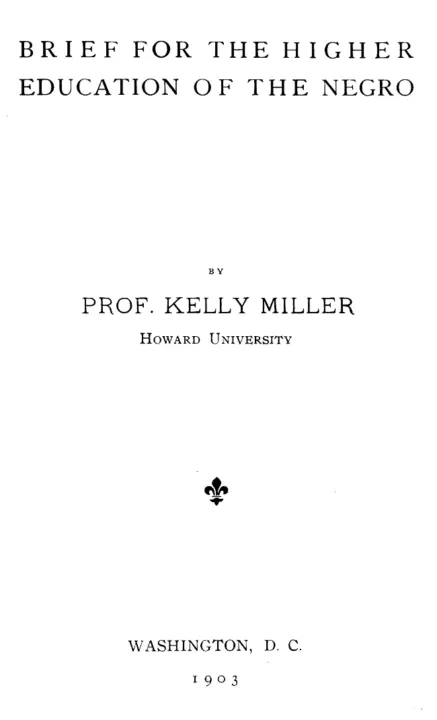
Brief for the higher education of the negro
Kelly Miller
THE CLASSIC COLLECTION · 1919
"Kelly Miller's History of the World War for Human Rights" by Kelly Miller is a historical account written in the early 20th century. This work provides a detailed exploration of World War I with a particular focus on the contributions of Black soldiers in the conflict and the broader implications for human rights and democracy. The book aims to highlight the pivotal roles played by African American troops and the significance of their service in the context of fighting against autocracy and for freedom. The opening of the book sets the tone for an extensive examination of the war and its impact, discussing the far-reaching changes it wrought on civilization. It introduces the main theme of the Negro's involvement in the war, particularly asserting their loyalty and bravery throughout the conflict. Miller plans to present a logical and passionate analysis of the Black contribution to the war, suggesting that their actions during this pivotal historical moment would influence future discussions surrounding civil rights and citizenship in America. By outlining the historical context and highlighting the valor of Black soldiers, the text immediately frames the significance of their contributions against the backdrop of a global struggle for democracy and human rights.
Introduction adapted from the source catalogue; source summaries may be automatically generated.
Free to read · English · 194,149 words · No account needed
MAKE TIME FOR A GOOD BOOK
On by default. Untick to stop anonymous reading totals. Each page counts after 10 seconds in view. How this works.
Anonymous counting is on unless you have switched it off.
Nov. 22-Dec. 13--Battle of Cambrai. Successful surprise attack near Cambrai by British under Gen. Byng on Nov. 22 (employs "tanks" to break down wire entanglements in place of the usual artillery preparations). Bourlon Wood, dominating Cambrai, taken Nov. 26. Surprise counter-attack by Germans, Dec. 2, compels British to give up fourth of ground gained. German attacks on Dec. 13 partly successful.
Nov. 29--First plenary session of the Inter-allied Conference in Paris. Sixteen nations represented. Col. E.M. House, chairman of American delegation.
Dec. 5--President Wilson, in message to Congress, advises war on
Austria.
Dec. 6--United States destroyer "Jacob Jones" sunk by submarine, with loss of over 40 American men.
Dec. 6--Explosion of munitions vessel wrecks Halifax.
Dec. 6-9--Armed revolt overthrows pro-Ally administration in Portugal.
Dec. 7--United States declares war on Austria-Hungary.
Dec. 9--Jerusalem captured by British force advancing from Egypt.
Dec. 10--Gens. Kaledines and Kornilov declared by the Bolsheviki Government to be leading a Cossack revolt.
Dec. 15--Armistice signed between Germany and the Bolsheviki Government
at Brest-Litovsk.
Dec. 23--Peace negotiations opened at Brest-Litovsk between Bolsheviki Government and Central Powers, under Presidency of the German foreign minister.
Dec. 26--President Wilson issues proclamation taking over railroads and appointing W.G. McAdoo, director-general. Proclamation takes effect at noon, December 28.
Dec. 29--British national labor conference approves continuation of war for aims similar to those defined by President Wilson.
Jan. 19--American troops take over sector northwest of Toul.
Feb. 6--"Tuscania," American transport, torpedoed off coast of Ireland;
101 lost.
Feb. 22--American troops in Chemin des Dames sector.
Mar. 3--Peace treaty between Bolshevik Government of Russia and the Central Powers signed at Brest-Litovsk.
Mar. 4--Treaty signed between Germany and Finland.
Mar. 5--Rumania signs preliminary treaty of peace with Central Powers.
Mar. 20--President Wilson orders all Holland ships in American ports
taken over.
Mar. 21--Germans begin great drive on 50-mile front from Arras to La Fere. Bombardment of Paris by German long-range gun from a distance of 76 miles.
Mar. 29--General Foch chosen commander-in-chief of all Allied forces.
Apr. 9--Second German drive begun in Flanders.
Apr. 10--First German drive halted before Amiens after maximum advance
of 35 miles.
Apr. 15--Second German drive halted before Ypres, after maximum advance
of 10 miles.
Apr. 23--British naval forces raid Zeebrugge in Belgium, German submarine base, and block channel.
May 27--Third German drive begins on Aisne-Marne front of 30 miles
between Soissons and Rheims.
May 28--Germans sweep on beyond the Chemin des Dames and cross the Vesle
at Fismes.
May 28--Cantigny taken by Americans in local attack.
May 29--Soissons evacuated by French.
May 31--Maine River crossed by Germans, who reach Chateau Thierry, 40
miles from Paris.
May 31--"President Lincoln," American transport, sunk.
June 2--Schooner "Edward H. Cole" torpedoed by submarine off American
coast.
Your reading position is saved on this browser. Take it to another device with a library code. Reading pages adapt to text, rather than matching a printed edition.
Kelly Miller
Kelly Miller
BEHIND THE BOOK
This eBook is for the use of anyone anywhere in the United States and most other parts of the world at no cost and with almost no restrictions whatsoever. You may copy it, give it away or re-use it under the terms of the Project Gutenberg License included with this eBook or online at www.gutenberg.org. If you are not located in the United States, you will have to check the laws of the country where you are located before using this eBook. Read the source licence.
The original source file, including credits and licence, is retained by this library. Request an original-format copy at no charge. Please include the book title and Project Gutenberg identifier #19179.
KEEP YOUR CURIOSITY GOING
Cécile Tormay

Moritz Busch
John L. Ransom
Frances Wright
Cécile Tormay

Mabel Potter Daggett