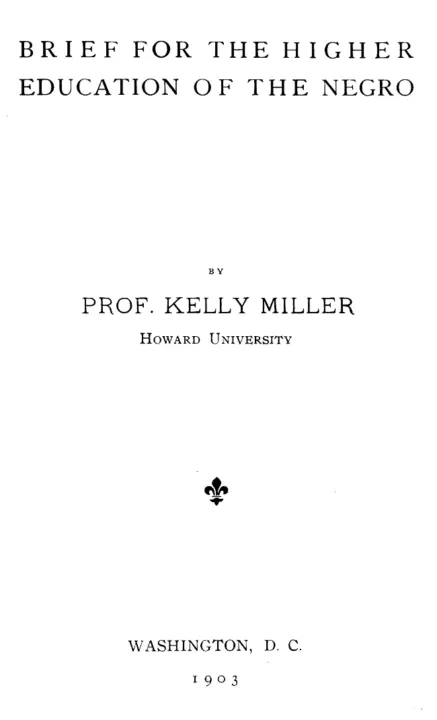
Brief for the higher education of the negro
Kelly Miller
THE CLASSIC COLLECTION · 1919
"Kelly Miller's History of the World War for Human Rights" by Kelly Miller is a historical account written in the early 20th century. This work provides a detailed exploration of World War I with a particular focus on the contributions of Black soldiers in the conflict and the broader implications for human rights and democracy. The book aims to highlight the pivotal roles played by African American troops and the significance of their service in the context of fighting against autocracy and for freedom. The opening of the book sets the tone for an extensive examination of the war and its impact, discussing the far-reaching changes it wrought on civilization. It introduces the main theme of the Negro's involvement in the war, particularly asserting their loyalty and bravery throughout the conflict. Miller plans to present a logical and passionate analysis of the Black contribution to the war, suggesting that their actions during this pivotal historical moment would influence future discussions surrounding civil rights and citizenship in America. By outlining the historical context and highlighting the valor of Black soldiers, the text immediately frames the significance of their contributions against the backdrop of a global struggle for democracy and human rights.
Introduction adapted from the source catalogue; source summaries may be automatically generated.
Free to read · English · 194,149 words · No account needed
MAKE TIME FOR A GOOD BOOK
On by default. Untick to stop anonymous reading totals. Each page counts after 10 seconds in view. How this works.
Anonymous counting is on unless you have switched it off.
Another comparative table that is important to any one desiring to study the costs and their effects is that relating to population and wealth of the principal countries. The latest available figures are:
Population Wealth United States 101,577,000 $187,739,071,090 British Empire 394,930,000 130,000,000,000 Germany 67,810,000 80,000,000,000 France 39,700,000 50,000,000,000 Russia 187,379,000 40,000,000,000 Austria-Hungary 53,000,000 25,000,000,000 Spain 20,000,000 5,400,000,000 Belgium 7,500,000 9,000,000,000 Portugal 5,958,000 2,500,000,000 Italy 37,048,000 20,000,000,000
Taxes have been the main sources for raising money to carry on the war. In Germany taxes on all incomes from the Kaiser to the ordinary business man were kept at the highest rate, the Kaiser paying $500,000 on his fortune of $35,000,000 during the early part of the struggle. This was in addition to his income tax which amounted to $440,000, making a total annual tax of nearly $1,000,000. The Krupps are said to have been assessed at $3,000,000.
When the new military service laws were approved in Paris, which was about the middle of July, 1913, the French Cabinet was at its wit's end to provide the financial end of the tremendous military budget. Investment markets were sluggish, and there were thousands of notes whose values were rapidly depreciating. The French Government was unable to float a loan of $200,000,000 which was necessary for making preparations.
Then in her desperation Paris closed her doors to all foreign loans. The Viviani Ministry practically duplicated the plan of its predecessor in proposing an issue of $360,000,000 3-1/2 per cent bonds, which were redeemable in 25 years.
One year previously to this financial struggle the Belgian Government had started to raise $62,800,000 in order that the people of this country might prevent its being used as the battleground for the world war which they had seen away off in the future. This money was raised for the purpose of making Antwerp an impregnable fortress.
Russia had taken steps to raise $3,700,000,000 which the Russian Minister of Finance had informed the Budget Committee must be spent in the next five years on the army and navy. During the first year of the war there was $500,000,000 spent by this country in military and naval defence. This does not include the cost of those strategic railroads of which so many were constructed by the Russian Government, and which cost so many hundreds of thousands of dollars.
Previous to the time Great Britain declared war on Germany the House of Commons had voted $525,000,000 for Emergency purposes, and within a couple of days of this appropriation an additional $500,000,000 was granted by the British Parliament.
Your reading position is saved on this browser. Take it to another device with a library code. Reading pages adapt to text, rather than matching a printed edition.
Kelly Miller
Kelly Miller
BEHIND THE BOOK
This eBook is for the use of anyone anywhere in the United States and most other parts of the world at no cost and with almost no restrictions whatsoever. You may copy it, give it away or re-use it under the terms of the Project Gutenberg License included with this eBook or online at www.gutenberg.org. If you are not located in the United States, you will have to check the laws of the country where you are located before using this eBook. Read the source licence.
The original source file, including credits and licence, is retained by this library. Request an original-format copy at no charge. Please include the book title and Project Gutenberg identifier #19179.
KEEP YOUR CURIOSITY GOING
Cécile Tormay

Moritz Busch
John L. Ransom
Frances Wright
Cécile Tormay

Mabel Potter Daggett