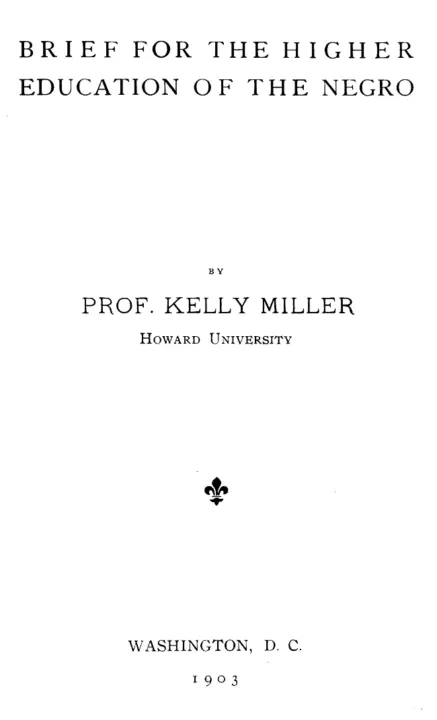
Brief for the higher education of the negro
Kelly Miller
THE CLASSIC COLLECTION · 1919
"Kelly Miller's History of the World War for Human Rights" by Kelly Miller is a historical account written in the early 20th century. This work provides a detailed exploration of World War I with a particular focus on the contributions of Black soldiers in the conflict and the broader implications for human rights and democracy. The book aims to highlight the pivotal roles played by African American troops and the significance of their service in the context of fighting against autocracy and for freedom. The opening of the book sets the tone for an extensive examination of the war and its impact, discussing the far-reaching changes it wrought on civilization. It introduces the main theme of the Negro's involvement in the war, particularly asserting their loyalty and bravery throughout the conflict. Miller plans to present a logical and passionate analysis of the Black contribution to the war, suggesting that their actions during this pivotal historical moment would influence future discussions surrounding civil rights and citizenship in America. By outlining the historical context and highlighting the valor of Black soldiers, the text immediately frames the significance of their contributions against the backdrop of a global struggle for democracy and human rights.
Introduction adapted from the source catalogue; source summaries may be automatically generated.
Free to read · English · 194,149 words · No account needed
MAKE TIME FOR A GOOD BOOK
On by default. Untick to stop anonymous reading totals. Each page counts after 10 seconds in view. How this works.
Anonymous counting is on unless you have switched it off.
When it comes to the cost in dollars and cents it is possible to tell something of what they mean with reference to war construction and maintenance, although no one can estimate what it represents in destruction. No one has yet devised an accounting system to determine the percentage of "depreciation" through wear and tear on guns and devices that cost thousands of dollars each, but everybody knows that guns wear out and that some of the larger ones have a very decided limit on the number of times they can be fired without being rebored or rifled.
Railroads which have taken years to build and develop have been destroyed, telephone and telegraph lines put out of commission, great castles and temples razed, works of art burned, whole cities devastated, green fields turned into great craters torn up by bombs and shells, factories dismantled, herds of cattle fed into the maw of the armies, and the ruthless Germans even went so far as to wantonly cut down and destroy whole forests and magnificent shade trees which it took generations to grow.
How the indebtedness of the nations grew during the progress of the war is shown in the following statement issued by some of the financial institutions of the country in the Spring of 1917:
"Indebtedness of the seven principal nations engaged in the European war has crossed $75,000,000,000. In the middle of 1914 the indebtedness of these seven nations was $27,000,000,000."
Financing on an extensive scale followed this state of affairs. France issued a second formal war loan, Germany a fifth loan and Russia a sixth loan. Great Britain issued temporary securities in enormous sums.
The war cost $105,000,000 every twenty-four hours, according to the statistics, expenditures of the Entente Allies being fully double those of the Central Allies.
Without for one moment taking into consideration the billions which were thrown into the war-pot by America the figures are staggering. An interesting comparison is found in the cost of the previous great world wars. The American Civil War, the greatest conflict in prior history cost $8,000,000,000, a sum equalled every three months in the conduct of the European war.
Approximate cost. Napoleonic Wars, 1793-1815 $6,250,000,000 American Civil War, 1861-1864 8,000,000,000 Franco-Prussian War, 1870-1871 3,000,000,000 South African War, 1900-1902 1,250,000,000 Russo-Japanese War, 1904-1905 2,500,000,000 European War, 1914-1917 (3 years) 75,000,000,000
It was further estimated that after the year 1917, the payment of $3,800,000,000 a year would be required to pay the interest on the debt, and that the total Government expenditures in Europe for bond interest and support of the various branches of the Governments would require in the neighborhood of 20 per cent of the people's income.
Your reading position is saved on this browser. Take it to another device with a library code. Reading pages adapt to text, rather than matching a printed edition.
Kelly Miller
Kelly Miller
BEHIND THE BOOK
This eBook is for the use of anyone anywhere in the United States and most other parts of the world at no cost and with almost no restrictions whatsoever. You may copy it, give it away or re-use it under the terms of the Project Gutenberg License included with this eBook or online at www.gutenberg.org. If you are not located in the United States, you will have to check the laws of the country where you are located before using this eBook. Read the source licence.
The original source file, including credits and licence, is retained by this library. Request an original-format copy at no charge. Please include the book title and Project Gutenberg identifier #19179.
KEEP YOUR CURIOSITY GOING
Cécile Tormay

Moritz Busch
John L. Ransom
Frances Wright
Cécile Tormay

Mabel Potter Daggett